'Economic Rents' Made It Worse
pp. 63-67 · Read in the full issue


I had no trouble convincing them that it was a sad day for me too, my husband being just as much affected as they. It had suddenly put an end to some of my plans.
We talked it over there and then, and I felt in them not bitterness or resentment (that was to come soon enough) but bewilderment —a loss of faith, a “why have they done this to us?” feeling.
Under the new wage plan which has caused so much trouble New Guinean public servants cannot obtain the salaries that are at present being paid to expatriates. As an example of how the difference in salary works, look at these figures:
Position Overseas Local
Clerk . . . $2,888-3,384 $1,280-1,416 Patrol Officer . . $3,010-4,250 $B4O-1,416 Chief Legai Officer . . $7,106-7,624 $2,880-3,000 Also there are many “extras” which the overseas officers get, thus in creasing the difference still further.
For example, a basic wage adjustment of $370, a child allowance of $364, and an expatriate allowance of $960, which would be paid to a married man with three children and seven years service, make a total of $1,694 in extras on top of a salary which is already two or three times that of his local counterpart.
Why Not For Others Too?
I’ve not heard any New Guinean officers disputing the expatriate allow ance. But some of them do feel strongly about being deprived of married and child allowance, especially as most of them have more children than the average European.
I noticed a more specific change a few months later. I had been on leave in Perth since soon after Sep tember 10, and then my husband came down.
He, too, had changed. There was a new resentment, a new “anti” feeling stemming from thwarted hopes and pent-up frustrations. And he was not alone.
His friends and contemporaries felt the same—many lacking John’s former good adjustment—felt much more so, and even those who still managed a smile weren’t really smil ing inside.
They had all been working towards promotion at that time. They would
very soon enter the second division of the Public Service (as it existed then) —the division which was occupied almost exclusively by Aus tralian public servants, because membership required the matricula tion certificate.
The effect of the new regulations was to freeze salaries for local people, and make it impossible for them to earn the greater rewards being shared by Australians along side whom they were working, even though they may have had the same qualifications, and, in a few cases, the same experience.
This was the bitter pill that was first causing resentment among that small group who were affected in that early stage. But worse was to come.
Economic rentals were introduced.
Broadly speaking, this means that rents were increased considerably (say, for a three-bedroom house, from roughly $2 to $8 per week) but expatriates were then given an additional rental allowance which reduced their actual payment to the original $2. This fooled no-one, least of all the local officers, who were annoyed about what they termed the futile deceit.
Far better to say openly, “We’ll charge $2 to Europeans and $8 to New Guineans!” It would be unjust, but honestly unjust, and honesty seems to be fast fading in all dealings and feelings between races. Some of the few New Guineans who were liv ing in the housing estate, Boroko, moved out simply because of the financial burden. Others were equally determined to stay.
To us, it mattered not. We had never wanted to live in Boroko any way (although we did want a better standard of housing than we had at Hohola).
John and his friends could, on rare occasions, glimpse the principle behind the new moves, but their understanding was swallowed in resentment that the belt-tightening measure—the entreaty for New Guinea to learn to live within its means—was directed only at the New Guinean and did not apply to the white man.
Is it really any wonder there was resentment? Those not particularly affected by the new measures were resentful on behalf of those who were.
For ourselves, it meant a complete change in our plans.
I had been blithely telling my friends that when the next baby arrived (the third), I was going to knock off work for 10 years. John would be eligible for promotion to the second division after he matricula ted in a few months and although his salary would be increased to only $4O plus per week, I felt we could manage to live on it (even in Moresby and with three children).
Now, suddenly, he would be on $36 a week almost forever (or so it seemed). And even I baulked at trying to live the way we wanted to on that.
We certainly didn’t ever live as most Europeans do. We didn’t stock
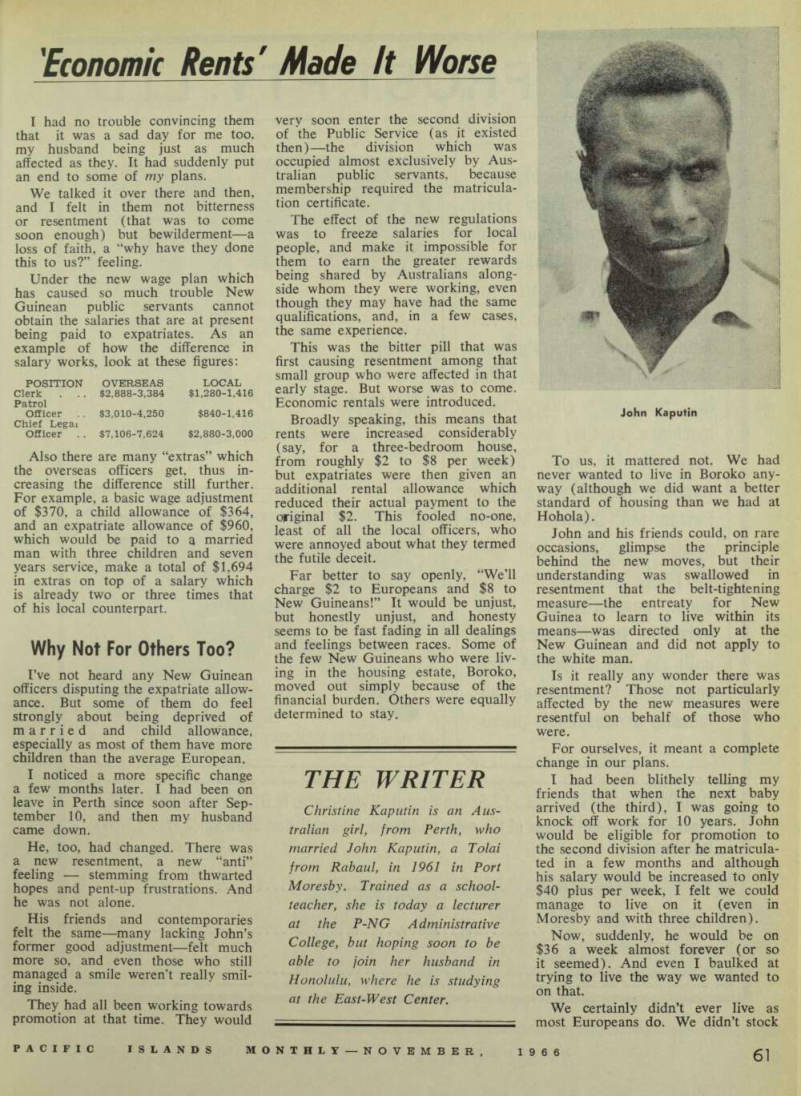
John Kaputin
'Easy To Talk' Of Future Leaders
much drink in the house, we rarely entertained, and then only very modestly, our outings were limited, and our diet included more than a fair share of tinned fish and rice. (Of course I realise there are Euro peans who live like this now, even to the fish and rice).
But the budget was always supple mented by my own income. To live entirely on John’s current salary would mean a greater pruning of expenses (mostly food) than I was prepared to undertake. We didn’t necessarily want “the best” for our children (as fond parents are wont to boast), but we did want what we considered a decent standard.
John, too, had been offered a high standard of living ever since he was sent to secondary school in Australia, and after 8-10 years a foreign way of life just isn’t so “foreign” any more.
A Confidence Trick
John and his contemporaries were sometimes divided and often in consistent in their assessment of the new situation, but the one thing they seemed to agree on was that it was some type of gigantic and not-very convincing confidence trick. These were the men who, because of their better education, were supposed to be the future leaders.
It is easy to talk about them being “future leaders” but apparently another thing to credit them with having the same feelings, hopes and ambitions as anybody else.
It was like saying on the one hand that they were no different from Europeans, and then making it quite clear, through economics, that they were different.
While we are all being exhorted to minimise racial differences and mix -mix-mix, They (those unseen opponents), are making the task in creasingly impossible. They are doing it through salaries (“Do come and have a piece of taro with me, in return for the chicken I shared with you last week”); through housing (“I’d love you to come, but not when it rains. The floor is underwater, and we have no furniture!”); and through plain inequality (“He earns as much in one day as I earn in five. How can I entertain him here!”) What I am especially concerned about is the effect of these measures on race relations at a time when
goodwill is more than ever required.
Too often people say that the New Guineans get everything for nothing, and don’t appreciate it. The critics seem unable to sit down and work out for themselves that this business of handing out things itself breeds resentment, and is doing just that right now.
Among the student group, especially, there is resentment, not because things are done for them; but because there is no alternative to having things done for them—they are not in a position to do things for themselves. More and more they really want to stand on their own
feet, but so often they are frustrated by lack of know-how, and even lack of opportunity.
I have a young Tolai friend, who took a job with a large private enterprise concern, on the understand ing that he would be given recog nised accountancy training. This has never materialised.
After months of agitation and frustration, he has finally realised it probably never will materialise. He had the determination to enroll him self in a course and pay his own fees (no mean effort on his wages!) Now he says he feels a greater sense of satisfaction at having done this,
knowing he is not beholden to any one for his training.
Certainly I do move a lot among the student group, who are a social class in themselves. But they are an important class and it is vital that New Guinea understands their think ing. It is dangerous to say, as some do, that it is “only” the student class that bears resentment, as if minor numbers are of minor importance.
Strong anti-white resentment as a result of the salary moves has spread to others besides the students in Port Moresby. I know of New Guineans, once polite, who are now offhand or openly offensive to Europeans. These people say they don’t want white men in their houses, they don’t want to drink with them, or have any social engagements. They have withdrawn inwards, and it is tragic.
I don’t profess to know where it will lead. I would think every New Guinean in Moresby is aware of this new spirit of resentment, and be cause many Europeans are still un aware, it is even deeper.
Solution Not Easy
It is not easy to offer solutions.
On the housing rentals there is no doubt in my mind that rents should be re-examined, and genuine economic rents should be worked out, so that the man on $36 per week is paying proportionately less than the man on $lOO. The current rent of $8 for a three-bedroom furnished house is cheap even by Australian standards, and it is minimal by ruling territory rates. Why can’t a European on $6O-$ 120 per week afford this?
Surely it is still low enough to act as an “enticement”!
On the other matters it is not so easy. I have heard several solutions offered. One is that the economic measures be introduced by the local people themselves, when the time comes for Australia to reduce its grant to New Guinea drastically.
The second is that everybody gets a decent wage on the same scale, and that local taxes be raised to take much of this back. I know that the minute any such proposals are voiced, there will come the old cry that it will be the “last straw” and “recruitment from Australia will cease”. I have heard this ever since I arrived in the territory in 1958. I believe this year has been a record year for recruitment!
Whatever complaints might arise from increased rents and taxation, at least black and white voices could complain in unison, and what better way of fostering “togetherness” than by sharing a grouch against the Gov ernment.