Ng Race Relations
p. 62 · Read in the full issue
The Day That Was
A Watershed In
By Christine Kaputin, in Port Moresby
“No. I don’t go to Koki anymore. It just doesn’t seem worth it!” My companions registered polite concern. They clearly thought I was exagerating. We had been discussing the current shortage of fresh fruit and vegetables in Moresby, and I was bemoaning the fact that even Koki market (a limited and expensive source of produce, at best ) was out of bounds to me.
Now how could I explain what it had been like when my hus band had been here?
‘C'OR years I had been going to the ■T market with John and the children, and always it had been an outing to look forward to.
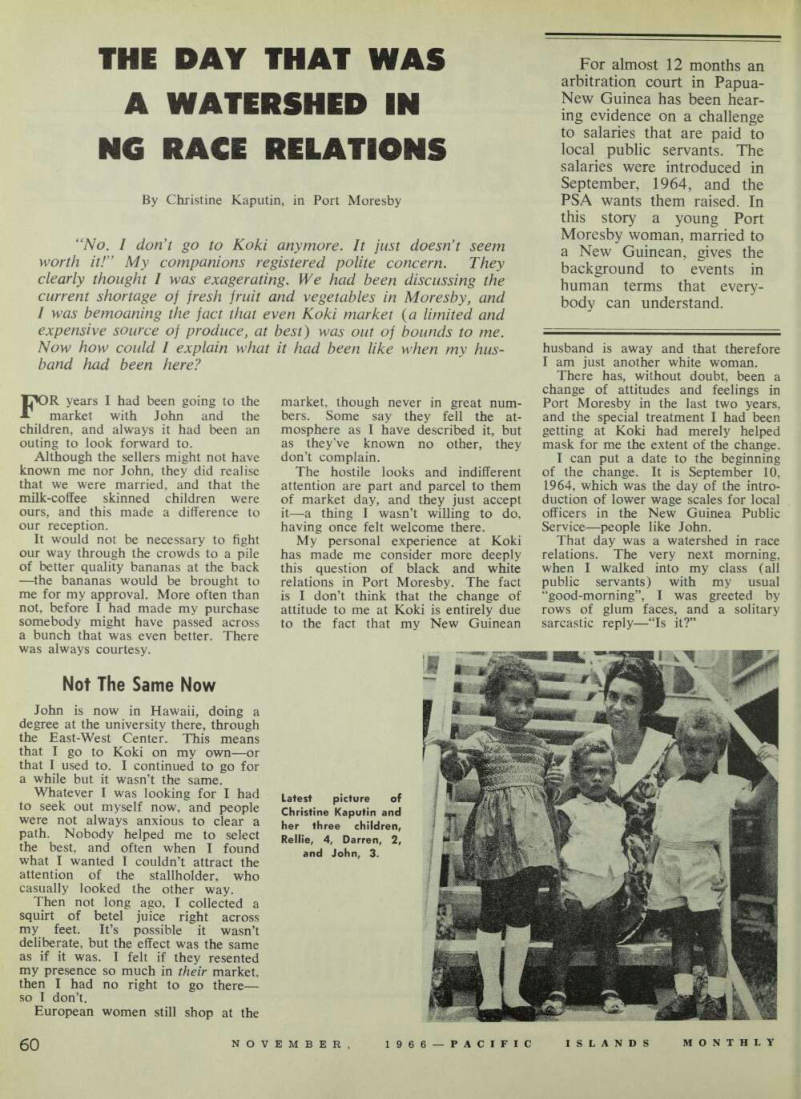
Although the sellers might not have known me nor John, they did realise that we were married, and that the milk-coffee skinned children were ours, and this made a difference to
our reception.
It would not be necessary to fight our way through the crowds to a pile of better quality bananas at the back —the bananas would be brought to me for my approval. More often than not, before I had made my purchase somebody might have passed across a bunch that was even better. There was always courtesy.
Not The Same Now
John is now in Hawaii, doing a degree at the university there, through the East-West Center. This means that I go to Koki on my own —or that I used to. I continued to go for a while but it wasn’t the same.
Whatever I was looking for I had to seek out myself now, and people were not always anxious to clear a path. Nobody helped me to select the best, and often when I found what I wanted I couldn’t attract the attention of the stallholder, who casually looked the other way.
Then not long ago, I collected a squirt of betel juice right across my feet. It’s possible it wasn’t deliberate, but the effect was the same as if it was. I felt if they resented my presence so much in their market, then I had no right to go there— so I don’t.
European women still shop at the
market, though never in great num bers. Some say they fell the at mosphere as I have described it, but as they’ve known no other, they don’t complain.
The hostile looks and indifferent attention are part and parcel to them of market day, and they just accept it—a thing I wasn’t willing to do, having once felt welcome there.
My personal experience at Koki has made me consider more deeply this question of black and white relations in Port Moresby. The fact is I don’t think that the change of attitude to me at Koki is entirely due to the fact that my New Guinean
husband is away and that therefore I am just another white woman.
There has, without doubt, been a change of attitudes and feelings in Port Moresby in the last two years, and the special treatment I had been getting at Koki had merely helped mask for me the extent of the change.
I can put a date to the beginning of the change. It is September 10, 1964, which was the day of the intro duction of lower wage scales for local officers in the New Guinea Public Service—people like John.
That day was a watershed in race relations. The very next morning, when I walked into my class (all public servants) with my usual “good-morning”, I was greeted by rows of glum faces, and a solitary sarcastic reply—“ls it?”
For almost 12 months an arbitration court in Papua- New Guinea has been hear ing evidence on a challenge to salaries that are paid to local public servants. The salaries were introduced in September, 1964, and the PSA wants them raised. In this story a young Port Moresby woman, married to a New Guinean, gives the background to events in human terms that every body can understand.
Latest picture of Christine Kaputin and her three children, Rellie, 4, Darren, 2, and John, 3.