M’Sstve
pp. 57-59 · Read in the full issue

The Boffins Behind
The Advance Of
Fiji Sugar Industry
Prom a Suva Correspondent In a long, white building, through the windows of which wafts a sickly sweet smell which has long been accepted by the locals as part of their environment, a white overalled man bends over a microscope.
A foot away another man checks the gradu ations on a thin tube and makes notes in a black book.
TIHERES nothing exciting about . any of it. It is an ordinary day in the backroom of Fiji’s sugar industry a routine move in the up-todate laboratories of South Pacific Sugar Mills Ltd. at Lautoka, in the heart of the canenelds, The building stands a few yards from the Lautoka mi , one of the world’s biggest sugar mi vr S '*K- „ Nothing exciting but it is all part of a tight that has gone on in Fiji tor more than 60 years, since the time when the Colonial Sugar Refinmg Company established its first experimental breeding station at T antnU* ab ° Ut 5 mlles fr ° m ‘ , Cane breeding must go on just nothing S els V e,” says M?? U Joe manager of SPSM’s agricultural research station. “No breeding prok "“ “ -
Credit To Bofflos
Yet the seemingly dull exercises earned out at the station have done
“iS T
on the rampage-disease, old age, soil erosion, breeding quirks and oldfashioned methods of farmfng
To the boffins goes the credit for the present high output of Fiji’s sugar fields and the relative peace m an industry bedevilled by politics, but peopled by peasant farmers who are now learning the value of artificial fertilisers and modern methods of farming, and unlearning the habits of their forefathers.
When the CSR came to Fiji shortly after King Cakobau and his chiefs had ceded their 500-odd islands to Queen Victoria, it found a handsome looking cane already growing there, a cane thick and juicy but one which was rapidly becoming inbred. //tL~ m„UL • <l6 Noble CdM6 The company was so impressed w,th the Fl )‘ cane that it called it r the noble ? a "e”, a "d “noble” it has ZJ? ~*f • «d Thanks to scientists in Java
secret of Afferent varieties
SS brought from Oueeis and WaS * r ° f science s invasion of nature s pre-
serves. The Rarawai station was only the third such station in the world, The early fight was a hard one There were two diseases rampant among the crops—Fiji disease, which is the sugar cane’s equivalent of man’s common cold, and downy mildew a fungus which stunts growth The scientists got to work on the Fiji disease virus and the fungus by producing new resistant types of cane. Out of their efforts and out of the much-improved soils, grew two of the then finest canes in the world, Pompey, produced by cross ing Petite Sennerville and Malaia and Badila ’ a native of New Guinea which had been weathered in Aus tralia.
tiomfor'yem-s^but^^ow^Ly obelong 0 belong
fn historv and i f u? 8
There was Aiax fhen r.l hi
M’Sstve
? T oman) ’ Mentor, Pindar, Ragnar, H ° mer ’ and nOW Spartan ‘
Weather "Manufactured"
£ r 6S ’ th ! „ cellu,ose ba Ss and the stran S e ’ tall, narrow building fT 6 dstance . from ‘ h * mate laboratories, which looks like the
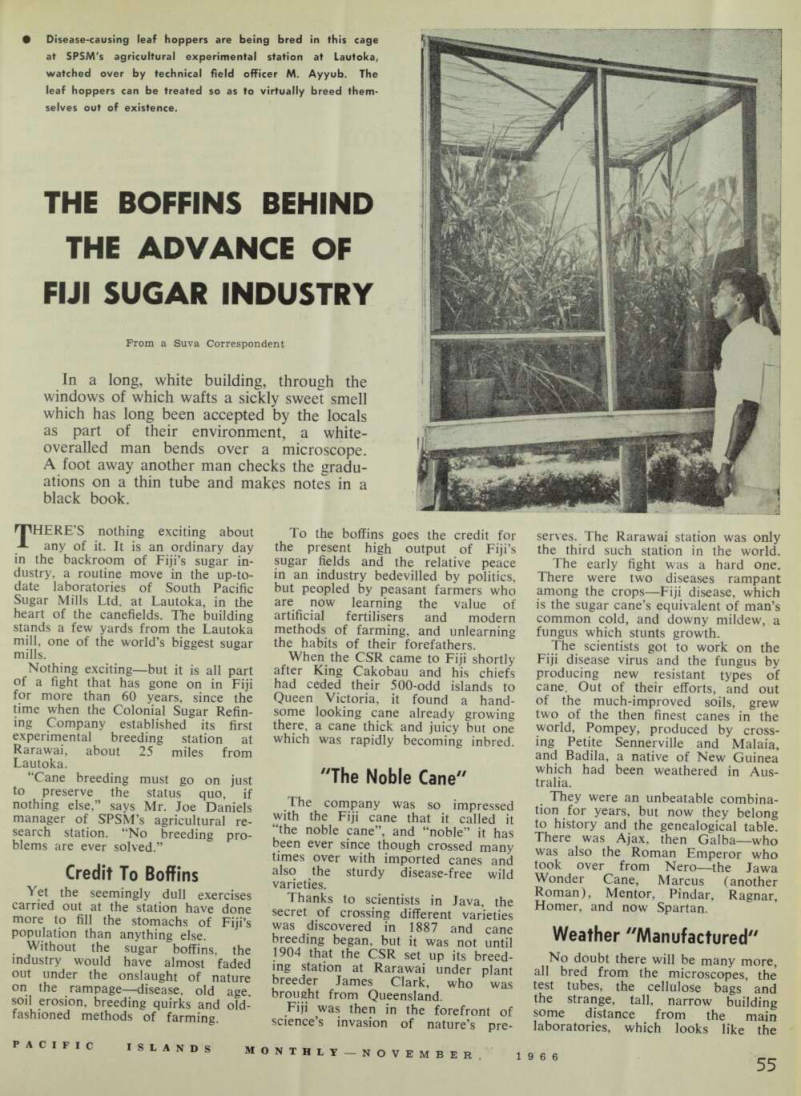
Disease-causing leaf hoppers are being bred in this cage at SPSM's agricultural experimental station at Lautoka, watched over by technical field officer M. Ayyub. The leaf hoppers can be treated so as to virtually breed them selves out of existence.
shower rooms or the detached kitchens common to Fijian villages and Indian settlements, only larger.
This shower room really is a shower room, or a tropical downpour room, or a drought room, or a tropical winter room or any other sort of weather likely to be en countered by sugar-cane.
Here, the boffns manufacture weather, and then use it to nudge Mother Nature into performing somersaults.
Experimenting with cane breeding, and crossing the noble aristocratic cane with the more vigorous, hardier wild cane, the scientist sometimes finds himself baulked, notably when it comes to crossing two varieties which flower at different times.
That is when the nudge comes from Mr. Joe Daniels and his first assistant, Mr. Krishnamurthi.
The wild cane normally flowers earlier than its noble cousin, and to obtain a cross both must flower at the same time. So the wild cane is put to sleep and its flowering delayed until the “noble” cane flowers and the marriage can take place.
This is how it’s done: Inside the weather room, selected wild cane is subjected to varying degrees of light and temperature. As the amount of “sleep” the cane gets affects growth, it is “wakened” at all sorts of odd times by time-controlled electric lights which supply artificial sunshine in the middle of the night.
"Tropical Rain"
Water jets in the roof are turned on and down comes the “tropical rain”. The cane accepts it all as coming from Mother Nature, lapses into a sleepy state and delays the flowering.
And cane is not the only subject that has undergone the weather trick.
Not very long ago Mr. Daniels decided to attempt a boon for Fiji’s epicures by getting them more of that great Fiji delicacy, the river-side reed called duruka, sometimes ir reverently known as “Fiji asparagus”.
The Fiji variety comes into season for only a few weeks in March and April, when it is much sought after.
But it is a bad keeper.
Duruka has a cousin in New Guinea which comes into season in January and February and a “mar riage” between the two might produce a duruka which would be in season for a much longer period than the Fiji parent.
That’s why some imported New Guinea duruka got the treatment with artificial weather, with what result we do not yet know.
But experiments of that kind are merely a recreational activity of
the backroom boys, whose main purpose is to produce new varieties of cane, including varieties which will be suitable for growing in the many places where conditions differ widely.
It may be a cane which relishes sandy soil, or one which is more at home on a well-drained hillside, or in the rich loamy soil of the valleys.
You will see in this area of Lautoka the equipment of the meteorologist— the rain gauge, thermometers, sun shine recorders, wind gauges, baro meters, daylight integrators for measuring the heat energy from the sun, and the evaporimeter for measuring the amount of moisture evaporating from the soil.
Climate research, it is hoped, will enable more accurate crop estimating, for the sugar producer has to plan his harvesting and milling programme and his overseas sugar shipments.
SPSM has three well-equipped met. stations and 61 rainfall stations in the four cane-growing areas, and all serve the colony in its day-to-day weather recording as well as being the company’s scientific team.
And there are also several glass houses in the area. In one, cane grows under simulated conditions, and buzzing in there among the cane are the insects which bring disease, notably Fiji disease. Some day this small glasshouse and its buzzing insects may supply the answer to many disease problems.
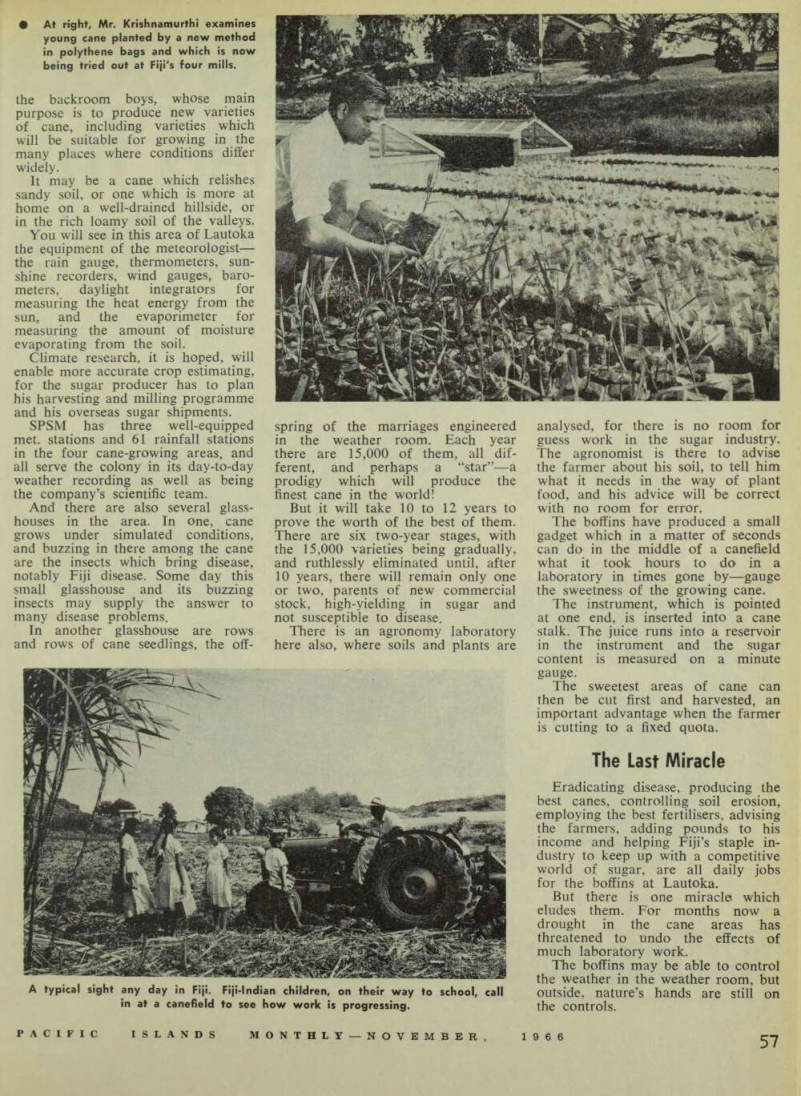
In another glasshouse are rows and rows of cane seedlings, the off
spring of the marriages engineered in the weather room. Each year there are 15,000 of them, all different, and perhaps a “star”—a prodigy which will produce the finest cane in the world!
But it will take 10 to 12 years to prove the worth of the best of them.
There are six two-year stages, with the 15,000 varieties being gradually, and ruthlessly eliminated until, after 10 years, there will remain only one or two, parents of new commercial stock, high-yielding in sugar and not susceptible to disease.
There is an agronomy laboratory here also, where soils and plants are
analysed, for there is no room for guess work in the sugar industry.
The agronomist is there to advise the farmer about his soil, to tell him what it needs in the way of plant food, and his advice will be correct with no room for error.
The boffins have produced a small gadget which in a matter of seconds can do in the middle of a canefield what it took hours to do in a laboratory in times gone by—gauge the sweetness of the growing cane.
The instrument, which is pointed at one end, is inserted into a cane stalk. The juice runs into a reservoir in the instrument and the sugar content is measured on a minute gauge.
The sweetest areas of cane can then be cut first and harvested, an important advantage when the farmer is cutting to a fixed quota.
The Last Miracle
Eradicating disease, producing the best canes, controlling soil erosion, employing the best fertilisers, advising the farmers, adding pounds to his income and helping Fiji’s staple in dustry to keep up with a competitive world of sugar, are all daily jobs for the boffins at Lautoka.
But there is one miracle which eludes them. For months now a drought in the cane areas has threatened to undo the effects of much laboratory work.
The boffins may be able to control the weather in the weather room, but outside, nature’s hands are still on the controls.
At right, Mr. Krishnamurthi examines young cane planted by a new method in polythene bags and which is now being tried out at Fiji's four mills.
A typical sight any day in Fiji. Fiji-Indian children, on their way to school, call in at a canefield to see how work is progressing.