In Port Moresby"
pp. 67-71 · Read in the full issue
"I Felt The Resentment
By Susan Young, in Port Moresby
Quite suddenly, the other day, I understood the resent ment—and sometimes hatred—with which New Guineans are increasingly coming to view the white people in their midst.
I REALLY felt, for the first time, the seething emotion which before I had been able to grasp only with my mind.
I was sitting outside one of Port Moresby’s newer residential build ings watching the world go by. A constant procession of sleek limousines slid up to the front door, collected or deposited their chatter ing white passengers and streamed off again; inside the building I could hear educated voices and the plush thud of large fridge doors closing on well stocked ice-boxes.
If you were to think that this is a description of a perfectly ordinary everyday scene in Port Moresby and therefore an extraordinary thing to get worked up about, you would be quite right on the first point and quite wrong on the second.
Because it is indeed a typical scene of European life in Port Moresby; and it is precisely that which is mak ing the New Guineans so angry— the very fact that we take our position of privilege so much for granted that we think it extraordinary that less fortunate mortals should envy us.
For it is undoubtedly a position of great privilege which the whites enjoy. They have large, well-equipped houses or flats, motor cars, servants and salaries which even at their lowest are way beyond the wildest dreams of most New Guineans.
As though that were not bad enough, all Europeans, in the eyes of the indigenous people, move with that unconscious air of ease and self-assurance which goes with superior education and social security and which (however irrationally) is
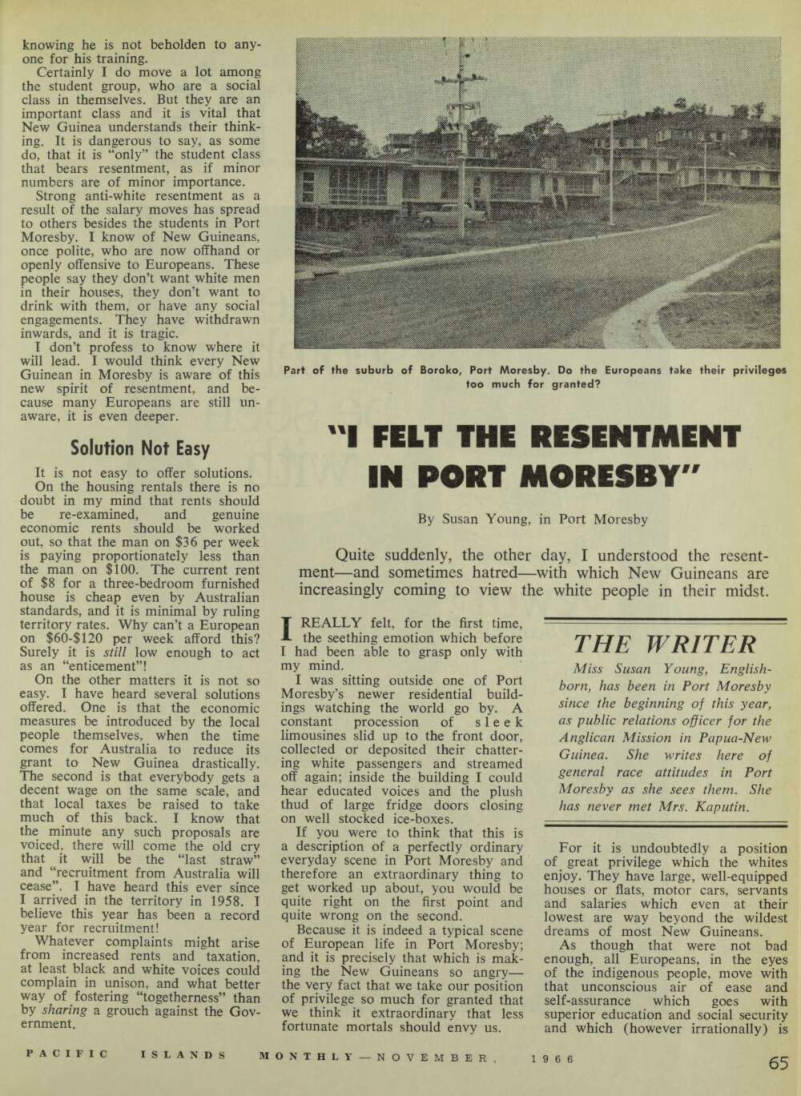
Part of the suburb of Boroko, Port Moresby. Do the Europeans take their privileges too much for granted?
Harmony Being Lost In The Towns
in itself a cause of resentment among the have-nots of this world.
The error of privilege is com pounded by the contempt, arrogance and lack of interest with which so many white people regard New Guineans.
All this, of course, is very bad for race relations.
Certainly it is true that the harmonious relations which exist be tween the races in many outback communities in P-NG are rapidly being lost in the towns.
This, I think, is chiefly because many New Guineans, on arrival in the towns, come across the worst type of white man for the first time and, moreover, come across him in large numbers.
In the bush they have probably dealt mostly with Government officers and missionaries, all of whom can plainly be seen to be working for the people in some way or another and who, generally speaking, treat them with respect.
But in the towns natives see Euro peans who are in the territory solely for what they can get out of it.
They meet European after European who is offhand to them, or con temptuous, or downright insulting.
They hear Europeans dismiss those fellow whites who do care as “native happy”. In the towns the myriad benefits of civilisation appear dazzlingly desirable, while at the same time the wildly unequal distri bution of this power and wealth is starkly apparent.
What Can Be Done?
This is the sort of thing that makes Communists out of people, which finally makes a man reach for his knife with hatred in his eyes. And who can blame him?
Yet all normal people, both white and brown, would say that this is something which must not be allowed to happen in Papua-New Guinea.
How do we stop it happening, how can we ensure that the territory develops peaceably into the full stature of nationhood? For many of the Europeans who are concerned about race relations these are hard questions to answer.
These are the people who try to do their bit towards fostering good relationships by treating natives with friendliness and courtesy, inviting them into their homes, offering them lifts in their cars; but who are afraid
to protest loudly on behalf of the New Guineans for fear that it might stir up just those feelings which they are anxious should be avoided.
They are sincere, honourable, responsible people and they want peace in our time.
These people fear the consequences of white discrimination and indifference. But most Europeans have a much cruder fear: they are afraid of the native people themselves because they are different, and because they represent a threat to white supremacy.
This fear takes the form of viciously expressed contempt and an almost hysterical dread of violence, especially rape. Every misdemeanour committed by a native is put down to his being brown, instead of being seen for what it really is—the kind of frailty which is the same the world over, regardless of race.
To be sure, women may be assaulted in the territory. But in what country in the world do women not run this risk? There are plenty of places where women are just as unsafe as they may be in Papua-New Guinea.
In any case, many women ask for trouble (and bring it on others who do not) by their dress—or rather un dress—which may be just normally provocative back home, but which in
Badly Needed r :Respect And Equality
more modest Papua-New Guinea be comes a flagrant invitation to rape.
This is specially true in the towns, where many of the native men are separated from their womenfolk back in the villages and who are bewildered and frustrated by the un familiar stresses of urban life in a white-dominated world.
To be sure, it is necessary to lock up your house at night in Port Moresby. But in what city in the world does the prudent householder not do this?
In any case, it is small wonder that the indigenes sometimes thieve, for the flaunted wealth of the Europeans constitutes a cruel temptation.
It seems to me that for all Euro peans living in the territory there are a couple of perfectly plain ways to ease the problem of race relations.
One is to get to know the New Guineans. It becomes difficult to hate or despise those whom you under stand.
The other is to give the New Guineans what they want—respect and equality of opportunity.
To some extent, the Administration and missions are already giving the respect and working towards the equality. But in the last resort the responsibility, as always, lies with individuals. It is the attitudes and behaviour of ordinary, average white people that is causing so much of the rising resentment.
The tragedy is that the ordinary, average white person does not recog nise his responsibilities, and would be shocked to see himself for what he is rapidly becoming—the villain of the piece.
If we are not careful, tragic history is going to repeat itself in Papua- New Guinea: trouble is going to be caused, not by the wilful acts of wicked men, but by the casual in sults and indifference of ordinary men; and by the failure of good men to do anything about it. When will we ever learn? • The Papua-New Guinea De partment of Forests has appointed an entomologist to carry out research into insect pests causing damage to departmental nurseries and planta tions. He is Mr, Barry Gray, formerly of Sydney. Mr. Gray will be stationed at Bulolo.