Relic Of Tahiti’s Royal Past
pp. 94-95 · Read in the full issue
Falls A Victim To Progress
By Robert Langdon
A two-storey palace in Papeete, that was begun for Tahiti’s Queen Pomare IV more than 100 years ago, has become a victim of the Jack-and-the-beanstalk development that has changed the face of the Tahitian capital since it became the supply centre for France’s nuclear testing base three years ago.
WORKMEN began demolishing the palace in August to make way for a new building for the Ter ritorial Assembly, French Polynesia’s parliament.
But their bulldozers and jack hammers did not swing into action against the palace’s august walls and balustrades without a protest.
The Papeete daily, Le Journal de Tahiti, described the demolition as “a deplorable act,” which was anni hilating a unique relic of the past.
“It is too late now, alas, to do anything about the situation,” the newspaper said, “but how much more preferable it would have been to have conserved those antique walls, to have surrounded them with a beautiful lawn, and to have created a public garden under the huge trees that surrounded the palace.
“All that would, perhaps, have been costly; but in a world where concrete has become king, where aesthetic, beautiful and natural things give way to the utilitarian, we would have saved at least one small corner where tourists and residents could come and dream at leisure of the marvels of the old times . .
Distant Origins
The origins of the Royal Palace dated back to the beginning of the 19th century when visiting European ships first began regularly to use the protected port of Papeete rather than the open roadstead of Matavai Bay.
To be on hand to trade with, and receive presents from, these ships, King Pomare II built a house for himself and family in the vicinity
of the now demolished palace. The building was erected in 1815.
After King Pomare II died ir 1821, the building remained the home of his children, one of whom reigned as King Pomare 111 until an influenza epidemic carried him off in 1827.
The sovereignty of Tahiti then passed to the young king’s 14-year-old sister Aimata, who took the title of Queen Pomare IV.
Queen Pomare occupied her father’s house until January, 1844, when —having annoyed the French, who had seized Tahiti and established a protectorate in 1842—she was forced to flee for protection to a British warship then in the harbour, Later, another British warship took her to the island of Raiatea.
Begun In 1860
Following the Queen’s flight, the French commandant, Captain Bruat, coolly appropriated her residence for himself, and he remained there until a prefabricated house was shipped out to him from France in 1845.
Captain Bruat had the prefabrica ted house erected alongside that of the Queen; and he ceremoniously offered the Queen the keys to this when—relations having been patched up—the Queen returned to Tahiti in February, 1847.
However, the Queen preferred to return to her own house; and so the prefabricated house remained the residence of the French commandant.
By this time, the Queen’s house was falling into disrepair; but it was
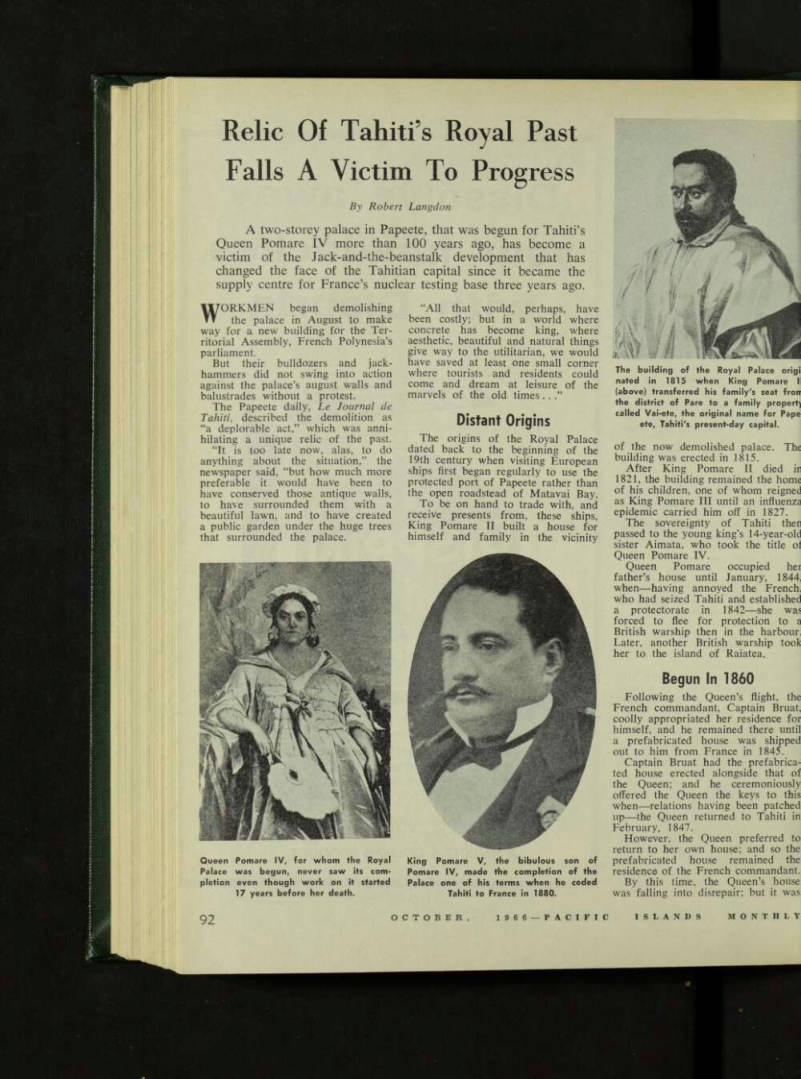
Queen Pomare IV, for whom the Royal Palace was begun, never saw its com pletion even though work on it started 17 years before her death.
The building of the Royal Palace origi nated in 1815 when King Pomare II (above) transferred his family's seat fronr the district of Pare to a family property called Vai-ete, the original name for Pape ete, Tahiti's present-day capital.
King Pomare V, the bibulous son of Pomare IV, made the completion of the Palace one of his terms when he ceded Tahiti to France in 1880.
(not until about 1857 that she ex pressed interest in having a new [palace built for her. » Material for the construction of a f new palace—the one that has just been demolished—was sent to Papeete Trom the districts, and a building fund ‘was opened by order of the Imperial (as the French com mandant had come to be called). A tax of one or two francs per person was levied on the people, according to their circumstances.
The construction of the palace began in 1860, but it dragged on year after year, and it was still not completed when Queen Pomare died in 1877. However, the Queen used the palace for parties occasionally in its unfinished state.
In his novel The Marriage of Loti, Pierre Loti, the French novelist, described one such party, a musical evening, which took place at the palace in November, 1872.
“The old queen,” Loti said, “sat at one end of the salon, underneath her own portrait painted some 30 years ago ... on a golden throne upholstered in red brocade. She held in her arms her little granddaughter, who was dying [of tuberculosis]. She wore a crimson velvet gown and her fat feet were more or less stuffed into satin boots. Next to the throne was a salver full of pandanus cigarettes...”
Delicious Perfume
Loti said that among the ladies of the Court were seated the princesses related to the queen. There was Princess Ariitea, Pomare’s gentle, dreamy daughter-in-law, who had Bengal roses in her hair which fell to her shoulders. There was the dowager queen of Bora Bora, an old savage with pointed teeth, in a velvet dress. And there was Queen Moe in a dark dress, whose beauty was classical and mysterious, whose strange eyes were half-closed, and whose expression turned inward as in old portraits.
“Behind these groups,” Loti said, ‘brightly illuminated by the indoor ighting, lay the transparent depth 3f the Pacific night, the mountain-tops silhouetted against the starry sky, in front of which were the gigantic leaves and huge bunches of fruit of i cluster of banana trees. . . . The ur was filled with the delicious perfume of gardenias and orange olossom; the deep silence broken Dnly by the murmuring and rustling Df insects in the grass, and those ypical sounds of a Tahitian night wepared one to enjoy the enchanting lowers of music.”
In 1880, when Queen Pomare’s bibulous son, Pomare V, ceded Tahiti to the French Government, the com pletion of the palace was one of the terms of the deed of cession, (The other terms were that the French should pay him an annual pension of 60,000 gold francs, and similar pensions to his divorced wife and two brothers).
The palace was completed and handed over to the king on May 21, 1883. It provided ample space for the boisterous dinners and entertain ments that were a feature of the king’s last dissipated years.
It was in this palace that the king suddenly expired in June, 1891; and it was from there that the French artist Paul Gauguin, then newly arrived in Papeete, saw his funeral procession leave for his last resting place at Arue—“the troops and the authorities in white helmet and black dress-coat; the natives in their mourn ing costume”.
After the king’s death, his heirs offered the building to the French colonial government. But this legacy was refused in 1897 because of legal difficulties.
Three years later, a Papeete merchant bought it for 60,050 francs; but he immediately sold it again for 64,136 francs to the Caisse Agricole.
Exactly nine months later again— on August 23, 1901—the colonial government acquired it and converted it to office use. During the next 60odd years, it housed the Administra tion Treasury and the territorial archives, among other things.
Needless to say, the house built by Pomare II near where the palace stood has long been demolished. It came down in 1880.
But the prefabricated house erected by Captain Bruat 120 years ago still stands—or at least it provides the basic framework of the building which is still the residence of the French Governor.
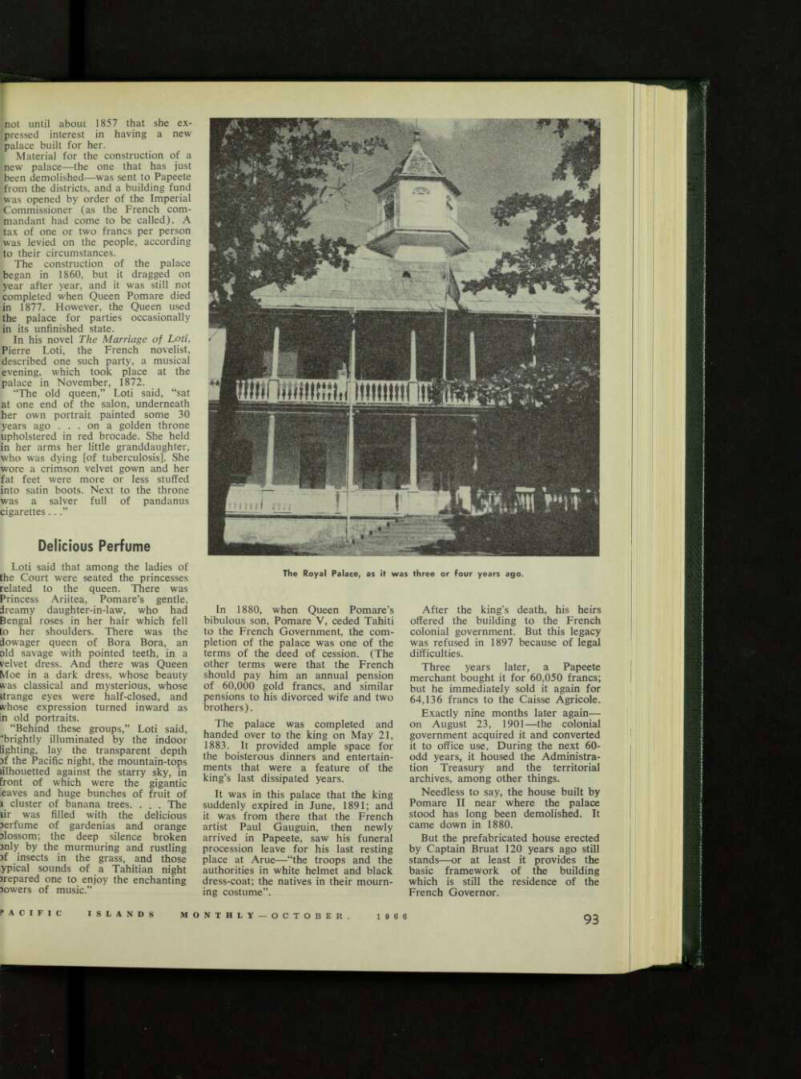
The Royal Palace, as it was three or four years ago.