Islands Birds
pp. 91-93 · Read in the full issue
Bsip "Bina" Was
A Celebrity Among
By a Staff Writer
Among people from the Solo mons who arrived in Sydney in August in the Tulagi was Mr.
Henry Hill, formerly of
Tenamba Plantation, Guadal canal, who has “gone finish” after 27 years in the BSIP.
MR. HILL has sold his plantation to the Melanesian Mission and has rejoined his wife in a house they have bought at St. Ives, a Sydney suburb. Mrs. Hill moved to Sydney about 18 months ago.
Soon after his arrival in Sydney, Mr. Hill dropped into our office with an interesting album of pictures.
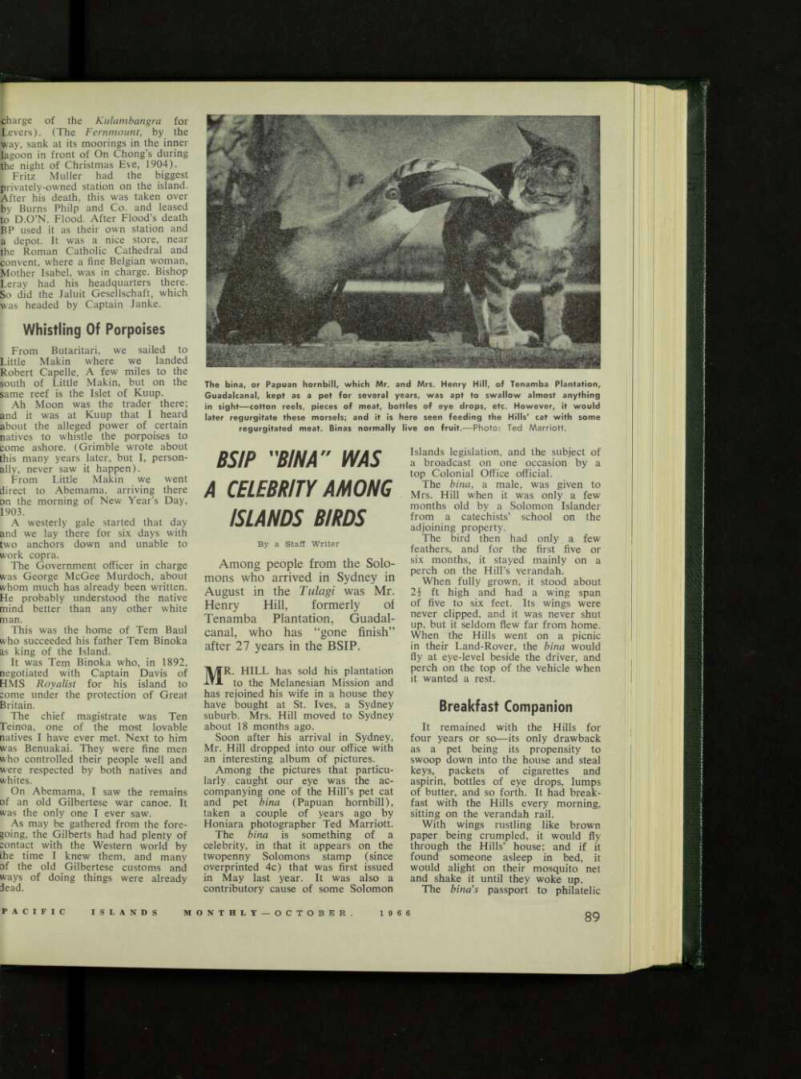
Among the pictures that particu larly caught our eye was the ac companying one of the Hill’s pet cat and pet bina (Papuan hornbill), taken a couple of years ago by Honiara photographer Ted Marriott, The bina is something of a celebrity, in that it appears on the twopenny Solomons stamp (since overprinted 4c) that was first issued in May last year. It was also a contributory cause of some Solomon
Islands legislation, and the subject of a broadcast on one occasion by a top Colonial Office official.
The bina, a male, was given to Mrs. Hill when it was only a few months old by a Solomon Islander from a catechists’ school on the adjoining property.
The bird then had only a few feathers, and for the first five or six months, it stayed mainly on a perch on the Hill’s verandah.
When fully grown, it stood about 2i ft high and had a wing span of five to six feet. Its wings were never clipped, and it was never shut up, but it seldom flew far from home.
When the Hills went on a picnic in their Land-Rover, the bina would fly at eye-level beside the driver, and perch on the top of the vehicle when it wanted a rest.
Breakfast Companion
It remained with the Hills for four years or so—its only drawback as a pet being its propensity to swoop down into the house and steal keys, packets of cigarettes and aspirin, bottles of eye drops, lumps of butter, and so forth. It had break fast with the Hills every morning, sitting on the verandah rail.
With wings rustling like brown paper being crumpled, it would fly through the Hills’ house; and if it found someone asleep in bed, it would alight on their mosquito net and shake it until they woke up.
The bina’s passport to philatelic
The bina, or Papuan hornbill, which Mr. and Mrs. Henry Hill, of Tenamba Plantation, Guadalcanal, kept as a pet for several years, was apt to swallow almost anything in sight—cotton reels, pieces of meat, bottles of eye drops, etc. However, it would later regurgitate these morsels; and it is here seen feeding the Hills' cat with some regurgitated meat. Binas normally live on fruit.— Photo: Ted Marriott.
fame was a Christmas card, depicting it, which the Hills sent to the former Western Pacific High Commissioner, Sir David Trench.
This produced an official request for permission to hand over the photograph to an artist so that he could do the art work for a postage stamp.
Meanwhile, the Hills had noticed a decided decline in the bina popula tion of Guadalcanal, due, they had no doubt, to the islanders’ relish for them in the stew pot.
Afraid that their own bina might finish up in the pot, and thinking that binas generally might eventually be eaten out, Mrs. Hill wrote to the Chief Secretary to see if legislation could be passed to protect the binas.
Such legislation was passed not long afterwards. At the same time, protection was removed from the white cockatoo, which had proved a menace to planters.
The Hills’ bina subsequently dis appeared after it had been on a picnic with them. The islanders told them that it had probably gone off to mate.
Last year, two binas perched in a tree outside the Hills’ house where the pet one had formerly roosted.
When Mr. Hill called them, he thought he got a familiar-sounding reply.
But if one of them was the former pet, it did not renew its former
close acquaintanceship.
Footnote: Mr. Hill first went to the Solomons for Lever Pacific Plantations Pty. Ltd. in 1934. In 1941, he joined the AIF, but returned to Levers in 1947. He remained with them until buying Tenamba Plantation in 1958.
Sir David Trench.