Yesterday
p. 97 · Read in the full issue
The October, 1946, issue of the “Pacific Islands Monthly” was notable in at least one respect—it con tained the first on-the-spot report from New Guinea from a PIM staff writer since the beginning of World War 11.
THE staff writer in question was Mrs. Judy Tudor, whose report said New Guinea had a “depressing present” and a ‘‘curiously uncertain future”. In Port Moresby, she said, “the administration centre is at Kone dobu . . . separated from the township by about two miles of road and an ocean of doubt, distrust and plain misunderstand ing”. Mrs, Tudor found that the biggest needs in the territory were shipping and “someone to stop planning long enough to fill in the holes in the roads, keep the power stations functioning, the water services running, transport on the roads and the temporary housing and quarters from entirely disintegrating”.
Other items in that issue of PIM of 20 years ago were:— 'THE Western Samoan Admini **■ stration was planning to create a Samoan Broadcasting Service and to install receiving sets with loud-speakers in all Samoan villages. The receiving sets were to be paid for by the villages but the Administration was to install and maintain them.
A CONFERENCE was to be “Cl held in early 1947 to set up a South Seas Regional Com mission. Australia and New Zea land had invited the Governments of the United Kingdom, the United States, France and the Netherlands to send representa tives.
THE Fiji Department of Mines . was planning a survey of iron deposits in Nadroga and Navosa Provinces. Samples of large boulders of magnetite ore and ochre had been treated before World War II and revealed good percentages of iron ore.
OEVERAL landslides were caused by a severe earth quake which struck Rabaul, P-NG on September 29. A bad slide was visible on the side of Mount Vulcan and there were large cracks in the surrounding area.
The road from Kokopo to Rabaui was also put out of commission.
NIUAFOOU (Tin-can) Island in Tonga was devastated by volcanic eruption in mid-Sep tember. The eruption was first reported by the pilot of an RNZAF aircraft flying between Auckland and Samoa. The erup tion caused serious damage along the north coast of the island. All Government buildings, the radio station, stores, copra sheds, boats and mission buildings were des troyed.
But there was no loss of life and the main food crops were undamaged.
W. R. Carpenter & Co. Ltd.
had inaugurated a new trans pacific shipping service between Western Canada, the South Pacific and the Orient with two 10,000ton ships, Rabaul and Lautoka.
THOR outstanding courage in the ■1 cause of freedom during the war, the King’s Medal had been awarded to Mr. C. H. Meen, a Chinese resident of Rabaul, and formerly employed by the Admin istration there. His citation stated that he had been interned with a small group of Chinese in Japanese-occupied Rabaul, that “in 1943, at great risk, he sent detailed information and maps by runner to the Australian Intel ligence Bureau which enabled Allied forces to make successful
air attacks on Japanese installa tions”; and that he had assisted in hiding two stranded American airmen at Sumsum and to have them taken to an Australian camp.
Mr. Meen was described as a keen photographer and a frequent con tributor to PIM. He still is.
ABEMAMA Atoll was reported to have been chosen as the post-war headquarters of the Gilbert and Ellice Islands Colony ahead of Ocean Island, Tarawa and Butaritari, and plans were said to be in hand for the erection of 30 houses for Europeans.
AMERICAN Samoa had been suffering from a severe food shortage, mainly due to the non arrival of the steamer Matua.
Canned meats, flour, rice and native foodstuffs were extremely scarce.
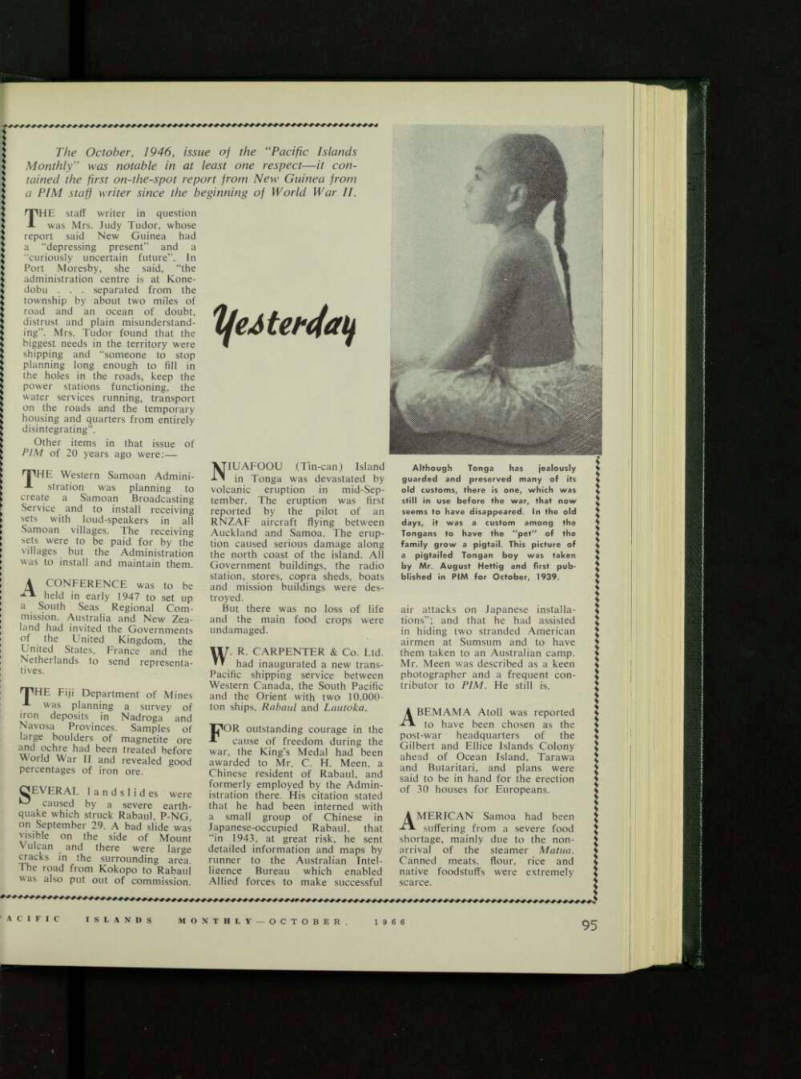
Although Tonga has jealously guarded and preserved many of its old customs, there is one, which was still in use before the war, that now seems to have disappeared. In the old days, it was a custom among the Tongans to have the "pet" of the family grow a pigtail. This picture of a pigtailed Tongan boy was taken by Mr. August Hettig and first pub lished in PIM for October, 1939.