Fijian Literature?
pp. 51-53 · Read in the full issue

What's Happened
To An Indigenous
From a Suva Correspondent Compiler of the official Fijian
language dictionary, Dr. A.
Capell, returned to Fiji recently
and took his first look for a quarter of a century at current Fijian and those who speak it.
DR. CAPELL, who is Reader in Oceanic Linguistics in the De partment of Anthropology at the University of Sydney, found the lan guage had changed, as all languages keep on doing, but, he said, “It isn’t changing in an encouraging direction.
“What I would have liked to have seen was the beginnings of an in digenous Fijian literature. The only answer to that would be the en couragement of the Fijians to develop their own language as a school sub ject, and to encourage possible writers to make literary use of it. The only literature coming out in the Fijian language are abbreviated translations of English works.
“While some African languages are producing literature, the Pacific lan guages are not, and I think it boils down to the fact that they are too busy following the European and haven’t got enough pride in their own cultures.”
Dr. Capell had been studying the vernacular newspapers and he found both the Fijian and Hindustani Press wanting.
English Words
“I noticed,” he said, “that the adaptation of English words is going on apace in both the Fijian and Hindi languages. One poor adaptation was the use on a poster of the English idiom ‘for saving money’. That had been translated as vakabula-i-lavo which really means ‘to give life, to rescue’ and is used in the religious sense of saving.
“Another which is commonly seen outside shops advertising a sale is lutu sobu, which literally means ‘to fall down’ and was used in the sense that prices were cheaper. When you combine that with levu (big) and make it lutu sobu levu —a big sale— it rather reminds me of Humpty Dumpty.”
He produced several examples of Fijian sentences which, he said,
seemed to him to be slavish imita tions of the English structure of sentences. That was also true of Hindi. One never saw the use of interjectory words which could not be translated but which added to the life of the thing.
Dr. Capell said he had also noticed the au sound had become ou and although there was a certain amount of that when he was last in Fiji it was now much more noticeable.
The introduction of English words was also changing the phonetic pat tern, he pointed out. He quoted the
word jabeni (champion) as one example. The “J” was never before used in the Bauan Fijian but it was in the West though the Nadroga speech is really a different language, “If the dictionary I compiled were being brought up to date you would have to have the letter ‘l’ with words starting with a ‘J’,” he said, and added. “But, of course, they are growing-pains which affect most lan guages influenced by other races and foreign surroundings.”
He pointed to another development he had come across—the building up
of elaborate words with prefixes and suffixes which would not be used in ordinary Fijian life but which were necessary because of the European development of the colony.
“I was asked by the Methodist Church for a word for ‘stewardship’,” he said. “I have made a word for them which is Veivakadauniyautaki which literally means ‘having full dealings with each other’s money’.
That word will have to find its own way into the language just as a word I saw the other day will have to do —Veivakavaletaki which is based on the word vale (house) which is used with the same prefixes to mean ‘hous ing’ for Housing Authority.”
Dr. Capell, who is an ordained Anglican priest as well as anthro pologist and linguist, has to deal with languages in the Pacific and Australia.
Racial Origins
Languages, he explained, aid investi gation into racial origins and at the moment there was a good deal of discussion and research into the rela tionship between Melanesia and Poly nesia. Radically new ideas had been put forward, some of them quite un tenable.
“One American in particular has put forward the idea that there was a population explosion somewhere in Melanesia, and that Indonesian, in stead of being generally regarded as ancestral to languages further east, is no longer so in his particular theory, a theory running counter to the one that the Polynesians all came from South-East Asia.
“My theory, from my knowledge of what is called the pidginisation of language, is that all the Melanesian languages represent the pidginised forms of the original incoming lan guage—the language which first came out from South-East Asia. It is rather like the spread of English all over the world.”
From the point of view of retracing history through languages. Dr. Capell thought Fijian was interesting because there were several dialects which were, basically, different forms of Melanesian and had come in at dif ferent times and in different ways.
“I would mention first of all the Western languages, Nadroga and others, which, I think, are earlier stages of Melanesian and were prob ably here before the others arrived.
“The official Fijian language is Bauan, and it owes its prominence partly to the fighting prowess of the warriors of Bau, but mainly to the combined influences of the mission
aries and the government of the last century. It actually springs from an area which is no bigger than 21 acres.”
Dr. Capell pointed to another tangle in the skein—Vanua Levu, which, he said, had dialects whose special vocabularies are hard to trace in other parts of Melanesia at all.
They sometimes agreed with Western Fijian but not altogether.
The big mystery, however, was Rotuma. “Rotumans stand apart,” added Dr. Capell. “Of two leading authorities last century, one classified Rotuman as Melanesian, the other as Polynesian.”
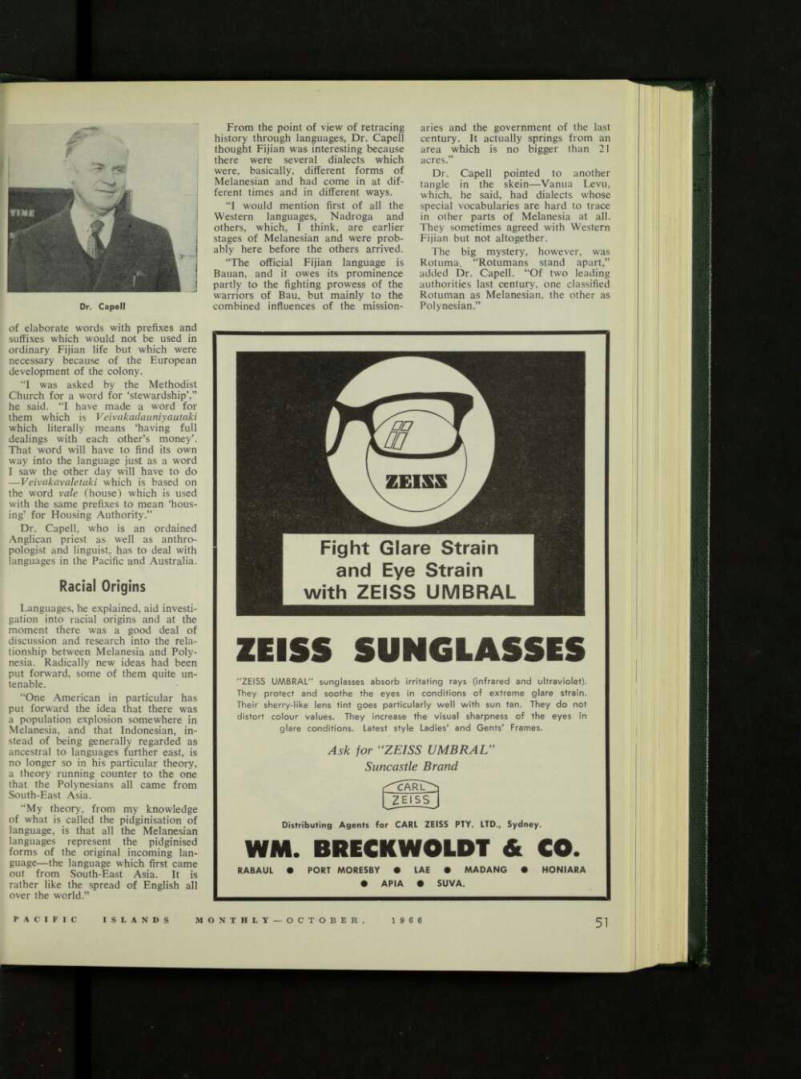
Dr. Capell