Skirts The Vital Issues
pp. 55-57 · Read in the full issue
P-Ng’S Constitutional Report
From Stuart Inder in Port Moresby The prospect of a 94-member House of Assembly in Papua-New Guinea in 1968 has caused hardly a ripple of in terest in the territory. The most significant facet of the pro posal so far is seen as merely where to seat the extra 30 mem bers in Port Moresby’s air-conditioned Assembly building.
THE new composition of the House has been proposed by the House of Assembly select committee on constitutional development, in a re port introduced into the House in September, and approved un animously.
The recommendations will now go :o Federal Parliament, where they should receive automatic approval, md changes will then be made in the Papua-New Guinea Act—the terri ory’s constitution—in time for the lew elections of February, 1968.
As about 12 months of prepara ions will be needed for the elections 'see panel) all these legal measures vill have to be cleared up by about February, 1967.
The House of Assembly at present :omprises 10 official members, 44 nembers elected from “open” lectorates, which are open to all, md 10 Europeans from “special”
electorates in which Europeans only may nominate.
The new proposals are for the same number of 10 official members, 69 members from “open” electorates, and 15 from a revised type of special electorate, to be called a “regional” electorate.
As now, members will be elected from a common roll, and the mini mum voting age will be 21.
Confusion
The only other recommendations affecting electorates are that elec torates be contained wholly within administrative district boundaries, as the division of boundaries causes confusion; and that candidates not born in the territory should have lived in the territory for five years before nominating.
The committee doesn’t want to see any changes in the present system
of voting; or the period between general elections (four years); or the residential qualifications for electors (who now don’t have to possess any educational qualifications, or be re quired to speak, read or write any specified language).
The recommendations affecting the new regional electorates were the only ones that drew any real comment during the debate, which was under standable because these most affect European members of the House.
Special or regional electorates have been a debating point since they were introduced in 1964. The critics, mostly in the UN, or in the uni versities, have been against Europeans holding reserved seats, but it has. not been a real issue in the territory, or in the House. Without European members the present House un doubtedly could never have got off the ground.
Special Electorates
In its report the select committee said it was opposed in principle to any form of representation based on racial grounds, and that in any case its re:ent inquiries did not show an overwhelming demand by the people for a special form of non-indigenous representation such as existed at the time the select committee of the old Legislative Council had got to work.
Nevertheless, the role of the special electorate members was “primarily in the House, and they should be in a position to bring broader experience into the House”.
The committee reported: “Having in mind this important function of a special electorate member, and the undesirability of maintaining a racial qualification, your committee thinks
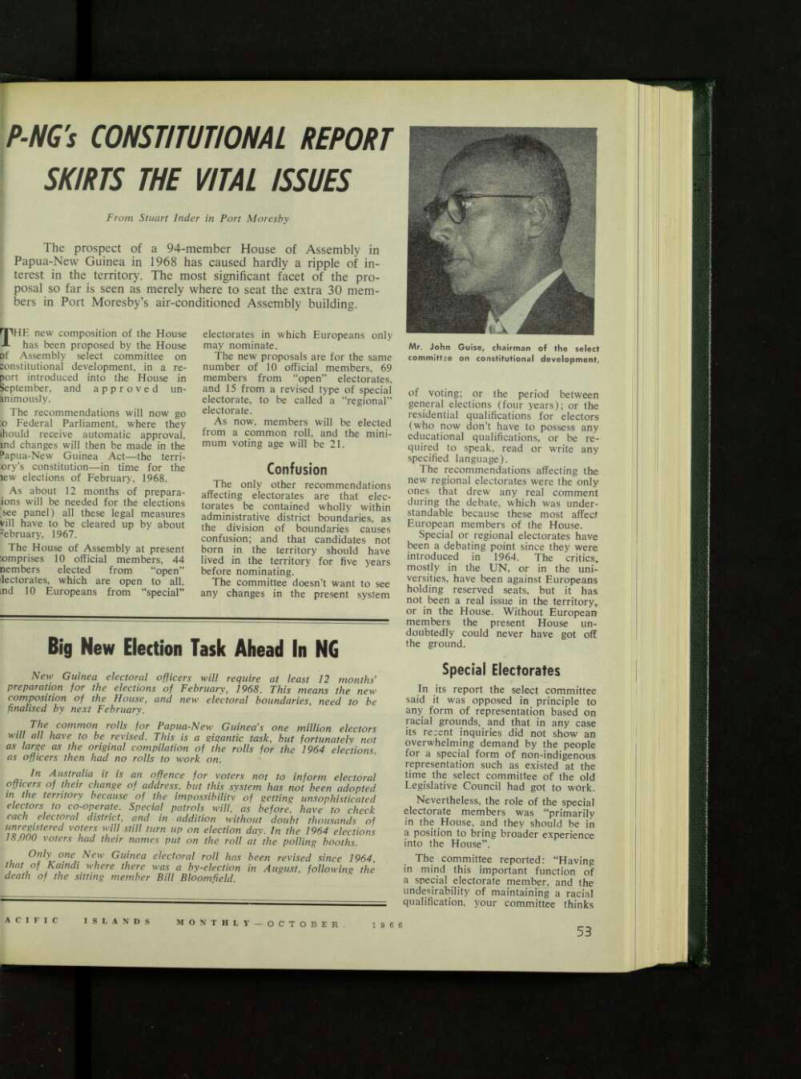
Mr. John Guise, chairman of the select committee on constitutional development.
that the functions of this type < member could be carried out I persons of any race with some tyj of educational qualification. ...
“The committee considers that tl possession of the territory Inte mediate Certificate or an equivale educational qualification sho u 1 ensure that the House will contim to contain men, both indigenous ai non-indigenous, with the necessa: skills to carry out the work of special electorate member.”
This was the crux of the coi mittee’s views on special electorate Candidates for special or region electorates may be of any race long as they have at least the ter tory Intermediate Certificate.
But if the previous qualificatio for special electorates were regard as discriminatory, then the ne proposals are no less so.
As there will be 15 region electorates taking in the same ar as 69 open electorates, it stands reason that candidates will have v< areas in which to campaign, and tl will require much time and travel ai often involve them in contact! many different tribal groups.
"International" Approach
It will require money, shre\ political campaigning and plannii and an “international” approach, gain a seat in one of these el< torates, and at this stage of the ter tory’s development it’s a safe bet tl most if not all of the 15 new regior electorates will be filled by Eui peans.
Some close observers here dor whether it was necessary to ha applied the educational qualificatioi because they think the result wor be the same anyhow. They suggest might have been shrewder to ha done away with the qualificatio and thus what might appear to discrimination.
The regional electorates, under t new proposals, vary in populati from 53,000 electors (in the Northe district) to 296,000 (in the Weste Highlands). Morobe will ha 220,000. Most of the electorates w have over 100,000.
The new 69 open electorates v, average about 30,000 electors p member—Manus being the best < with about 19,000, and Bougainvi being at the other end of the scj with 33,700. At present the numb of people to each member in op electorates is about 49,000.
The committee recommended increase in the number of open el< torates because it said the ov<
Report On Constitutional Development
I whelming majority of people it spoke ito felt 64 were not enough. The [large size of electorates prevented members from visiting all parts, and the people expected members to visit 4hem often, informing them of pro ceedings in the House. The new five-year residential [qualification for expatriate election [candidates is likely to affect only one member at present sitting in the House—the new member for Kaindi, Tony Voutas, although Voutas him self hopes he might scrape around it (see elsewhere).
Budget Argument
One aspect of the committee’s re port which turned out to have un expected significance in the September Budget session of the House was its view on the control of internal revenue.
The committee in its tour of the territory had sought opinions on whether the House of Assembly should have control over New Guinea’s internal revenue (as distinct from the Australian grant).
The committee said it regarded it as desirable that the elected members should, “as far as practicable”, assume some control over locally raised revenue. But it was not at the moment prepared to say how this should be done. It would, in its own time, go into the question of whether controls should be exercised by way of a separate budget (a split budget) or by way of a budget com mittee working in conjunction with the Administration,
Written With Care
This section of its report was obviously written with great care, for members knew they were getting on to delicate ground.
The fierce budget debate in the same session indicated clearly enough that the House wants greater financial control, but most members of the select committee know this can’t be done by making recommendations on a sheet of foolscap and expecting Federal Parliament to rubber stamp it.
Control of the territory’s $ 120billion budget is closely allied with political responsibility, and nowhere in the select committee’s report are ;here any proposals for added respon sibility.
There are no suggestions for putting teeth into the moribund under-secretaryship system, or of re placing it with a cabinet whose members will make real decisions and take responsibility for them, in cluding the responsibility for making the territory meet recurring expendi ture from its own revenue.
This report has attracted little interest simply because it avoids the vital issues of constitutional reform.
Obviously it is keeping these for a further report, and in the meantime
the Government may have sorted out its own proposals for a cabinet system, and it is possible that a compromise will be reached so that the committee will in fact propose what the committee and the Govern ment both want.
Australia is prepared to change the Papua-New Guinea Act to appoint a small number of ministerial “repre sentatives”, giving them more respon sibility than the under-secretaries have. Something of the sort will have to be got working in the House of 1968, and the question of just what it will be is the only big question left which requires New Guinea’s attention this side of the elections.