The Editors' Mailbag
pp. 47-49 · Read in the full issue

A Pacific Games?
Sir, —I have been a subscriber to PIM for twelve months and during that time have found the contents to be very educational and informative.
With the staging of the Second South Pacific Games in Noumea, New Caledonia, in December, and the slow disintegration of the British Commonwealth and Empire, it has occurred to me that some thought could be given by people in the right places to the inauguration of a Pacific Games which would embrace all those countries and islands which have a seaboard to the Pacific Ocean.
These games could be held in the year prior to the Olympic Games.
The staging of such a Games alternately in the Southern and Northern Hemispheres has untold possibilites when a study is made of the surrounding lands of the Pacific Ocean.
Any persons interested in the idea could communicate with me c/- City Hall, Newcastle, N.S.W. I hope that you will in some way be able to further this idea.
R. Trowbridge.
Newcastle,
Nsw.
Captain Tippetts Tortoise
Sirs, Captain Tippett’s tortoise Algie (referred to in PIM for July, p. 89) was taken to Nukualofa, Tonga, in the early 1920’s by a Mr.
Guiness who was travelling around the Pacific in his yacht. Mr. Guiness brought Algie from the Galapagos Islands. He sold his yacht in Nukua lofa, and gave Captain Tippett the tortoise. The yacht was re-named Feituaho.
Mr. Guiness told Captain Tippett that Algie was three years old. His back measurement, half circum ference, was 13 inches. He later grew very large, much larger than Tui Malila, the palace tortoise. Algie died in the 1950’s from neglect.
Captain Tippett remained in Tonga until his death on November 5, 1964.
Mrs. A. Tippett,
(Widow of Captain Tippett) Lautoka, Fiji.
Editors' Note: Mrs. Tippett’s letter throws further doubt on the reliability of the Tongan tradition that Tui Malila, which died in May ( PIM, June, p. 23), was brought to Tonga by Captain Cook. When we pub lished a picture of Captain Tippett’s
tortoise in July (p. 89), we stated that a caption on the back, dated August 9, 1932, said that Algie was reputed to be more than 100 years old. However, as Mrs. Tippett says that Algie was said to be only three years old in the early 1920’5, it is evident that it was not more than 15 years year old in 1932! Our guess is that Tui Malila’s age was similarly exaggerated somewhere along the line, particularly as a Sydney Uni versity zoologist tells us that a good age for a tortoise would be 40 years.
De Gaulle's Visit
Sir, —Since you will no doubt be swamped with other jottings about President de Gaulle’s visit to Vila, in September, you might like the Santo viewpoint.
A UTA plane took a full load of people Santo-Vila return, the same day, to participate in the many functions to honour the French President’s one-day visit to the New Hebrides.
The French Government gave free passages to Europeans and New Hebrideans representing various organisations, and others who held invitations to cocktails at the Residency in Vila were invited to make up the full load. The selected ones were deeply honoured, yet sorry there was not more space so everyone could have gone.
Although newspaper pictures often portray a hard-looking President, de Gaulle is soft spoken, kindly and gentle. Madame de Gaulle, who was with him, is motherly and most charming.
Although some Vila residents said that organisers were “flustered and muddled” this did not appear so to the Santo tourists, and from an outsider’s point of view the proceed ings ran smoothly and efficiently and a happy day was had by all.
"Madam X"
Santo, New Hebrides.
Clam Shell Age
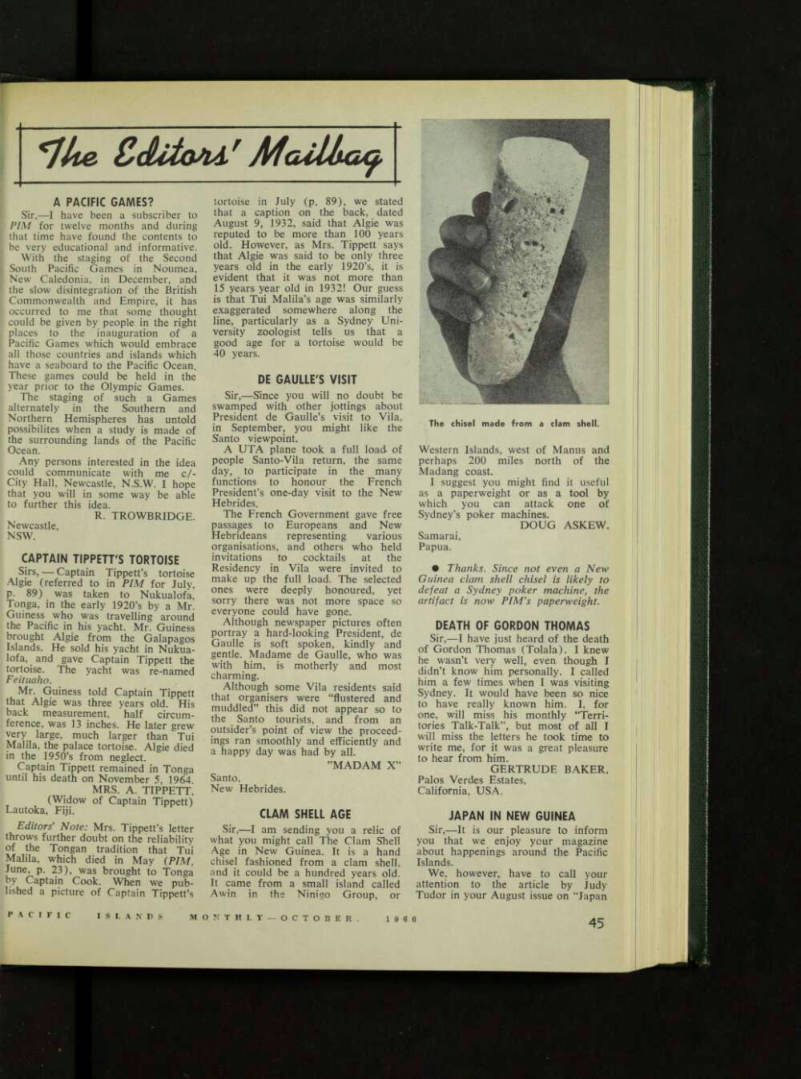
Sir, —I am sending you a relic of what you might call The Clam Shell Age in New Guinea. It is a hand chisel fashioned from a clam shell, and it could be a hundred years old.
It came from a small island called Awin in the Ninigo Group, or
Western Islands, west of Manus and perhaps 200 miles north of the Madang coast.
I suggest you might find it useful as a paperweight or as a tool by which you can attack one of Sydney’s poker machines.
Doug Askew.
Samarai, Papua. • Thanks. Since not even a New Guinea clam shell chisel is likely to defeat a Sydney poker machine, the artifact is now PlM's paperweight.
Death Of Gordon Thomas
Sir, —I have just heard of the death of Gordon Thomas (Tolala). I knew he wasn’t very well, even though I didn’t know him personally. I called him a few times when I was visiting Sydney. It would have been so nice to have really known him. I, for one, will miss his monthly “Terri tories Talk-Talk”, but most of all I will miss the letters he took time to write me, for it was a great pleasure to hear from him.
Gertrude Baker.
Palos Verdes Estates, California, USA.
Japan In New Guinea
Sir, —It is our pleasure to inform you that we enjoy your magazine about happenings around the Pacific Islands.
We, however, have to call your attention to the article by Judy Tudor in your August issue on “Japan
The chisel made from a clam shell.
Takes The Long View In New Guinea”, which includes some in correct information.
The first thing to be clarified, and the most important to us, is that our firm, the Nissho Co. Ltd,, is not a shareholder of the South Pacific Development Co. Ltd., Jap a n, although it is a shareholder of the Southern Trade & Industry Co Ltd., Japan, which is connected with the New Guinea Lumber Development Co. Ltd., Rabaul.
Such being the case, you are kindly requested to make the cor rection in your next issue, so that it would not misguide your readers.
Some other parts of the article are also not according to our knowledge, but they seem to involve many parties, for which we cannot ask for your correction.
In the meantime, generally speak ing, your articles are well read by us, and we like to subscribe to your magazine.
H. Yamasaki,
General manager. Lumber Dept.
The Nissho Company Ltd.
Tokyo.
Moorea's Old Church
Sirs, —I have just received your July, 1966, issue and have enjoyed reading Mr. Robert Langdon’s article on the Moorea church, pp. 85-87.
As I collect books and journals on French Polynesia, I am interested in learning from what published journal or book the drawing on page 86 comes from. Also, mention is made on the same page of a Captain Waldegrave who attended service at that church in 1830. What published journal does this information come from?
Jean-Jacques Laurent.
Km. 16, Punaauia, Tahiti. • The drawing came from Conway Shipley's “Sketches in the Pacific”, London, 1851; and the information about Captain Waldegrave came from pp. 73-79 of the “Christian Keepsake and Missionary Annual”, London, 1836.
Whale-Sized Whale Shark
Sirs, —The picture of Ben Cropp riding a 35 ft whale shark {PIM, June, p. 57) has given me the solu tion to an argument 53 years ago between Joni Jackka, myself, an old
man named Miller, and the captain of the old ship Manapouri.
The Manapouri was taking a trial shipment of bananas to Melbourne from Fiji. About half-way there one calm morning, a huge spotted shark came quite close to the ship (about 10 feet) and kept with us for about half a mile or more, Jackka, Miller and myself esti mated its length at around 40 to 50 feet. I said it was a white shark and I could not be shifted from my opinion. Miller said it was a whale and nothing but a whale, as sharks do not grow that size.
Jackka was emphatic the large white spots were barnacles, although I argued that barnacles have never been known to attach themselves to live fish, sharks or whales.
Later the captain got into the
argument. He had two opinions— that it was a white shark and that perhaps the white spots were barnacles. No one really won the argument, but after seeing that spotted whale shark in PIM, I feel that I won.
I have always been doubted when I tell of that huge shark that we saw. I get hit-back answers such as “There’s no such thing as a spotted shark”, or “what brand were you drinking aboard the old Manapouri?”
Believe me what we saw was a whale-sized whale of a whale shark and then some, and after seeing the white spots on the whale shark pub lished in PIM, I may be able to con vince friends that there is such a thing.
Arthur Robinson
Levuka, Fiji.