Yesterday
p. 91 · Read in the full issue
There was plenty of talk, but not too much action in the South Pacific this time 20 years ago, if one may judge from the issue of PIM for September, 1946. Much of the talking was being done in New Guinea where European planters were complaining that industry was paralysed through lack of labour and transport, and public servants were indignant over the Administration’s failure to provide them with “reasonable amenities of life”, BUT among all the talk, there was a lot of material that is still of interest today.
The main news items were:
TWO new industries which pro mised economic benefits to the Tongans had been established in the kingdom by two New Zealand companies. A juice-ex tracting station had been set up at Vavau, a major orange-pro ducing area, and was expected to absorb the large annual surplus formerly left to rot on the ground.
A shark-fishing depot had been set up at Haapai. Over fifty full size sharks were taken during the first two days of fishing from the depot’s launch.
IN Papeete, Tahiti, two Chinese schools had been closed by order of Governor Haumant be cause not enough pupils had pre sented themselves for the French examinations. Two Chinese traders had also had their shop licences withdrawn because of over charging.
FIJI’S candlenut oil factory, which had been established about a year previously, was crushing about 16 tons of nuts a week. New machinery was on order from Australia and when installed in the Suva factory, it was expected that all the candle nuts in Fiji, Tonga and Samoa could be treated.
Candlenut oil is valuable as a drying agent in the manufacture of paint, the nut pulp is a useful stock food, and the shell makes good “wood flour”, a base in the manufacture of plastics.
THE first regular post-war air service from Lae to the goldfields settlement at Wau, in the New Guinea Highlands, was launched by Mandated Air Lines on August 28, 1946. Services
were weekly, but it was expected that traffic would soon warrant an increase.
THE first shipment of Ocean Island phosphate to arrive in Australia since the Pacific War began had reached Melbourne in the vessel Triona. Unloading of the 9,000-ton shipment began immediately as supplies of phosphate from Makatea, French Polynesia, on which Victoria had depended during the war, were almost exhausted.
THE New Zealand Air Force was operating regular air services from Suva to Nadi; Suva to Auckland; Fiji to the Cook Islands via Tonga and Samoa; and Fiji to New Zealand via Norfolk Island and New Cale donia, with Dakota, Sunderland and Dominie aircraft. The fare from Fiji to New Zealand by flying boat was £F2S/5/2.
THE British Solomon Islands Administration was ex perimenting on a large scale with rice-growing at Tenaru, on Guadalcanal. Lack of rice ship ments from Malaya and Indo nesia, the sources, of large supplies to the Pacific before the war, had prompted the experiments, THE United States Army and Navy officially withdrew from New Caledonia in August with the departure of the vessel
Lubbock from Noumea. However, a small force of about 400 mixed ranks from the Navy and Army remained to wind up affairs. The Americans first arrived in New Caledonia in March, 1942, when the Pacific War was at its most critical stage.
PAN American Airways had resumed their weekly trans pacific air service with Douglas Clipper aircraft. The service had been interrupted in July, 1946 when all Constellation aircraft, which had previously been used, were grounded following a crash in the USA. British Common wealth Pacific Airways were also operating trans-Pacific serv ices on a fortnightly basis, with DC-4 Skymaster aircraft from Melbourne to Fiji. Hawaii, and San Francisco.
A FORMER Tongan govern ment official, T. T. Toutaio lepo, had been convicted of embezzling £152 of government funds. He had been an official interpreter and translator. Many hundreds of people had signed a petition asking for his release under probation. He had been imprisoned for 18 months.
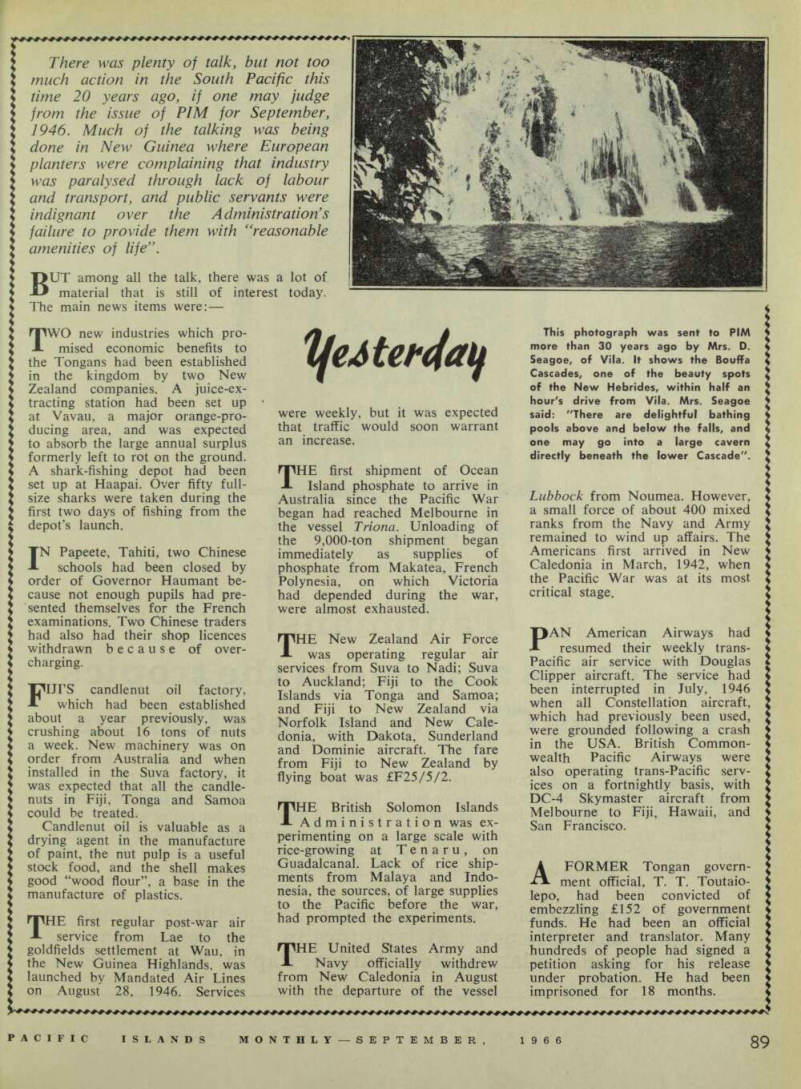
This photograph was sent to PIM more than 30 years ago by Mrs. D.
Seagoe, of Vila. It shows the Bouffa Cascades, one of the beauty spots of the New Hebrides, within half an hour's drive from Vila. Mrs. Seagoe said: "There are delightful bathing pools above and below the falls, and one may go into a large cavern directly beneath the lower Cascade".