Divertingly frank journey through
pp. 93-94 · Read in the full issue
The Month's New Reading
Divertingly frank journey through many a green isle
Anyone who has admired Judy Tudor’s shrewd and some what wry reporting in Pacific Islands Monthly will be sure to enjoy this wider view of the many green isles which have been her journalistic province for the last 25 years.
MANY A GREEN ISLE ranges in time from the late 1930’s to the present day, and in space from West New Guinea to French Poly nesia. It is a broad conspectus from a firmly personal point of view. Mrs.
Tudor writes as she speaks, and is never afraid to say what she thinks —whether her opinions are currently fashionable or not.
“Every Pacific Islands territory has its occasional agony,” she writes. “All are now in a mad commotion of change, at the top. But it is still never necessary to look far beneath the surface to have one’s sense of the ridiculous tickled. This un consciously zany element—call it South Seas magic if you must—is still the common denominator of all the islands, which, politically, ethno logically and physically are very dif ferent indeed.”
Mrs. Tudor now seems to have transferred her personal allegiance from New Guinea (where she and her husband prospected for gold im mediately before World War II) to Fiji (which she came to know and love after the war), but I for one found her six chapters on Papua-New Guinea the most rewarding section of the book.
Fair-Minded
As Mrs. Tudor remarks, the history of Papua-New Guinea was cut in two by World War 11, and nothing has been the same since. Having spent four years in the territory before the Pacific war, mostly in the mountains behind Wewak (“In my time I must have cried several gallons of smoky tears while leaning over camp-ovens suspended over reluctant New Guinea fires; and burned acres of skin from my hands juggling the lid full of coals”), Mrs. Tudor is in dubitably a “Before”.
This is her unique advantage as a reporter of postwar events in the
territory. It could have been a dis advantage. But although Mrs. Tudor’s view of postwar events is naturally coloured by her before-the-war ex periences, she is too fair-minded to allow those days of uncomplicated colonialism (“We laughed about be ing Empire Builders but, secretly, felt that we should be congratulated on being just that”) to warp her under standing of what has happened since.
She does not approve of all that has happened. . . the individual Papuan or New Guinean needs self government as much as he needs two heads . . . The question that history is going to ask, and only I imagine when we have long passed out of this anti-colonialism phase, is whether Australia could have helped the Papuans and New Guineans more if it had ignored world pressures in the 1960’s and allowed Papua-New Guinea nationalism to develop before
it started the political yeast—rather than, as Australia has done, gambled on the yeast producing the national ism.”
She admits, however, that such con siderations are now purely academic, and to her credit she has retained the ability to look objectively at the fermentation caused by the yeast.
As she says herself, “the role of observer sits far more easily these days than that of the totally in volved”. In this more comfortable capacity, she records not only political developments but also such non-political titbits as Mick Leahy’s belated reception of an MBE (her account of this, incidentally, is not quite as picturesque as the version I have heard); landing on Omkalai air strip (“This is the one that runs up hill,” explained the pilot), and the glamour girls of Kundiawa hotel.
So-Brief Briefs
“One of them wore skin-tight, flesh pink stretch-pants; another blue jeans; the third, short-shorts that turned out, on closer inspection, to be men’s cotton under-briefs. They had these garments on when I arrived, still wore them at midnight, and appeared in them the next day. At least two of them did—Short-Pants did not appear on the second day. It was said that she was ‘completely exhausted’, but I couldn’t imagine what from.”
Mrs. Tudor has been with the Pacific Islands Monthly organisation since 1942. Her first roving jour nalistic assignment was Fiji—in 1945.
Since then, and more particularly since 1956 when Pacific Publications Pty. Ltd. bought The Fiji Times, she
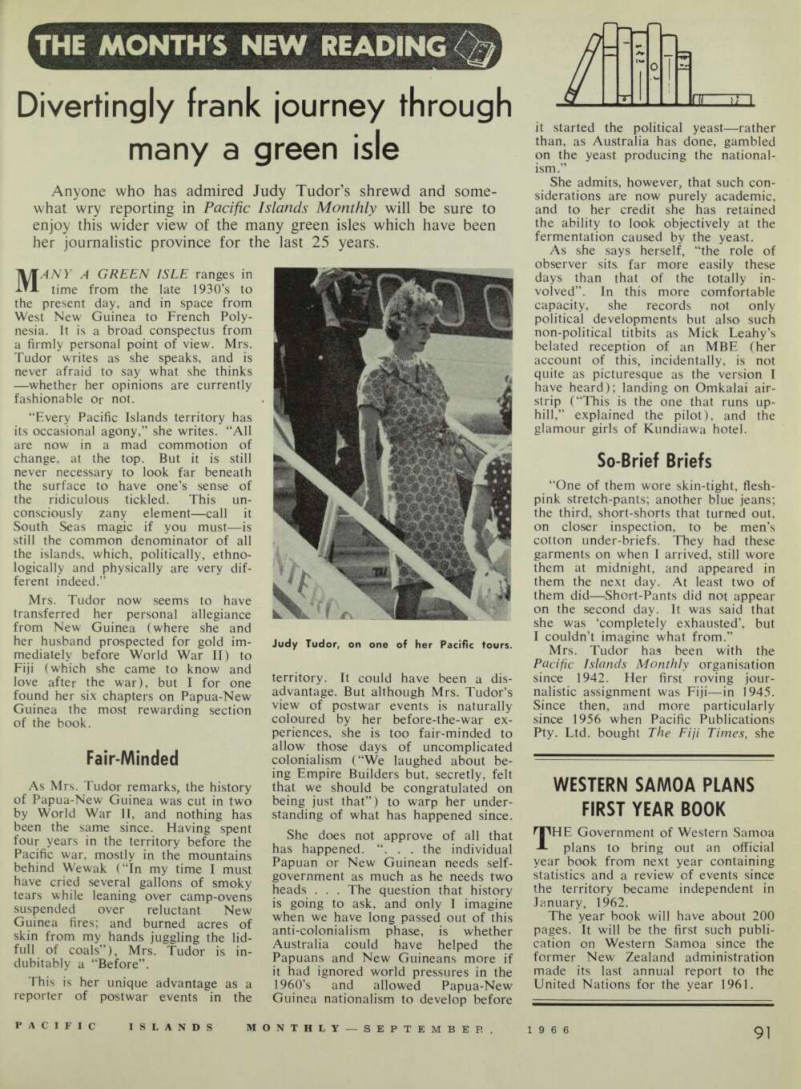
Judy Tudor, on one of her Pacific tours.
has seen a good deal of the colony.
She writes about it bluntly, but with affection.
“Although the British gifts to the Fijian have been incalculable,” she writes, “the regard between the indi vidual European and the individual Fijian is often based on nothing more than the fact that the Fijian is a wonderful soldier and a ‘hell of a good bloke at a party’.
“All too often chiefs are renowned for the amount of hard liquor they can drink, rather than for deep political thought. Far too few, either in the chiefly or non-chiefly ranks, seem capable of charting a steady course through the shoals and cur rents of life, away from the com munal restrictions of the village.
They become hopelessly complicated by debt, drunkenness or the social troubles which they inevitably en counter by trying to live both a tribal and a sophisticated, democratic life.”
Mrs. Tudor hastens to except from this generalisation such chiefs as Ratu Mara—the tall, craggy-faced “Mem ber” for Natural Resources who is an MA (Oxon.) and both an Oxford athletics Blue and a cricket Blue from Otago University.
There are many pages of photo graphs in the book. In addition to New Guinea and Fiji, Mrs. Tudor takes her readers to Tahiti, the Cook Islands, the Gilbert and Ellice Islands and Nauru combining history, political development and personal experience as she goes. It is always
a diverting journey.-
Gavin Souter.
(MANY A GREEN ISLE. Pacific Pub lications Pty. Ltd., Sydney. $3.50.)