Vostok Island’s History
pp. 88-89 · Read in the full issue
Is Yet To Be Made
By a Staff Writer
If a prize should ever be awarded to the South Sea island with the least human history, the judges will be hard put to find one with a better claim to the award than Vostok Island in the Eastern Pacific,
VOSTOK is one of the few islands in the Pacific on which no one neither Polynesians nor Euro peans—is ever known to have lived.
And the number of people who have gone ashore there is so small that they can virtually be counted on two hands.
Situated in 10 deg. 5 min. south latitude and 152 deg. 23 min. west longitude, Vostok is one of the five Southern Line Islands. These islands come under the jurisdiction of the British High Commissioner for the Western Pacific, whose office is in Honiara 3.000 miles away.
Vostok is a low island of coral formation, about 1,400 yards long in a north-south direction, and roughly triangular in shape. It has no lagoon, but is surrounded by a fringing reef 100 yards or so wide, with sunken reefs extending north and south of it for 400-500 yards.
The other islands in the group— if you can call five islands scattered over about 200,000 square miles of ocean a “group”—are Malden, Star buck, Caroline and Flint.
Malden and Caroline were both inhabited by Polynesians in pre- European times; and with Starbuck and Flint, they were exploited for their guano in the latter half of last century.
Malden and Starbuck are now uninhabited; while Caroline and Flint, which were planted in coconuts years ago, are leased by an American, Captain Omar Darr.
Vostok was so named by the Russian explorer Captain Thaddeus von Bellingshausen, who sighted it in the ship Vostok on August 3, 1820.
During the next few years, it was sighted by a number of whalers, all of whom appear to have thought that it had not been seen before. As a result it also acquired the names of Stavers, Reaper, Leavitts and Anne.
The first close examination of the island was made on February 8, 1841, when the brig Porpoise, of the United States Exploring Expedition, reported that landing was impossible because of heavy surf.
This report, published in the nar rative of the expedition of Com modore Charles Wilkes, seems to have discouraged other people from trying to land on the island during the next two decades or so.
However, a landing was made there on December 1, 1879. when the 800-ton, three-masted British vessel Tokatea was wrecked on it— the crew escaping shortly afterwards in the shin’s boats to Tetiaroa Atoll. 26 miles from Tahiti, and from there to Tahiti.
Meanwhile, in 1874, Mr. J. T.
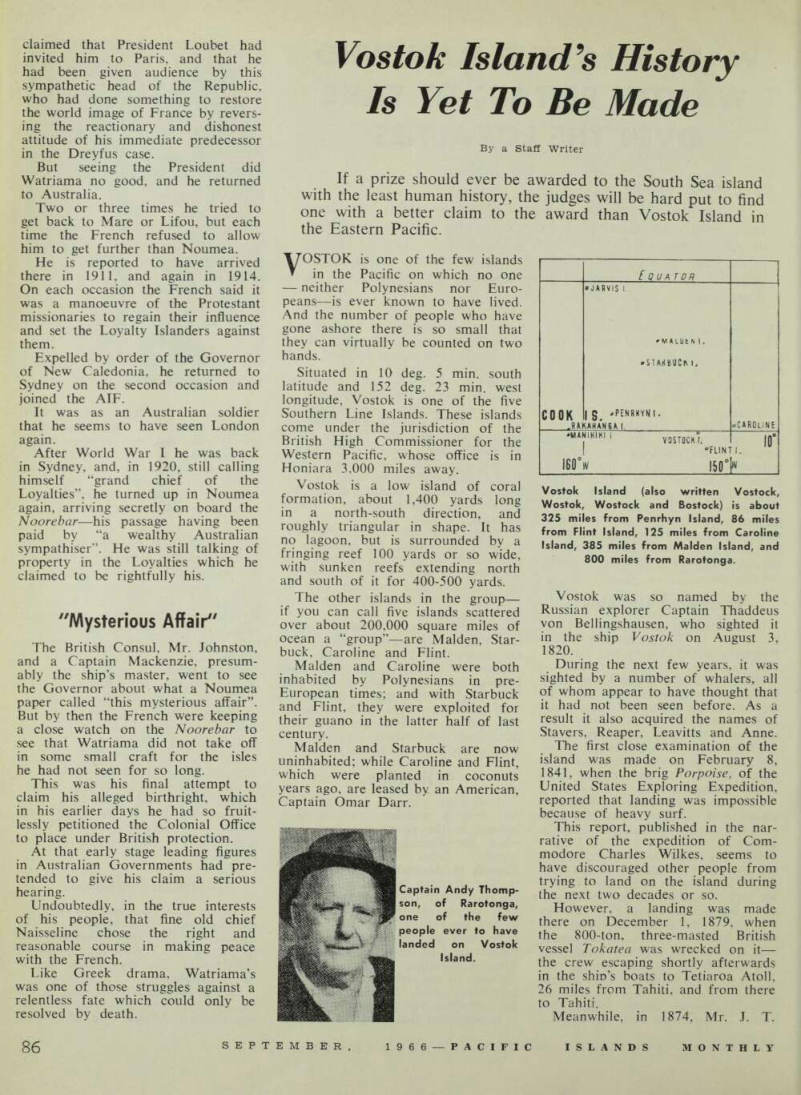
Vostok Island (also written Vostock, Wostok, Wostock and Bostock) is about 325 miles from Penrhyn Island, 86 miles from Flint Island, 125 miles from Caroline Island, 385 miles from Malden Island, and 800 miles from Rarotonga.
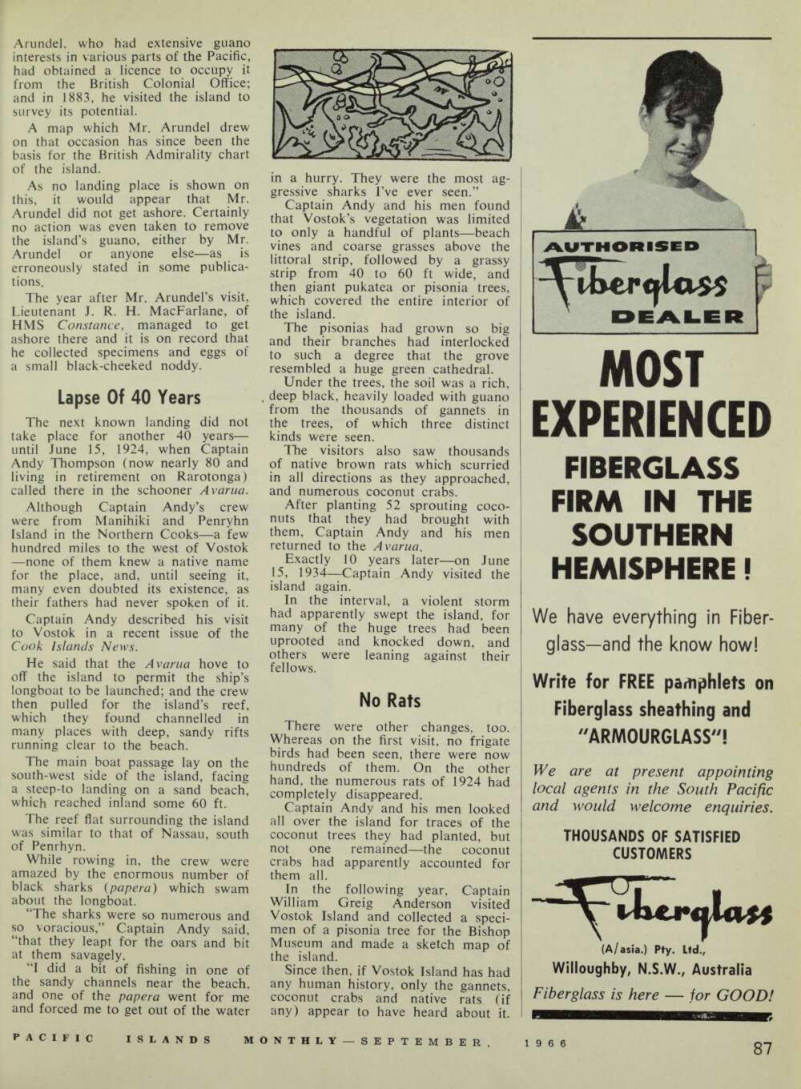
Captain Andy Thomp son, of Rarotonga, one of the few people ever to have landed on Vostok Island.
Arundel, who had extensive guano interests in various parts of the Pacific, had obtained a licence to occupy it from the British Colonial Office; and in 1883, he visited the island to survey its potential.
A map which Mr. Arundel drew on that occasion has since been the basis for the British Admirality chart of the island.
As no landing place is shown on this, it would appear that Mr.
Arundel did not get ashore. Certainly no action was even taken to remove the island’s guano, either by Mr.
Arundel or anyone else—as is erroneously stated in some publica tions.
The year after Mr. Arundel’s visit.
Lieutenant J. R. H. MacFarlane, of HMS Constance, managed to get ashore there and it is on record that he collected specimens and eggs of a small black-cheeked noddy.
Lapse Of 40 Years
The next known landing did not take place for another 40 years— until June 15, 1924, when Captain Andy Thompson (now nearly 80 and living in retirement on Rarotonga) called there in the schooner Avarua.
Although Captain Andy’s crew were from Manihiki and Penryhn Island in the Northern Cooks —a few hundred miles to the west of Vostok —none of them knew a native name for the place, and, until seeing it, many even doubted its existence, as their fathers had never spoken of it.
Captain Andy described his visit to Vostok in a recent issue of the Cook Islands News.
He said that the Avarua hove to off the island to permit the ship’s longboat to be launched; and the crew then pulled for the island’s reef, which they found channelled in many places with deep, sandy rifts running clear to the beach.
The main boat passage lay on the south-west side of the island, facing a steep-to landing on a sand beach, which reached inland some 60 ft.
The reef flat surrounding the island was similar to that of Nassau, south of Penrhyn.
While rowing in, the crew were amazed by the enormous number of black sharks ( papera ) which swam about the longboat.
“The sharks were so numerous and so voracious,” Captain Andy said, “that they leapt for the oars and bit at them savagely.
“I did a bit of fishing in one of the sandy channels near the beach, and one of the papera went for me and forced me to get out of the water
in a hurry. They were the most ag gressive sharks I’ve ever seen.”
Captain Andy and his men found that Vostok’s vegetation was limited to only a handful of plants—beach vines and coarse grasses above the littoral strip, followed by a grassy strip from 40 to 60 ft wide, and then giant pukatea or pisonia trees, which covered the entire interior of the island.
The pisonias had grown so big and their branches had interlocked to such a degree that the grove resembled a huge green cathedral.
Under the trees, the soil was a rich, deep black, heavily loaded with guano from the thousands of gannets in the trees, of which three distinct kinds were seen.
The visitors also saw thousands of native brown rats which scurried in all directions as they approached, and numerous coconut crabs.
After planting 52 sprouting coco nuts that they had brought with them, Captain Andy and his men returned to the Avarua.
Exactly 10 years later—on June 15, 1934—Captain Andy visited the island again.
In the interval, a violent storm had apparently swept the island, for many of the huge trees had been uprooted and knocked down, and others were leaning against their fellows.
No Rats
There were other changes, too.
Whereas on the first visit, no frigate birds had been seen, there were now hundreds of them. On the other hand, the numerous rats of 1924 had completely disappeared.
Captain Andy and his men looked all over the island for traces of the coconut trees they had planted, but not one remained—the coconut crabs had apparently accounted for them all.
In the following year, Captain William Greig Anderson visited Vostok Island and collected a speci men of a pisonia tree for the Bishop Museum and made a sketch map of the island.
Since then, if Vostok Island has had any human history, only the gannets, coconut crabs and native rats (if any) appear to have heard about it.