Watriama, The Man Who
pp. 87-88 · Read in the full issue
Wanted Britain To Take
Over The Loyalties
By Lew Friday
The Loyalty Islands of New Caledonia, which have long been under the control of France, might now be a colony or protectorate of Great Britain if the British Colonial Office, in the latter part of last century, had taken serious notice of the petitions and pretensions of a tireless Loyalty Islander, W. J.
Watriama.
WATRIAMA claimed to be the paramount chief of the Loyalties. But although he pressed his claims in France, Britain and Australia, he could get no govern ment to recognise them.
Watriama had grown up with a fierce dislike of French administra tion. This was in the days when several of his relatives and Islands followers were exiled to the Isle of Pines, Indo-China or Tahiti for supporting the English Protestant missionaries (who had established themselves in the Loyalties a couple of years before France annexed New Caledonia) in their bitter protests against French “outrages” and “aggression”.
Frustrated, Unhappy
In declarations seeking support for his claim to be paramount chief, Watriama stated that he was born at Ete, on Mare.
His father, Eaupo, and his mother, Wakanude, who were both dead at the time of his claim, had come from Auuarawedre on Lifou. They had received hospitality at Mare from chief Jeuvene, grandfather of grand chief Naisseline, whose line has con tinued to this day as suzerain chief of that enchanting isle.
Like most “pretenders”, Watriama seems to have been a frustrated and unhappy man, although entirely sincere.
He had been well educated by the English missionaries, notably by the leading one on Mare, the sterling Mr. Jones, whom the present grand chief Naisseline extolled to me in wartime days, when I visited his chiefly house at Netche, as an honest and upright man who had taught the Mareans many a useful trade.
The French, however, after a vain attempt to convert the Protestants to Catholicism—an attempt which re sulted in confusion and bloodshed—
sent along a shipload of soldiers and brought Mr. Jones to Noumea, where the local newspapers labelled him “an English Tartuffe”.
Later Mr, Jones went to Australia, where he received much sympathy.
I gave an account of this happen ing in my book Cannibal Island, pointing out that the English were replaced by French Protestant missionaries, and that schools con ducted in the English and Marean languages were closed down by decree and replaced by French language schools.
At the same time I gave the view accepted today, that the replacement of English by French influence in the Loyalties was needed to stabilise the situation and put an end to fratricidal disputes which were caus ing bloodshed.
The change was political rather than religious, as most Loyaltians did not desert their Protestant faith.
The year of the change was 1884.
It was not long afterwards that Watriama, in his teens, quarrelled with his father, because, he said, he had allowed the French to establish their dominion over the islands “at a time when I was 11 years old”.
Hostility
A Sydney church, of which he was long a member, took a keen interest in the young islander. And when the French met with much hostility from the Presbyterian Church in Australia in their efforts to take over the New Hebrides, they always insisted that the Presbyterians were keeping Watriama’s claim alive to stir up political trouble.
As long as she lived, Watriama’s mother used to send him money, and when his father, whom he always claimed to be rightful “king of the Loyalties”, died, he is reported to have become comparatively rich.
It was then that he tried to enter
into official negotiations with the British and the French to have his title recognised.
He reiterated that Naisseline was his brother, but said he was acting as regent in the interests of France.
Watriama claimed that he, himself, had large property rights in the group; and, that he feared the Japanese would be allowed entry to the detriment of the natives.
Settling in Paddington, a suburb of Sydney, Watriama is known to have worked for a time as a gardener and then as a coachman.
But the strangest part of his odyssey began when he decided to go to London to press his claims.
There, finding that the Boer War was on, he joined the Army and fought as a corporal in South Africa under Lord Methuen, who was his colonel.
French Invitation
All the time he was protesting—to the Australia Prime Minister, to the President of the French Republic, and to the British Foreign and Colonial Offices—that he was being denied his birthright.
In London he put his case before Sir Edward Grey, who was Minister for Foreign Affairs. He afterwards
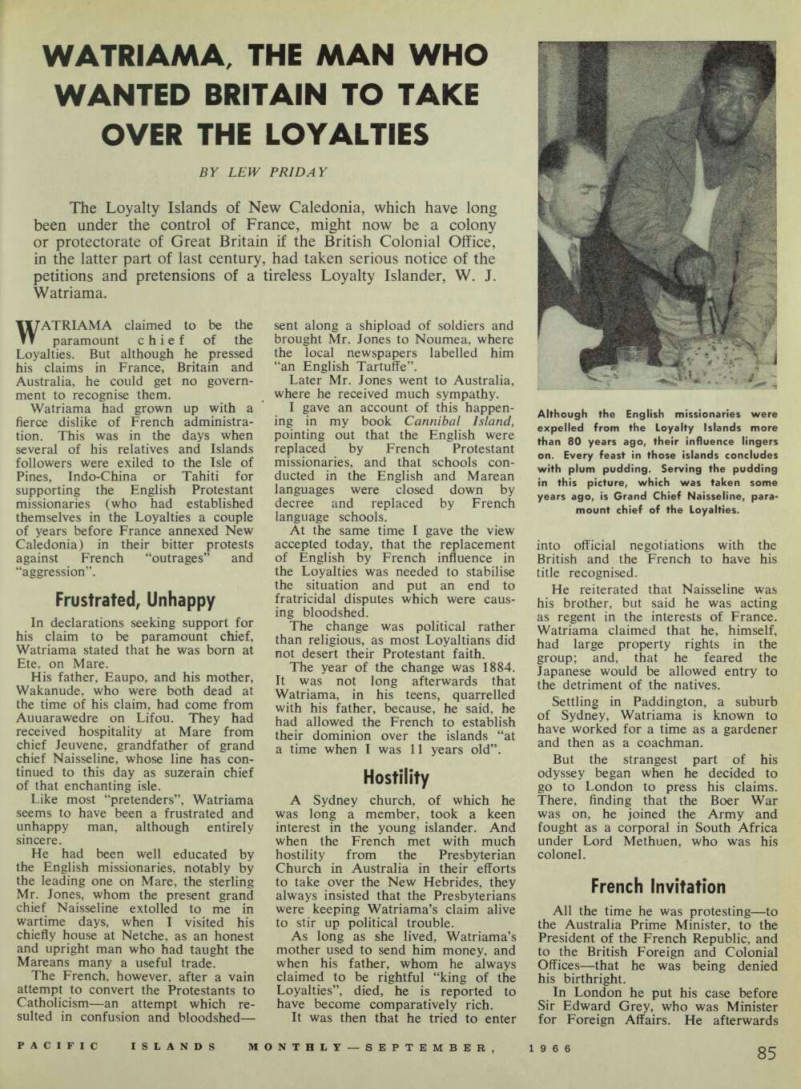
Although the English missionaries were expelled from the Loyalty Islands more than 80 years ago, their influence lingers on. Every feast in those islands concludes with plum pudding. Serving the pudding in this picture, which was taken some years ago, is Grand Chief Naisseline, para mount chief of the Loyalties.
claimed that President Loubet had invited him to Paris, and that he had been given audience by this sympathetic head of the Republic, who had done something to restore the world image of France by revers ing the reactionary and dishonest attitude of his immediate predecessor in the Dreyfus case.
But seeing the President did Watriama no good, and he returned to Australia.
Two or three times he tried to get back to Mare or Lifou, but each time the French refused to allow him to get further than Noumea.
He is reported to have arrived there in 1911, and again in 1914.
On each occasion the French said it was a manoeuvre of the Protestant missionaries to regain their influence and set the Loyalty Islanders against them.
Expelled by order of the Governor of New Caledonia, he returned to Sydney on the second occasion and joined the AIF, It was as an Australian soldier that he seems to have seen London again.
After World War I he was back in Sydney, and, in 1920, still calling himself “grand chief of the Loyalties”, he turned up in Noumea again, arriving secretly on board the Noorebar —his passage having been paid by “a wealthy Australian sympathiser”. He was still talking of property in the Loyalties which he claimed to be rightfully his.
"Mysterious Affair"
The British Consul, Mr. Johnston, and a Captain Mackenzie, presum ably the ship’s master, went to see the Governor about what a Noumea paper called “this mysterious affair”.
But by then the French were keeping a close watch on the Noorebar to see that Watriama did not take off in some small craft for the isles he had not seen for so long.
This was his final attempt to claim his alleged birthright, which in his earlier days he had so fruit lessly petitioned the Colonial Office to place under British protection.
At that early stage leading figures in Australian Governments had pre tended to give his claim a serious hearing.
Undoubtedly, in the true interests of his people, that fine old chief Naisseline chose the right and reasonable course in making peace with the French.
Like Greek drama, Watriama’s was one of those struggles against a relentless fate which could only be resolved by death.