South Seas
pp. 83-86 · Read in the full issue
An Expert Looks At Pacific Flag Lore, or . . .
Vexillology In The South Seas
By John J. Hurley.
Just as the “winds of change” swept over Asia during the post-war era and then hit Africa with a chaotic fury, they are undoubtedly blowing in the direction of the South Seas. Hence we can expect that this area of the world will experience more self-government within the next 20 years.
ONE of the major symbols of independence is a national flag.
This sometimes tells the story of a people’s struggle for the attainment of their national destiny, or it might reflect the customs, culture and history of a state. Thus it flies supreme over any other representa tion of the nation.
The only two South Pacific terri tories that are already independent— Tonga and Western Samoa—have, of course, flags of their own. But this is also true of the islands terri tories of the United States, although the Stars and Stripes is usually seen alongside them. In the British Commonwealth territories, the Union Jack or the flags of Australia and New Zealand are the official emblems, but in some cases the terri
lories have badges or coats of arms of their own, or even unofficial flags.
The French territories fly only the famous Tricolor.
Dating from 1866, the flag of the
Kingdom of Tonga is probably the oldest South Seas flag in continuous use.
The country’s strong Christian influence is evidenced by a red cross superimposed on a white background while the other three-quarters consist of a red field.
In an article on Pacific Islands flags, the Flag Bulletin for winter 1963-64 quoted its designer, King George Tupou I, as saying; “It is my wish that our flag should have the cross of Jesus, for we are saved because of the sacrifice made by Jesus on the Cross of Calvary. Every Tongan should remember the Cross and the flag should be red in colour to repre sent the blood shed on the Cross of our salvation”.
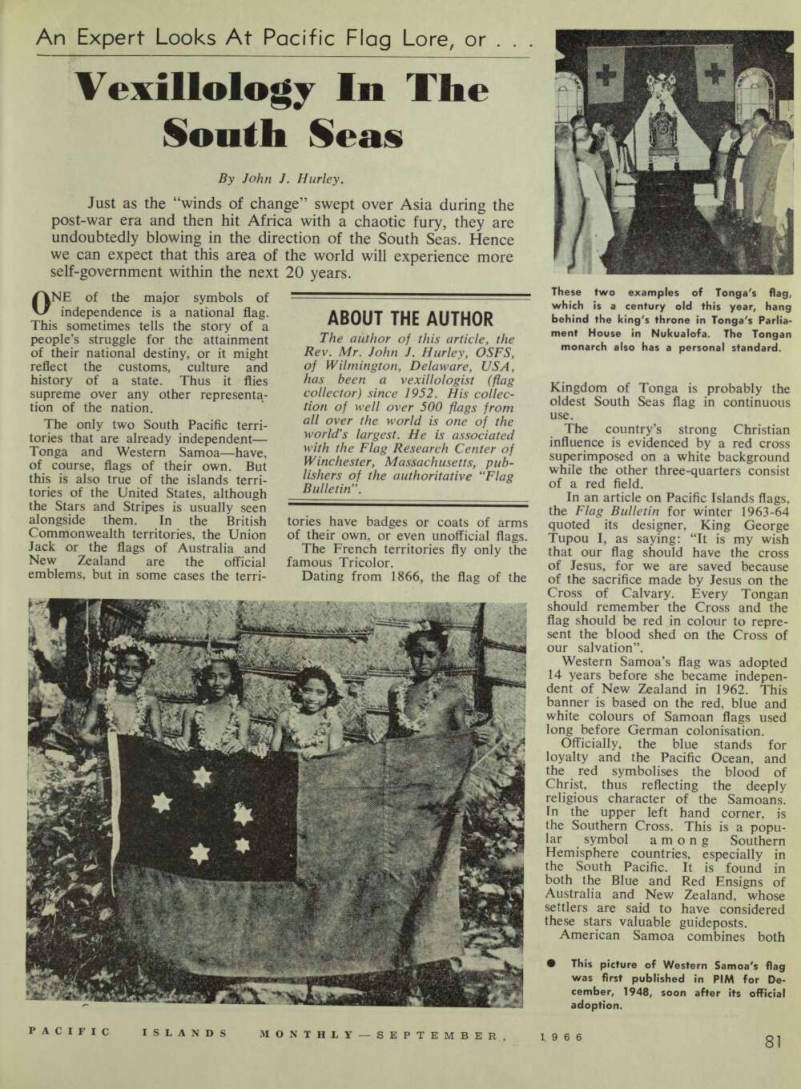
Western Samoa’s flag was adopted 14 years before she became indepen dent of New Zealand in 1962. This banner is based on the red, blue and white colours of Samoan flags used long before German colonisation.
Officially, the blue stands for loyalty and the Pacific Ocean, and the red symbolises the blood of Christ, thus reflecting the deeply religious character of the Samoans.
In the upper left hand corner, is the Southern Cross. This is a popu lar symbol among Southern Hemisphere countries, especially in the South Pacific. It is found in both the Blue and Red Ensigns of Australia and New Zealand, whose settlers are said to have considered these stars valuable guideposts.
American Samoa combines both
These two examples of Tonga's flag, which is a century old this year, hang behind the king's throne in Tonga's Parlia ment House in Nukualofa. The Tongan monarch also has a personal standard.
This picture of Western Samoa's flag was first published in PIM for De cember, 1948, soon after its official adoption.
the traditional American and Samoan colours in its territorial flag which was adopted in April, 1960, when a constitution for the territory was approved.
This flag consists of a blue field bearing a large white triangle, bordered in red and containing a white-headed eagle. This American national bird grasps in its claws a yellow uatogi and fue. A uatogi is a war club representing the state’s power, while the fue signifies wisdom and the traditional Samoan council.
The United States Trust Territory of the Pacific Islands (Micronesia) has officially had a flag of its own since August 19 last year.
The flag was designed by a Micro
The newest flag in the Pacific is that of the United States Trust Territory of the Pacific Islands (above). Below, with the Stars and Stripes, is the flag of American Samoa. This was first raised by Mr. Fred A. Seaton, US Secretary of the Interior, and Governor Peter Coleman of American Samoa at the opening ceremonies of the Flag Day celebration in Pago Pago on April 27, 1960. The occasion honoured the 60th anniversary of the first raising of the United States flag in American Samoa in 1900 and was also the date of the promulgation of the first Constitution of American Samoa.
nesian, Gonzalo Santos, in a com petition sponsored by the US Administration to help instil a spirit of nationalism into the population.
The flag has six white stars in a circle on a medium blue field.
The six stars represent the six political divisions of the Trust Terri tory Marshall Islands, Mariana Islands, Ponape, Yap, Truk and Palau—and white symbolises peace.
Interestingly, there is a re semblance between the general layout of this banner and that of the United Nations.
The neighbouring US territory of Guam uses the Governor’s standard as the territorial flag. Basically a dark blue field bordered in red, it displays the island’s seal—a vertical elliptical figure, edged in red and showing an outrigger canoe which approaches a coconut tree growing beside an estuary.
As mentioned above, Great Britain’s Union flag is the official emblem of her colonies. Yet each dependency is permitted to use its own distinctive shield or badge in the fly of a British ensign (a blue or red flag containing the Union design in the upper left hand corner).
Fiji Badge
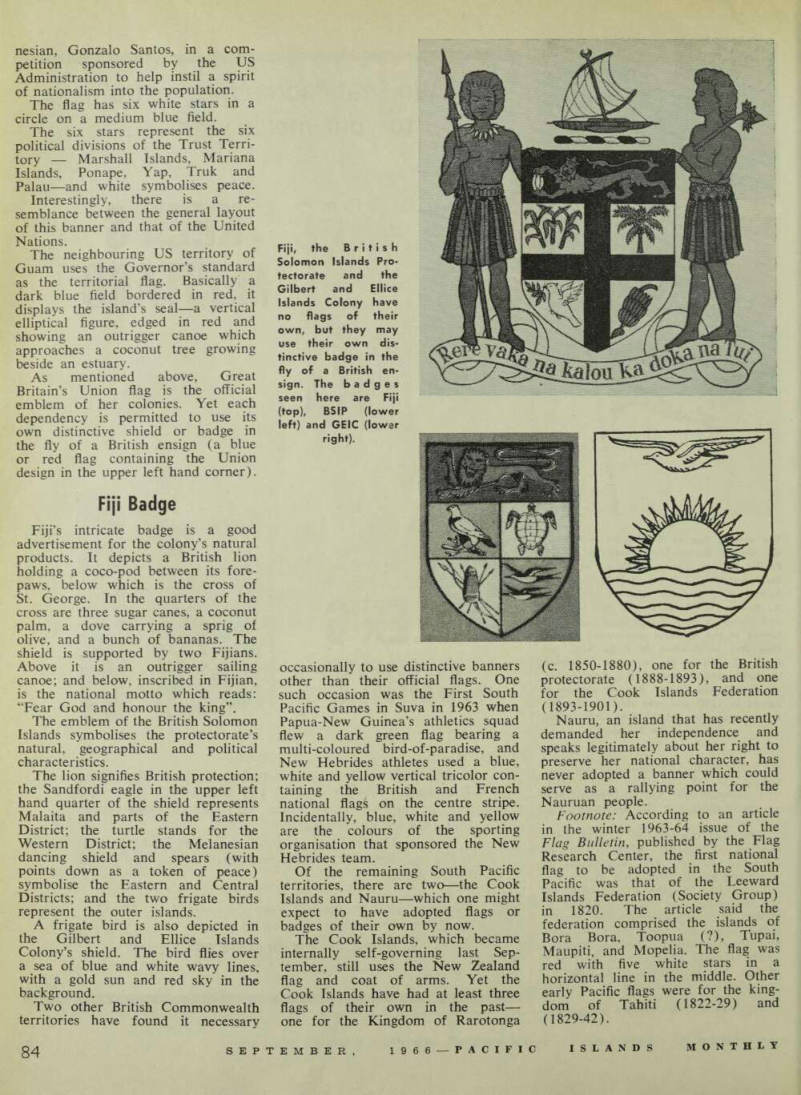
Fiji’s intricate badge is a good advertisement for the colony’s natural products. It depicts a British lion holding a coco-pod between its fore paws, below which is the cross of St. George. In the quarters of the cross are three sugar canes, a coconut palm, a dove carrying a sprig of olive, and a bunch of bananas. The shield is supported by two Fijians.
Above it is an outrigger sailing canoe; and below, inscribed in Fijian, is the national motto which reads: “Fear God and honour the king”.
The emblem of the British Solomon Islands symbolises the protectorate’s natural, geographical and political characteristics.
The lion signifies British protection; the Sandfordi eagle in the upper left hand quarter of the shield represents Malaita and parts of the Eastern District; the turtle stands for the Western District; the Melanesian dancing shield and spears (with points down as a token of peace) symbolise the Eastern and Central Districts; and the two frigate birds represent the outer islands.
A frigate bird is also depicted in the Gilbert and Ellice Islands Colony’s shield. The bird flies over a sea of blue and white wavy lines, with a gold sun and red sky in the background.
Two other British Commonwealth territories have found it necessary
occasionally to use distinctive banners other than their official flags. One such occasion was the First South Pacific Games in Suva in 1963 when Papua-New Guinea’s athletics squad flew a dark green flag bearing a multi-coloured bird-of-paradise, and New Hebrides athletes used a blue, white and yellow vertical tricolor con taining the British and French national flags on the centre stripe.
Incidentally, blue, white and yellow are the colours of the sporting organisation that sponsored the New Hebrides team.
Of the remaining South Pacific territories, there are two—the Cook Islands and Nauru—which one might expect to have adopted flags or badges of their own by now.
The Cook Islands, which became internally self-governing last Sep tember, still uses the New Zealand flag and coat of arms. Yet the Cook Islands have had at least three flags of their own in the past— one for the Kingdom of Rarotonga
(c. 1850-1880), one for the British protectorate (1888-1893), and one for the Cook Islands Federation (1893-1901).
Nauru, an island that has recently demanded her independence and speaks legitimately about her right to preserve her national character, has never adopted a banner which could serve as a rallying point for the Nauruan people.
Footnote: According to an article in the winter 1963-64 issue of the Flag Bulletin , published by the Flag Research Center, the first national flag to be adopted in the South Pacific was that of the Leeward Islands Federation (Society Group) in 1820. The article said the federation comprised the islands of Bora Bora, Toopua (?), Tupai, Maupiti, and Mopelia. The flag was red with five white stars in a horizontal line in the middle. Other early Pacific flags were for the king dom of Tahiti (1822-29) and (1829-42).
Fiji, the British Solomon Islands Pro tectorate and the Gilbert and Ellice Islands Colony have no flags of their own, but they may use their own dis tinctive badge in the fly of a British en sign. The badges seen here are Fiji (top), BSIP (lower left) and GEIC (lower right).