Fiji's Biggest Election
pp. 15-16 · Read in the full issue
79 At The Barriers For Fiji's Biggest Election
From a Suva Correspondent
The hustings are on in Fiji. With loins girded, and some of them probably with staff in hand, 79 candidates are preparing to descend on the colony’s electorate, and with honeyed tongues and the usual promises, to persuade the electors to put their tick opposite their names on the ballot paper.
BY the time these notes are read the patterns of the campaign in Fiji’s biggest-ever elections will have been clearly defined, and, no doubt, the majority of the electors will have decided whom to champion. This will have happened long before the voting stations are opened on Sep tember 26. There are 36 seats avail able—34 to be filled in the general
election and two by nominations by the Fijian Council of Chiefs.
The candidates have a six-weeks’ campaign in which to get their messages across. Some people think this is too long and that the new Legislative Council will be born too late to give sufficient thought to the Budget at the end of November.
Nevertheless, the elections are dead ahead, and most of Fiji’s population of half a million are concentrating on first things first.
It is probably over-simplifying it to say the political issue is clear-cut, but to the Fiji man-in-the-street the thing is a straight fight between the Alliance (that conglomeration of newly-formed political parties of Fijians, Europeans and moderate Indians), and the Federation Party of Mr. A. D. Patel (which began life in the canefields as an organisa tion of cane farmers during the 1960 troubles).
Improvisation, Muddle
During the two hours on Nomina tion Day, August 12, 84 candidates handed in their nominations. In Suva, particularly, there was a bit of a scramble by officials to get the nomination papers processed in time, with some hasty improvisation and a deal of muddle. It had been forgotten that there were twice as many seats to fill as in the previous election.
One would-be candidate, Mr. J. A.
Campbell, a fitter and turner at the Rarawai sugar mill, didn’t get past the starting gate. He was disqualified on a ruling by Attorney-General Justin Lewis that his nomination came in too late.
He had intended to stand as an independent in West Viti Levu and make a three-cornered fight of it, for two General seats, with Alliance candidates Mr. Ron Kermode (a member of the old council), and Mr. R. H. Yarrow, safety and welfare officer at Vatukoula.
His disqualification meant a walk over for Messrs. Kermode and Yarrow, two candidates with the General Electors’ Association’s tickets.
Drama stalked on to the election stage only a few hours after nomina tions closed.
Mr. Abdul Lateef, Suva lawyer and an Alliance candidate for the cross voters’ seat in the Central Consti tuency, collapsed at his home with a stroke, which left him unconscious and partially paralysed.
He is recovering and his nomina tion was not withdrawn, but it is too early to say whether he will adhere to his intention to fight for the seat, for which there are six contenders.
Four candidates got their seats without a fight.
Ratu Edward Cakobau was un opposed in the Central Fijian cross voting seat, and Dr. Lindsay Verrier, retired medico and popular among the Fijians, was unopposed for the Northern and Eastern General seat.
In two Fijian communal con stituencies, Solomoni Momoivalu
Among the 79 candidates at the election are two European women, Mrs. Margaret Bain (top), and Mrs. L. Livingstone, both of the Alliance.
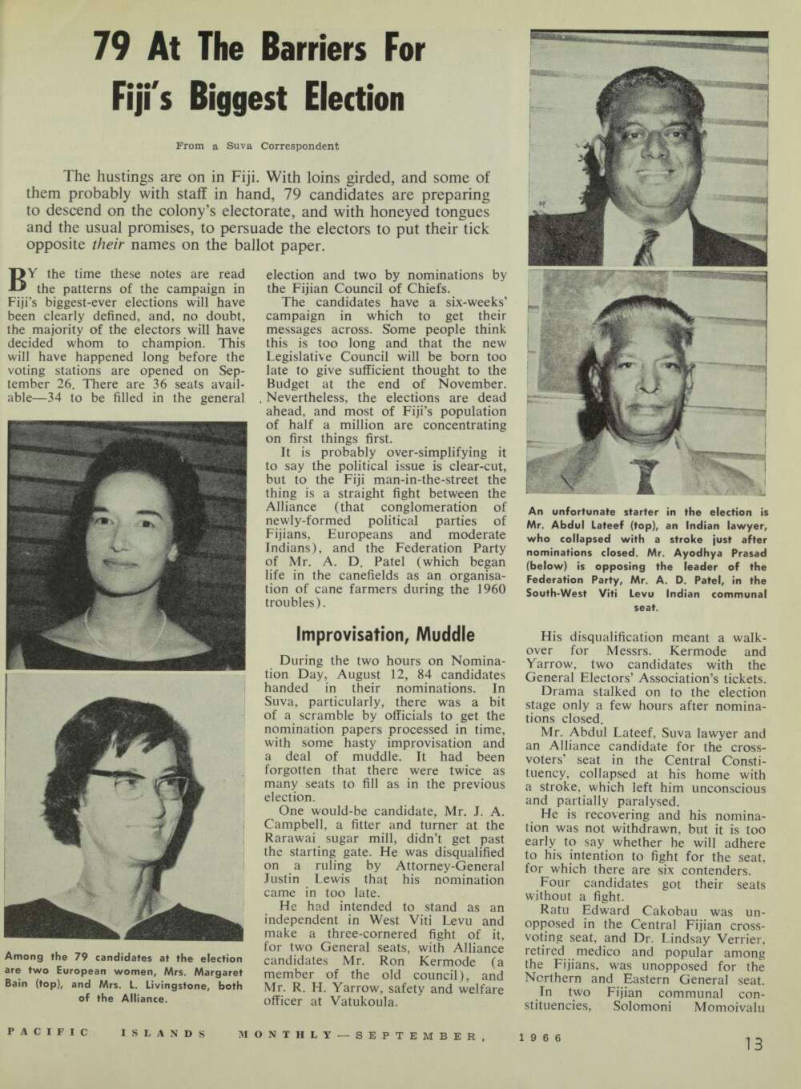
An unfortunate starter in the election is Mr. Abdul Lateef (top), an Indian lawyer, who collapsed with a stroke just after nominations closed. Mr. Ayodhya Prasad (below) is opposing the leader of the Federation Party, Mr. A. D. Patel, in the South-West Viti Levu Indian communal seat.
(Lom,aiviti-Kadavu) and Jonati Mavoa (Lau-Rotuma) have also saved the taxpayers’ money by get ting themselves elected without op position.
All four unopposed candidates sup ported the Alliance which, there fore, enters the list with a plus-4 handicap.
The Federation had to scrape the barrel hard to find someone to fight the non-Indian seats. One of their propaganda organs boasted after nomination day that their party was truly representative, because it had candidates for each of the Indian seats, communal and cross voting, and for a General cross voting seat and a Fijian cross-voting seat.
They neglected, however, to com pare the position of the Alliance which has Indians, Fijians and “General” candidates.
Their General candidate, Mr. Billy Wilson, a part-European who is described as a retired fitter and turner, and who used to do a certain odd job at Suva Gaol some days at 8 a.m., let them down. He failed to turn up with his £5O deposit.
Their other non-Indian candidate is Penaia Rokovuni, a Ba farmer, who has been connected with the Federation Party for some time. He is contesting the Fijian Western cross voting seat, against Ratu Josua Toganivalu, of Lautoka, and cane farmer Isikeli Nadalo, secretary of the Nadroga Fijian Cane Farmers’
Association.
Two-Way Fight
The leader of the Federation Party, Mr. A. D. Patel, has a straight fight with one of his bitterest op ponents for the South-West Viti Levu Indian communal seat. He opposes Mr. Ayodhya Prasad, Lautoka farmer and president of the Kisan Sangh, the biggest of the cane farmers’ unions.
Mr. Prasad, one of the founders of the Alliance, announced his candidature a couple of days before the Federation Party chose its candidates. He challenged Mr. Patel to fight him. Mr. Patel accepted.
The Patel-Prasad fight will pro bably be the most news-worthy of the 32 fights, but if anybody makes a book on the elections he will probably offer 2 to 1 on Mr. Patel.
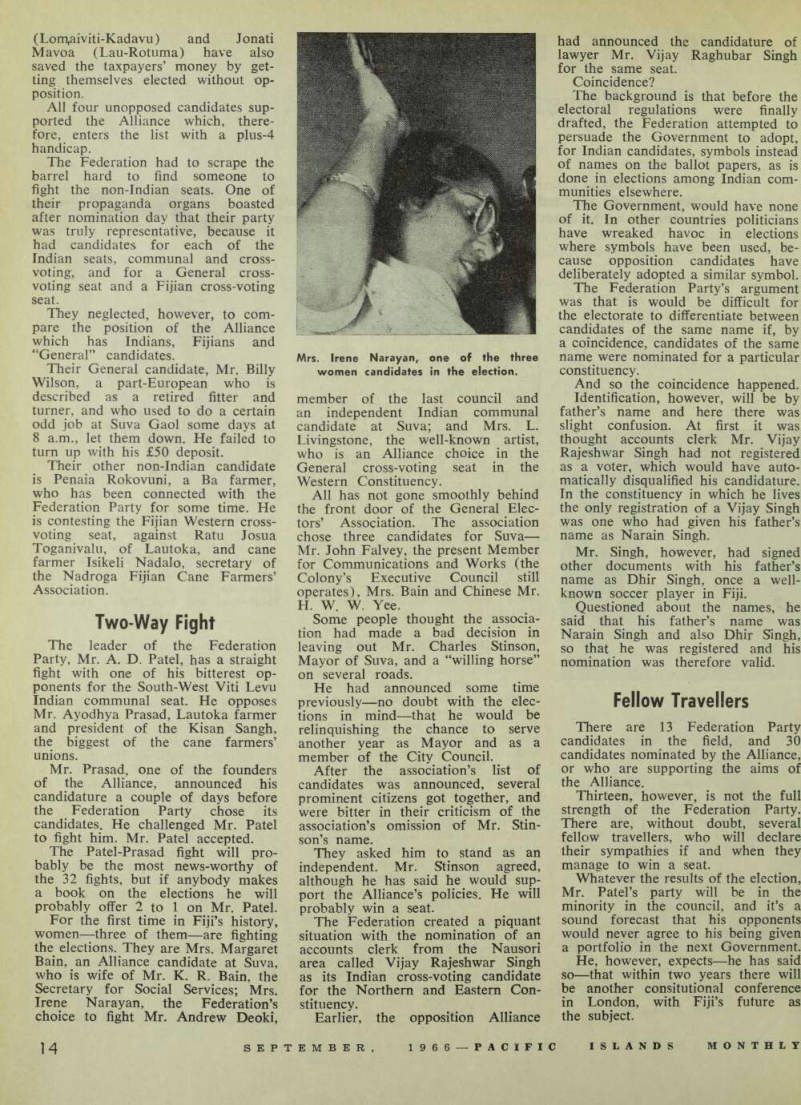
For the first time in Fiji’s history, women—three of them—are fighting the elections. They are Mrs. Margaret Bain, an Alliance candidate at Suva, who is wife of Mr, K. R. Bain, the Secretary for Social Services; Mrs.
Irene Narayan, the Federation’s choice to fight Mr. Andrew Deoki,
member of the last council and an independent Indian communal candidate at Suva; and Mrs. L.
Livingstone, the well-known artist, who is an Alliance choice in the General cross-voting seat in the Western Constituency.
All has not gone smoothly behind the front door of the General Elec tors’ Association. The association chose three candidates for Suva— Mr. John Falvey, the present Member for Communications and Works (the Colony’s Executive Council still operates), Mrs. Bain and Chinese Mr.
H. W. W. Yee.
Some people thought the associa tion had made a bad decision in leaving out Mr. Charles Stinson, Mayor of Suva, and a “willing horse” on several roads.
He had announced some time previously—no doubt with the elec tions in mind—that he would be relinquishing the chance to serve another year as Mayor and as a member of the City Council.
After the association’s list of candidates was announced, several prominent citizens got together, and were bitter in their criticism of the association’s omission of Mr. Stin son’s name.
They asked him to stand as an independent. Mr. Stinson agreed, although he has said he would sup port the Alliance’s policies. He will probably win a seat.
The Federation created a piquant situation with the nomination of an accounts clerk from the Nausori area called Vijay Rajeshwar Singh as its Indian cross-voting candidate for the Northern and Eastern Con stituency.
Earlier, the opposition Alliance
had announced the candidature of lawyer Mr. Vijay Raghubar Singh for the same seat.
Coincidence?
The background is that before the electoral regulations were finally drafted, the Federation attempted to persuade the Government to adopt, for Indian candidates, symbols instead of names on the ballot papers, as is done in elections among Indian com munities elsewhere.
The Government, would have none of it. In other countries politicians have wreaked havoc in elections where symbols have been used, be cause opposition candidates have deliberately adopted a similar symbol.
The Federation Party’s argument was that is would be difficult for the electorate to differentiate between candidates of the same name if, by a coincidence, candidates of the same name were nominated for a particular constituency.
And so the coincidence happened.
Identification, however, will be by father’s name and here there was slight confusion. At first it was thought accounts clerk Mr. Vijay Rajeshwar Singh had not registered as a voter, which would have auto matically disqualified his candidature.
In the constituency in which he lives the only registration of a Vijay Singh was one who had given his father’s name as Narain Singh.
Mr. Singh, however, had signed other documents with his father’s name as Dhir Singh, once a well known soccer player in Fiji.
Questioned about the names, he said that his father’s name was Narain Singh and also Dhir Singh, so that he was registered and his nomination was therefore valid.
Fellow Travellers
There are 13 Federation Party candidates in the field, and 30 candidates nominated by the Alliance, or who are supporting the aims of the Alliance.
Thirteen, however, is not the full strength of the Federation Party.
There are, without doubt, several fellow travellers, who will declare their sympathies if and when they manage to win a seat.
Whatever the results of the election, Mr, Patel’s party will be in the minority in the council, and it’s a sound forecast that his opponents would never agree to his being given a portfolio in the next Government.
He, however, expects—he has said so—that within two years there will be another consitutional conference in London, with Fiji’s future as the subject.
Mrs. Irene Narayan, one of the three women candidates in the election.