Indonesian Plan Fails: West
pp. 17-19 · Read in the full issue
New Guinea In Sorry Plight
From a Canberra Correspondent
LUCK, who is based in Port Moresby, said in a report broad cast over the ABC throughout Aus tralia, that West New Guinea was in economic difficulties, that its ex port and import figures had never been so low for many years, that the current budget had been pruned, and that there were shortages of food and clothing.
There was considerable evidence to indicate that shipments of food and clothing, destined for West New Guinea, were being trans-shipped to other parts of Indonesia, and that most of them never got past the wharf.
During the visit to WNG of the Indonesian Foreign Minister, Mr.
Adam Malik, in August, troops and police with loaded rifles and auto matic weapons were posted at all vantage points.
This was something that had never been seen before—even for the visit of President Soekarno in 1963.
Visit Curtailed
The ABC report said that Mr.
Malik’s tour had been cut from eight to five days—his proposed visits to Wamena in the Central Highlands and Waris on the border (to see the joint border survey) being cancelled.
Pressure of business in Djakarta was given as the reason for the can cellations, the report said.
It added that Mr. Malik was guest of honour at official ceremonies at Sukarnapura’s Mandala Oval on August 17 to celebrate the 21st an niversary of the proclamation of the Indonesian Republic, and he later laid a wreath at the Heroes’ Cemetery on the Sentani Road, where men who fell in the fight to liberate West New Guinea from the Dutch are buried.
He then flew by Fokker Friendship to Merauke, and returned to Djakarta on August 19, without returning to Sukarnapura.
Observers in Canberra on Indo nesian affairs said the ABC story
Indonesia’s ambitious, three-year development plan for West New Guinea has failed, according to Geoffrey Luck, director of ABC news services in Papua-New Guinea, who visited the Indonesian territory in August.
highlighted a deteriorating situation in West New Guinea, few details of which were known in Australia, and which the Indonesians were not willing to have examined too closely.
It was known, for example, that West New Guinea had become an economic derelict since the Indo nesian withdrawal from the UN in January, 1965.
The chief result, for the area, of this decision, was to cut off access to the US$3O million in aid which would have flowed into West New Guinea through the special UN Fund for West Irian. (FUNDWI). This cash was put up as a parting gesture by the Dutch, $lO million a year for three years.
The UN imposed the condition that it must be met by a similar Indonesian grant, as counterpart finance, and Indonesia undertook to invest 91 million Rp. (about US$25 million) to match it.
It is known that not one cent of the Dutch money has been made available, and the brash bravado of Dr. Subandrio—that Indonesia would “go it alone” in West New Guinea— rings pretty hollow today. Not one of the 27 projects designed to provide a springboard for ordered develop ment has started. Schemes ranging from the provision of a basic tele communications network and air liners, ships, construction machinery, wharves, sawmills, coconut oil fac tories, TB and malaria eradication to printeries, abattoirs, and mobile health units are still in the planning books.
No Projects Started
However, if Indonesia returns to the fold of the UN, as Mr. Malik has promised, international funds could provide the much-needed es sentials for progress. This would be the only hope for development of the area.
It is known that Indonesia main tains more than 10,000 troops in West New Guinea, from all armed services—about the same as the maximum figure reached by the Netherlands at the height of their defence of the area.
There is no doubt that their role is principally one of maintaining internal security, and that the risk of subversion, antagonism and even revolt rises continually as a direct result of economic conditions.
Canberra observers say that every recent traveller through the area has commented on the empty shops of the towns. There are neither food stuffs nor stocks of clothing, and
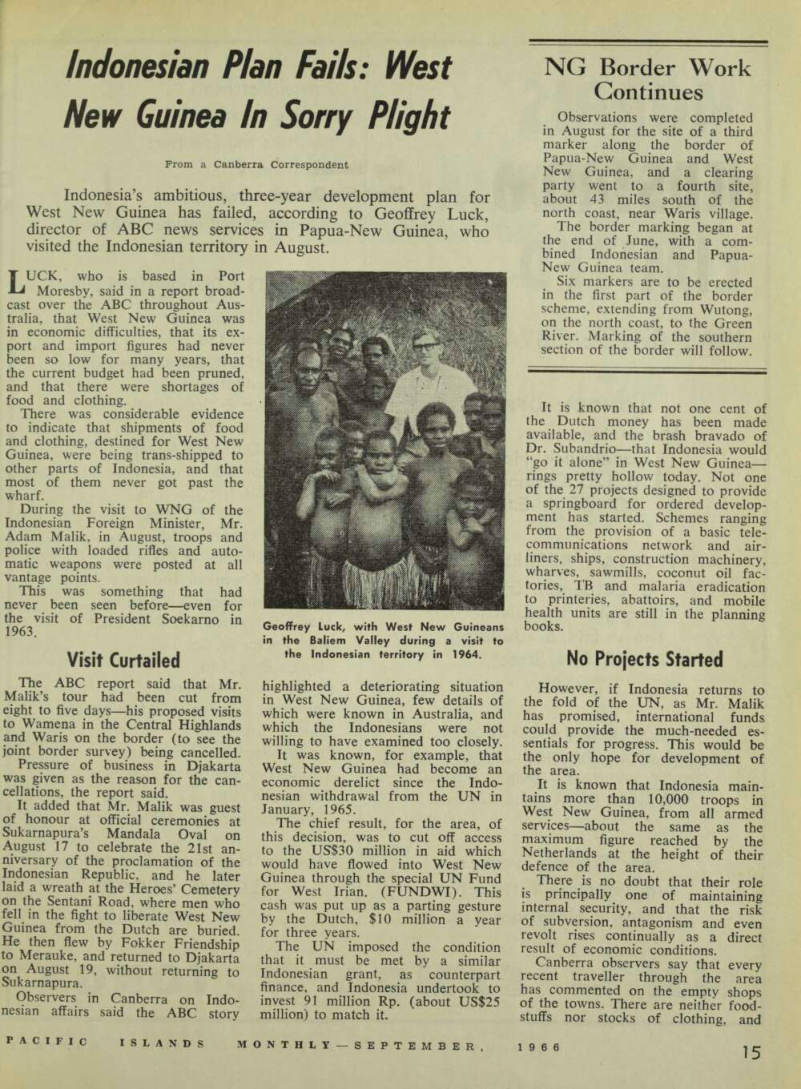
Geoffrey Luck, with West New Guineans in the Baliem Valley during a visit to the Indonesian territory in 1964.
apparently only rations of rice stave off hunger for town workers. The Indonesian promise to make West New Guinea independent of imported food supplies within three years has almost been made to come true!
Some attempt to grapple with development has been made. Japan ese. Dutch and Filipino businessmen have been invited to prospect the forestry and mineral potential for possible development, either on the basis of payment, or profit-sharing.
The job of improving agricultural techniques, never easy with sub sistence farmers, is being tackled through importation of Javanese migrant farmers, but the peasant transmigration programme is slow, and the task of cultivating around Merauke or along the Sepik border is discouraging.
Development Proposals
There is talk of more oil prospect ing in the “Birds’ Head”, where the small Sorong wells are slowly peter ing out, and of adventuresome hunting for diamonds and crocodile skins along jungle-fringed rivers.
Some road-building is projected, but these are local feeder roads on Biak and Semi, and along the coast from Manokwari, rather than any ambitious trunk routes opening areas of economic potential.
Thus the inland remains, as ever, the domain of the missionary and the recalcitrant, warring highlanders.
Perhaps one of the only changes in recent years has been that ill-con trolled Papuan policemen have used their firearms to indulge in wars of their own, killing for pigs or women, or placing their superior weaponry at the disposal of this chief, or that, as suited them. The men of the Baliem Valley still run naked, despite hor rified Indonesian protests a few years ago, and a Presidential “operation” to send trousers and shirts to clothe them.
From all reports, the Indonesian civil service is still a dedicated band of superior public servants. Some travellers have even commented wryly that their devotion would benefit Papua-New Guinea, if applied there.
However, lack of money and the bureaucratic obfuscation of Indonesia is beating them. They are slowly strangling in a hopeless, leaderless, insoluble economic morass.
• For a review of Maslyn Williams 7 new book on Indo nesia, including West New Guinea, see p. 92.