G.E.I.C Sees Big
pp. 14-153 · Read in the full issue
" Break-Through "
In Jobs Quest
The poor and overcrowdec Gilbert and Ellice Islands Colony may be “on the verge of i major break-through” to the ex tensive employment of its mei in the merchant navies of th< world, according to the GEIC Resident Commissioner, Mr. V J. Andersen.
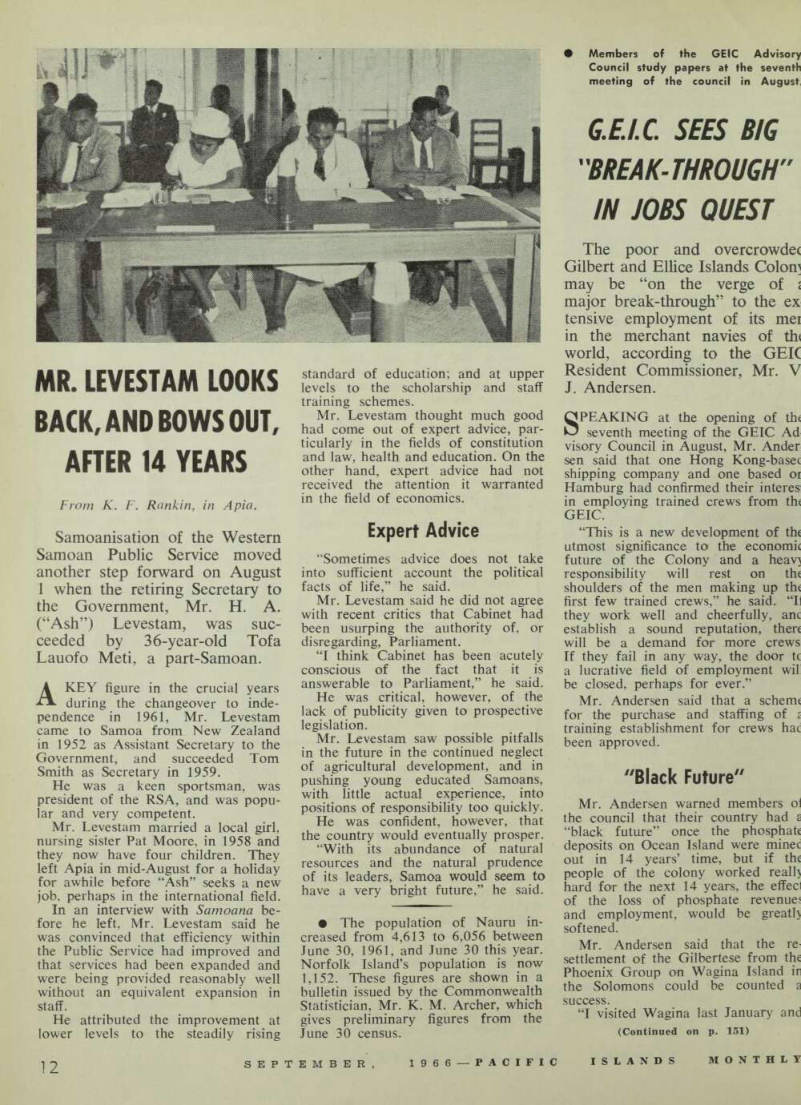
SPEAKING at the opening of the seventh meeting of the GEIC Ad visory Council in August, Mr. Ander sen said that one Hong Kong-basec shipping company and one based or Hamburg had confirmed their interesi in employing trained crews from the
Geic.
“This is a new development of the utmost significance to the economic future of the Colony and a heavj responsibility will rest on the shoulders of the men making up the first few trained crews,” he said. “II they work well and cheerfully, anc establish a sound reputation, there will be a demand for more crews If they fail in any way, the door tc a lucrative field of employment will be closed, perhaps for ever.”
Mr. Andersen said that a scheme for the purchase and staffing of £ training establishment for crews had been approved.
"Black Future"
Mr. Andersen warned members of the council that their country had a “black future” once the phosphate deposits on Ocean Island were mined out in 14 years’ time, but if the people of the colony worked really hard for the next 14 years, the effect of the loss of phosphate revenues and employment, would be greatly softened.
Mr. Andersen said that the re settlement of the Gilbertese from the Phoenix Group on Wagina Island in the Solomons could be counted a success.
“I visited Wagina last January and
(Continued on p. 151)
was impressed by the interest and energy of the settlers by making something of their new homeland,” he said.
“Extensive groves of coconuts were being planted along the foreshore, and inland on the hills considerable acreages of gardens have been estab lished.
“A very small trickle of migrants goes to the Protectorate on every direct ship. This trickle does virtually nothing to ease our population pres sure, and ways and means of increas ing the flow are under constant examination.
“The snag is that the inhabitants of other countries do not want out siders coming in to take up their land and their employment opportunities.
We would be deluding ourselves if we thought that resettlement overseas was ever going to solve our popula tion problems, “On the other hand I, for one, am optimistic enough to think that the
present trickle of migrants will in crease slightly and that every now and again a major resettlement pro ject will come into being.”
Phosphate Revenues
Reviewing the Colony’s economy, Mr. Andersen said that phosphate ex ports in 1965 totalled 360,800 tons.
For 1966, the figure would be in the vicinity of 340,000 tons.
As a result of negotiations in late August and early September between the UK, Australian and New Zealand Governments, it was hoped that the GEIC would obtain a substantial in crease in revenues from the Ocean Island phosphate industry.
Referring to copra, Mr. Andersen said that thanks to an above average rainfall and reasonable prices over seas, the high production figure of 9,733 tons was recorded in 1965.
With rainfall continuing to be good and overseas prices not too bad, production was again expected to be high. The estimated forecast for the year was 8,000 tons, but after seven months, there was reason to believe that this would be surpassed.
Mr. Andersen said that the Colony’s attractive postage stamps continued to make an appreciable contribution to the economy.
Revenue from the sale of stamps in 1965 totalled $123,788, and a similar figure was expected this year.
Mr. Andersen said that, despite greatly increased traffic on Fiji Air ways’ weekly Suva-Tarawa air ser vice, the airline had been unable to cover costs, and it had asked the Colony Government for a subsidy of up to $28,000 for the 1966 calendar year.
Constitutional Proposals
On the question of the proposed constitution for the colony (PIM, July, p. 12), Mr. Andersen said that this represented “a very real devolu tion of power” to the elected repre sentatives of the people; that it pro vided a flexible structure which could develop in a number of directions when the territory as a whole wished to progress further; and it did not saddle the colony with an expensive political machine at a time when there was a cryine need for develop ment in many fields.
In a subsequent debate on the constitutional proposals, the general view was that the proposals required further and detailed study before they could be accepted.
A select committee was appointed to make this study and report back to the council.