In The Trobriands
p. 89 · Read in the full issue
Before ‘The Pill ’
By Basil Hall
In pubs and clubs and on back verandahs where the old hands sit and yarn, a perennial discussion concerns the way in which the Island girls contrive to have their cake and eat it.
THEORIES differ, but conclusions reached are much the same.
Somehow or other, village teenagers seem able to be as promiscuous as they like without fear of con sequences.
It may be a matter of mis carriage, abortion, sterility or some sort of contraceptive practice, and I only add my two penn’orth because the recent death of C. B. Cameron (King Kam of Kitava) has reminded me that, when half in fun, we started something in the Trobriand Islands before World War 11, he was in it too.
It began at a mission station in Milne Bay on the north-east tip of Papua, where the authorities were worried about what appeared to be a falling birth rate.
Couples married in the church were not having the families expected, and there was reason to believe that the Wise Women were on the job again.
Vine-like Creeper
Suspicion in this case was sup ported by a length of vine-like creeper, which, when boiled, was said to produce a liquid that did the trick.
Just how was unknown, but as the first bit of tangible evidence to come my way, I offered to submit the plant to the University of Mel bourne for an opinion.
With some help from their opposite numbers in Brisbane, the specimen was finally identified as Desmodium dependens blume, a legume growing in North Queens land, New Guinea and the New Hebrides.
Preliminary tests showed that an infusion of the leaves did cause contraction in the uterus of non pregnant guinea pigs, and, although that was not much to go on, it was a trifle more than the great
Austrian anthropologist, Bronislaw
Malinowski, offers by way of ex planation.
Malinowski, who arrived in Aus tralia in 1914, was interned as an
enemy alien on the outbreak of war, but was released on the intervention of Sir Hubert Murray to carry on his work in Papua.
What he subsequently wrote about the peoples of the Trobriands re ceived world-wide attention.
Like everyone else, Malinowski was struck by the precocious habits of the young islanders, but remained convinced that they knew nothing of any chemical or mechanical means of guarding against conception. In fact, he said, they had only the haziest notion of how conception came about.
Malinowski was not so certain about the incidence of abortion.
The natives told him about the properties of certain plants; and, like the rest of us, he heard of the manual means employed such things as sliding down a coconut palm, a poultice of hot stones, and several other unpleasant forms of treatment. Yet no one seemed to have seen those things being done, and for a time we wondered whether the answer had been found at Milne Bay.
Money-spinner
The number of people who followed the fortunes of the guinea pigs increased as the story went the rounds.
I used to be stopped in the street and asked for news, and it became evident that, if hopes were justified, we had a money-spinner as certainly as an off-shore gas strike.
It was at that stage that I cut Cameron in, for, living alone on Kitava, the second largest island in the Trobriands, he knew a great deal about the Trobriand people and their way of life. But he wouldn’t have a bar of the Desmodium tale.
His version was that the girls in local villages pinned their faith on a coastal plant with a white flower named gavagava, the leaves of which, when picked and soaked in salt water taken at low tide, could be relied upon to keep them out of trouble.
It was a bitter brew, but every girl on the island took a pre cautionary dose before a party, and the only thing to watch was the state of the tide when the water was collected.
As Cameron explained: “Native magic differs in different parts of Papua. On the north-east coast, the specific is the main consideration.
On Kitava it is the incantation.
Everybody knows the specific or plant used. , . .”
"Nursery Governess"
According to the same source, it was customary for parents inflicted with a run of female childen to. turn one of them into a sort of nursery governess, capable of help ing out with her sister’s offspring.
This was a variation of the same theme, for gavagava juice was not an abortant, but induced sterility.
Treatment began at about 10 years of age, girls chosen being dosed at monthly intervals for periods of four months at a time.
After an interval of six months or so, a similar course of treatment was imposed, the result being a seven-year spell of infertility, with no side effects whatever.
I never heard what happened to the guinea pigs. The war came along and if anyone rode around in a Rolls Royce it wasn’t me.
There has been no noticeable change in the customs of the Trobriand Islanders either. They are still a pleasant, friendly people who have never heard about The Pill.
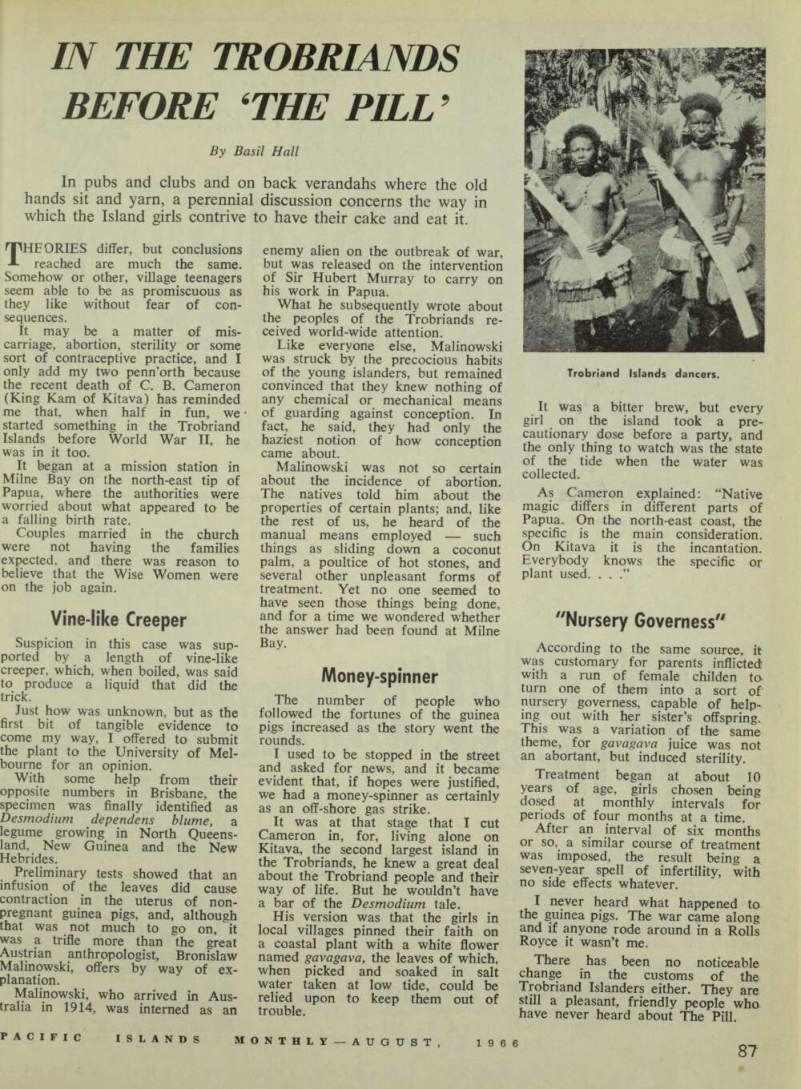
Trobriand Islands dancers.