Norfolk Is.
pp. 91-93 · Read in the full issue

Remembers Its
Links With
The Mission
• Norfolk Island in August will celebrate the centenary of the establishment of the Melanesian Mission on the island—yet the mission has not been there now for more than 40 years. In this article, PlM's Norfolk Island correspondent, Merval Hoare (the author of "Rambler's Guide to Norfolk Island") gives the back ground to this event in the island's history.
By Merval Hoare
Establishment of the mission on Norfolk Island is an im portant date for both the church and the islanders, because for the first time the mission had established its headquarters in the south Pacific Islands. Previously it had done its work from headquarters in St. John's College, Auckland.
Archbishop marcus loane, of Sydney, will visit Norfolk for the celebrations in August. The Norfolk Island Administration will issue a 5c and a 25c commemora tive stamp on August 23, the anniversary of the signing of the mission grants in 1866.
The mission received 99 acres free, and bought another 933 acres at £2 an acre, for the establishment of a training school, and for the head quarters of the first Bishop of Melanesia, Bishop John Coleridge Patteson. The grant was signed by Sir John Young, who was Governor of New South Wales and of Norfolk Island.
It had all started several years previously in Auckland with Bishop George Augustus Selwyn, who had been consecrated first Bishop of New Zealand in 1841. It was his task to extend his commission to the Pacific Islands.
In 1848, after establishing the church in New Zealand, he turned his attention to the Melanesian part of his diocese; touring the New Hebrides
and the Solomon Islands in 1849 and returning with five Melanesian students.
A year later the Australasian Board of Missions was formed and the Melanesian Mission was adopted by the Australian and New Zealand Colonies.
Climate Too Severe
As time went by, the Bishop found that the New Zealand climate was too severe for his Pacific students, accustomed as they were to the tropics. His thoughts turned towards Norfolk, where, in the early 1850’s, preparations were being made to close the island’s penal settlement and to receive the Pitcairn Islanders, whose own home was becoming over crowded.
Bishop Selwyn visited Norfolk at the end of 1853 in HM brig Victoria, and was very favourably impressed with the island. In England the following year he placed before the Pitcairn Island Committee—then con cerned with the transfer of the Pitcairners a proposal for the
Pitcairners and the mission to share the island for 10 years. The com mittee rejected the scheme, and another attempt made by the Bishop in 1857 to gain a footing on Norfolk was also unsuccessful. But by 1866 there had been a change in govern ment policy which resulted in land for the mission being granted, and thus the mission’s activities began in earnest.
In October that year the mission ship Southern Cross brought the Rev.
J. Palmer and 16 Melanesian lads to settle on the new mission land.
The station was named in honour of St. Barnabas, on whose feast-day the site was selected.
The mission grew to be a large concern, with homes for missionaries and students, a printing house, school and a store. By the turn of the century there were more than 200 students and a large staff of Euro pean and Melanesian missionaries.
The trained students took the Gospel to the Islands.
The Norfolk Islanders had at first opposed the establishment of the mission on what they considered to be their land. But later they changed
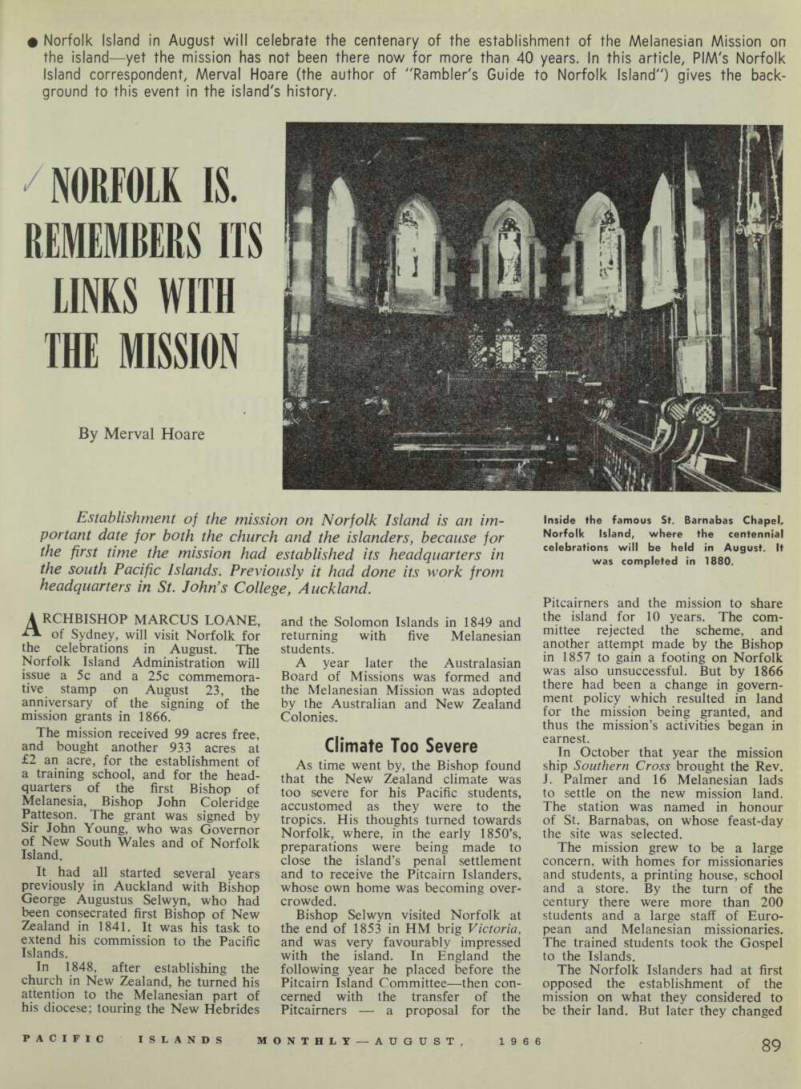
Inside the famous St. Barnabas Chapel, Norfolk Island, where the centennial celebrations will be held in August. It was completed in 1880.
their attitude, and some trained, as missionaries while others were em ployed at the mission.
But the mission remained separate from the Norfolk community, which had its own pastor, the Rev. George Hunn Nobbs and its own church at Kingston. However, from 1871 on it contributed to the cost of a medical officer and later shared the expenses of a subsidised shipping service and helped with public works.
It was probably natural that with the expansion of the Melanesian Mission’s work in the South Seas that Norfolk Island should become less suitable as a site for a training school. The mission needed to move far further to the north to become more closely involved with Pacific affairs. Following World War I headquarters was moved to the Solomons, the transfer being com pleted in 1920.
One of the mission’s best known sons is missionary-author Dr. C. E.
Fox, who was ordained at Norfolk in 1903 and who is still living in the Solomons, aged 85.
St. Barnabas Chapel, where the centennial celebrations will be held in August, is a fine stone church completed in 1880. It was dedicated as a memorial to that first bishop, Bishop Patteson, who was killed by the natives of Nukapu, in the Solomons, in 1871. [All that now remains on Norfolk of the large Melanesian establish ments are the fine chapel, the vicarage and a house once occupied by Bishop Cecil Wilson. A few beautiful and exotic trees are still standing in the vicinity of the chapel.—Editor].