Sweet, Forgotten Rose
pp. 87-88 · Read in the full issue
Atoll Makes The
News At Last
By Robert Langdon
In the late 16th and early 17th centuries, when God-fearing Spaniards such as Alvaro de Mendana and Pedro Quiros picked their way across the largely unexplored Pacific, numerous islands appeared on the map which clearly betokened the re ligious fervour of their discoverers.
SANTA YSABEL, Espiritu Santo and Santa Cruz are a few examples of these names that still survive.
A century and a half later, when the British explorers sailed into the Pacific one after another, the map became peppered with the names of kings, queens, dukes, noble lords and top Admiralty brass—King George 111 Island, the Sandwich Islands, Lord Howe Island and so forth.
The reason for names of this kind was that the hard-headed Britishers believed that a little flattery would keep them in well with the people who paid and patronised them.
The French explorers, who fol lowed such Britishers as Byron, Wallis, Carteret, Cook, Bligh and Vancouver, were different again.
Gallic and gallant to their boot straps, they thought more of their women than they did of their saints or their paymasters. So, whenever they came across a bit of land that didn’t have a name as far as they were concerned, their minds were apt to turn to the sweets of love.
Goddess Of Love
Unfortunately for romance, there were not many lands or islands left to discover by the time the gallant Frenchmen really got into the ex ploring business. So examples of their kind of nomenclature are not as numerous as the others.
Three examples that do come to mind are La Nouvelle Cythere (Bougainville’s name for Tahiti), Adelie Land in Antarctica, and Rose Atoll in American Samoa.
La Nouvelle Cythere was so named because everything in Tahiti reminded Bougainville of Cytherea, the Greek goddess of love. (The Romans knew her as Venus).
Adelie Land received its name from Captain J. S. C. Dumont d’Urville, who was a sort of latter-day
Captain Cook (French variety). The name honoured his wife, from whom the task of Pacific exploration kept him separated for many long years. (It has since become the identifying tag for a species of penguin, also).
Rose Atoll commemorates Rose Freycinet, intrepid wife of the ex plorer Louis Freycinet, who—dis guised as a man—was smuggled aboard his ship Uranie in Toulon in 1817, and illicitly accompanied him on a four-year voyage round the world.
Although Rose Atoll had been seen and named Vayle Eyland by the Dutch navigator Roggeveen about a century earlier, it was not marked on Freycinet’s charts, and he recorded it as a new discovery on passing it on October 21, 1819.
His wife was wildly excited at the honour of having “a little point of the globe” named after her, and she wrote to a friend that day that although “the envious might perhaps call it only an islet,” it could have been fatal to the expedition if they had chanced to come upon it in the night.
Freycinet, himself, wrote many years later, when the question of his wife’s illegal voyage with him was no longer a live issue, that he had named Rose Atoll “from the name of someone who is extremely dear to me”.
If Rose Atoll had then had, or had since had, any permanent native inhabitants, there is little doubt that its native name would long since have superseded the gently feminine one that Freycinet gave it—as has mercifully happened with most of the Spanish and English names.
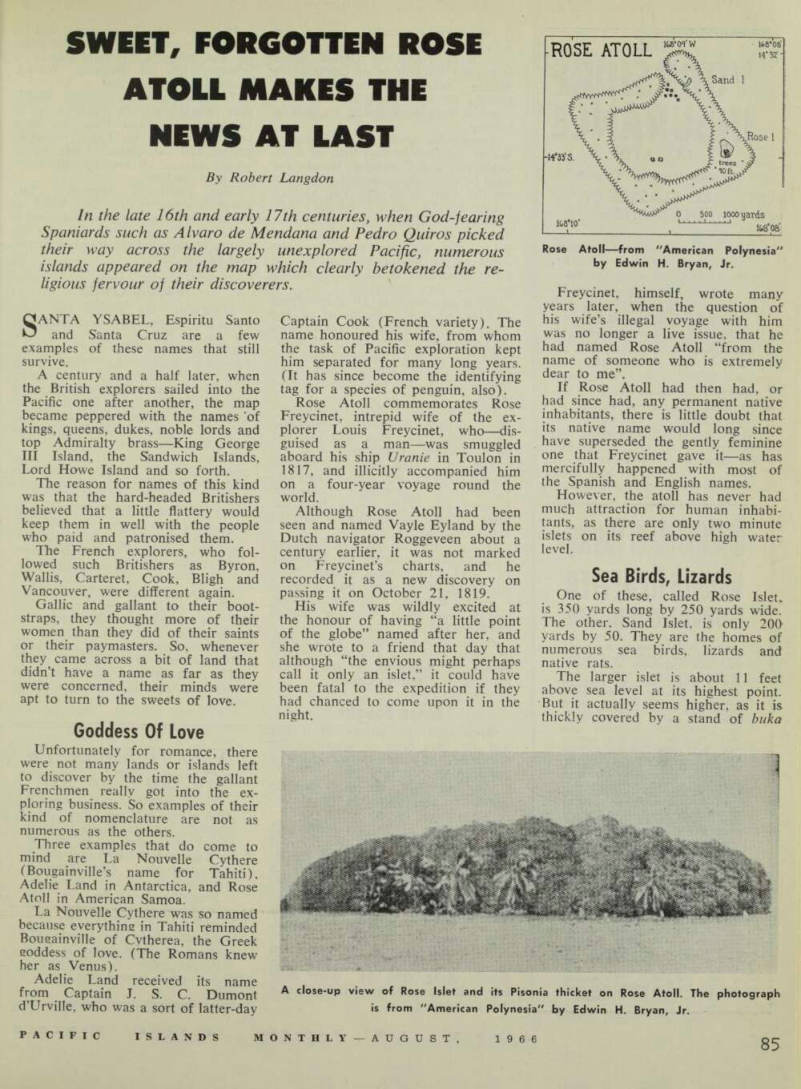
However, the atoll has never had much attraction for human inhabi tants, as there are only two minute islets on its reef above high water level.
Sea Birds, Lizards
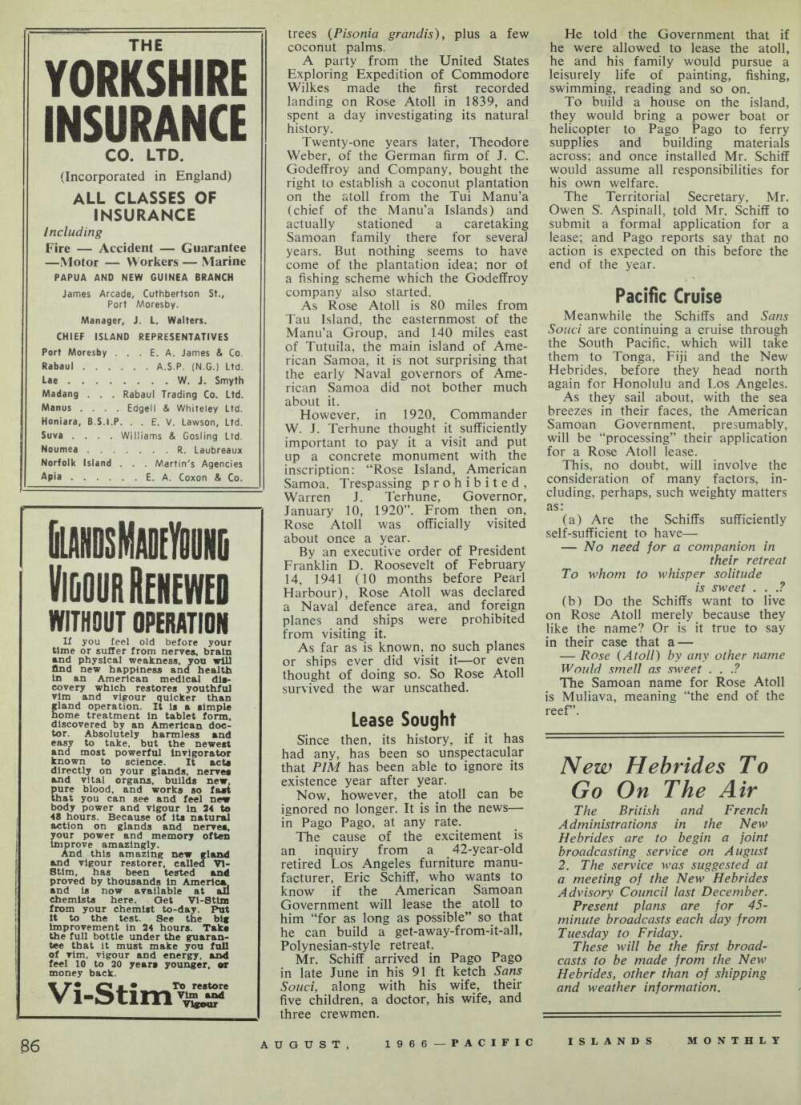
One of these, called Rose Islet* is 350 yards long by 250 yards wide.
The other. Sand Islet, is only 200 yards by 50. They are the homes of numerous sea birds, lizards and native rats.
The larger islet is about 11 feet above sea level at its highest point.
But it actually seems higher, as it is thickly covered by a stand of buka
A close-up view of Rose Islet and its Pisonia thicket on Rose Atoll. The photograph is from "American Polynesia" by Edwin H. Bryan, Jr.
Rose Atoll—from "American Polynesia" by Edwin H. Bryan, Jr.
trees {Pisonia grandis), plus a few coconut palms.
A party from the United States Exploring Expedition of Commodore Wilkes made the first recorded landing on Rose Atoll in 1839, and spent a day investigating its natural history.
Twenty-one years later, Theodore Weber, of the German firm of J. C.
Godeffroy and Company, bought the right to establish a coconut plantation on the atoll from the Tui Manu’a (chief of the Manu’a Islands) and actually stationed a caretaking Samoan family there for several years. But nothing seems to have come of the plantation idea; nor of a fishing scheme which the Godeffroy company also started.
As Rose Atoll is 80 miles from Tau Island, the easternmost of the Manu’a Group, and 140 miles east of Tutuila, the main island of Ame rican Samoa, it is not surprising that the early Naval governors of Ame rican Samoa did not bother much about it.
However, in 1920, Commander W. J. Terhune thought it sufficiently important to pay it a visit and put up a concrete monument with the inscription: “Rose Island, American Samoa. Trespassing prohibited, Warren J. Terhune, Governor, January 10, 1920”. From then on.
Rose Atoll was officially visited about once a year.
By an executive order of President Franklin D. Roosevelt of February 14, 1941 (10 months before Pearl Harbour), Rose Atoll was declared a Naval defence area, and foreign planes and ships were prohibited from visiting it.
As far as is known, no such planes or ships ever did visit it—or even thought of doing so. So Rose Atoll survived the war unscathed.
Lease Sought
Since then, its history, if it has had any, has been so unspectacular that PIM has been able to ignore its existence year after year.
Now, however, the atoll can be ignored no longer. It is in the news — in Pago Pago, at any rate.
The cause of the excitement is an inquiry from a 42-year-old retired Los Angeles furniture manu facturer, Eric Schiff, who wants to know if the American Samoan Government will lease the atoll to him “for as long as possible” so that he can build a get-away-from-it-all, Polynesian-style retreat.
Mr. Schiff arrived in Pago Pago in late June in his 91 ft ketch Sans Souci, along with his wife, their five children, a doctor, his wife, and three crewmen.
He told the Government that if he were allowed to lease the atoll, he and his family would pursue a leisurely life of painting, fishing, swimming, reading and so on.
To build a house on the island, they would bring a power boat or helicopter to Pago Pago to ferry supplies and building materials across; and once installed Mr. Schiff would assume all responsibilities for his own welfare.
The Territorial Secretary, Mr.
Owen S. Aspinall, told Mr. Schiff to submit a formal application for a lease; and Pago reports say that no action is expected on this before the end of the year.
Pacific Cruise
Meanwhile the Schiffs and Sans Souci are continuing a cruise through the South Pacific, which will take them to Tonga, Fiji and the New Hebrides, before they head north again for Honolulu and Los Angeles.
As they sail about, with the sea breezes in their faces, the American Samoan Government, presumably, will be “processing” their application for a Rose Atoll lease.
This, no doubt, will involve the consideration of many factors, in cluding, perhaps, such weighty matters as: (a) Are the Schiffs sufficiently self-sufficient to have— — No need for a companion in their retreat To whom to whisper solitude is sweet . , .? (b) Do the Schiffs want to live on Rose Atoll merely because they like the name? Or is it true to say in their case that a Rose {Atoll) by any other name Would smell as sweet . . .?
The Samoan name for Rose Atoll is Muliava, meaning “the end of the reef”.