Gilbertese Unmoved By British Plan
p. 14 · Read in the full issue
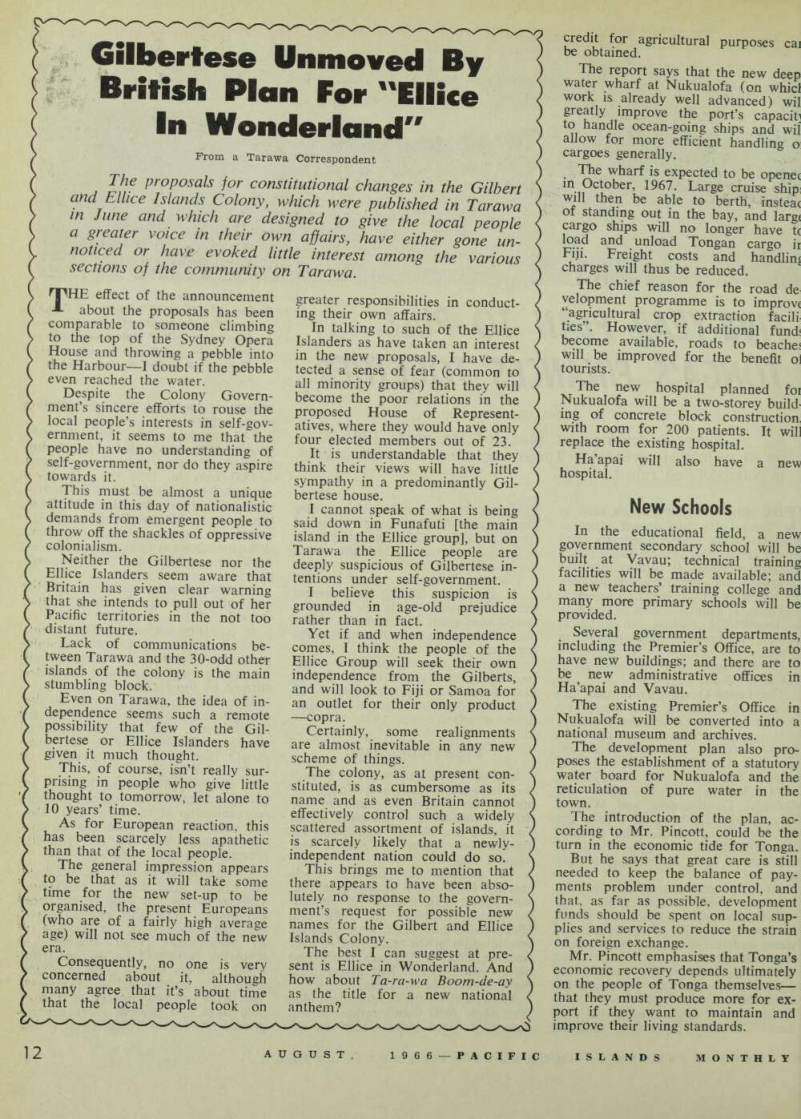
British Plan For "Ellice In Wonderland"
Prom a Tarawa Correspondent The proposals for constitutional changes in the Gilbert and Ellice Islands Colony, which were published in Tarawa m June and which are designed to give the local people a greater voice in their own affairs, have either gone un noticed or have evoked little interest among the various sections of the community on Tarawa.
fpHE effect of the announcement about the proposals has been comparable to someone climbing to the top of the Sydney Opera House and throwing a pebble into the Harbour—l doubt if the pebble even reached the water.
Despite the Colony Govern ment’s sincere efforts to rouse the local people’s interests in self-gov ernment, it seems to me that the people have no understanding of self-government, nor do they aspire towards it.
This must be almost a unique attitude in this day of nationalistic demands from emergent people to throw off the shackles of oppressive colonialism.
Neither the Gilbertese nor the Ellice Islanders seem aware that Britain has given clear warning that she intends to pull out of her Pacific territories in the not too distant future.
Lack of communications be tween Tarawa and the 30-odd other islands of the colony is the main stumbling block.
Even on Tarawa, the idea of in dependence seems such a remote possibility that few of the Gil bertese or Ellice Islanders have given it much thought.
This, of course, isn’t really sur prising in people who give little thought to tomorrow, let alone to 10 years’ time.
As for European reaction, this has been scarcely less apathetic than that of the local people.
The general impression appears to be that as it will take some time for the new set-up to be organised, the present Europeans (who are of a fairly high average age) will not see much of the new era.
Consequently, no one is very concerned about it, although many agree that it’s about time that the local people took on
greater responsibilities in conduct ing their own affairs.
In talking to such of the Ellice Islanders as have taken an interest in the new proposals, I have de tected a sense of fear (common to all minority groups) that they will become the poor relations in the proposed House of Represent atives, where they would have only four elected members out of 23.
It is understandable that they think their views will have little sympathy in a predominantly Gil bertese house.
I cannot speak of what is being said down in Funafuti [the main island in the Ellice group], but on Tarawa the Ellice people are deeply suspicious of Gilbertese in tentions under self-government.
I believe this suspicion is grounded in age-old prejudice rather than in fact.
Yet if and when independence comes, I think the people of the Ellice Group will seek their own independence from the Gilberts, and will look to Fiji or Samoa for an outlet for their only product —copra.
Certainly, some realignments are almost inevitable in any new scheme of things.
The colony, as at present con stituted, is as cumbersome as its name and as even Britain cannot effectively control such a widely scattered assortment of islands, it is scarcely likely that a newly independent nation could do so.
This brings me to mention that there appears to have been abso lutely no response to the govern ment’s request for possible new names for the Gilbert and Ellice Islands Colony.
The best I can suggest at pre sent is Ellice in Wonderland. And how about Ta-ra-wa Boom-de-ay as the title for a new national anthem?