Five-Year Plan To Pull
pp. 13-14 · Read in the full issue
Tonga's Finances Together
By a Staff Writer
A five-year development plan for the years 1965-70, aimed mainly at revitalising Tonga’s economy, was published in Nukualofa on July 1.
THE plan is the first of its kind in Tonga. Its chief accent is on re habilitating the coconut industry, and reorganising and modernising agri cultural services. It is also intended to expand and improve social services “in harmony with population growth”.
The total estimated cost of the plan is nearly £2i million, an unprece dented figure for development in Tonga.
Of this sum, £279,190 was spent before 1965-66.
The Tonga Government already ex pects to be able to raise nearly £2 million of the total amount required.
It expects to obtain £956,000 from local resources and £987,500 ex ternally. A total of £687,500 of the external funds will come from Britain —£437,500 by grant under the Colonial Development and Welfare Scheme and £250,000 as a loan for the Nukualofa wharf. The remain ing £300,000 of overseas funds is expected to be in the form of further grants.
About 65 per cent, of the financial resources available under the plan will be devoted to economic projects; 23 i per cent, will go on social ser vices; and the remainder on adminis trative services.
The heaviest spending will be in 1966-67, for which the plan calls for £519,450.
The biggest single items in the plan are: Coconut replanting scheme,
£232,000; development of Agriculture Department, £100,000; new hospital for Nukualofa, £250,000; deepwater Nukualofa wharf, £514,000; road construction, £213,000.
The plan was prepared by Mr. W.
J. R. Pincott, a British Government official, who arrived in the kingdom last December to advise on the imple mentation of a development pro gramme.
The plan appears to have come into being as a result of the British Government’s concern over the alarming deterioration in Tonga’s financial affairs since 1958.
Restraining Hand
In that year, a new treaty of friend ship between Britain and Tonga re moved the restraining hand of the British consul in Nukualofa from Tonga’s purse strings and gave the Tongan Government full control over its own finances.
An exceptionally adverse trade balance (£408,080) occurred in that same year; and except for modest favourable balances in 1959 and 1960, there has been a progressive deterioration in the trade pattern ever since. (Before 1958, back to the end of the war, Tonga had always had favourable trade balances.) The report on the development plan says that this deterioration is ac counted for “to some extent” by de
velopment spending, and by declining copra exports.
The report says that Tonga’s smaller copra production (10,000 tons in 1964 compared with an average of 17.000 tons in 1953-61) has been attributed to the 1961 and 1963 hurri canes. But there are other contribut ing factors such as the non-replace ment of over-age coconut palms, droughts, rodent damage and in adequate extension and advisory ser vices.
A systematic rehabilitation of the coconut industry is therefore a vital priority.
It is estimated that 35 per cent. (20,000 acres) of Tonga’s coconut plantations need to be replanted to replace over-age palms and those de stroyed by hurricanes.
It is also proposed to increase the acreage under coconuts by 20,000 to 25.000 acres, thus bringing the total acreage to 75,000-80,000 acres. Tonga should then be able to produce up to 28,000 tons a year.
A detailed programme has yet to be drawn up for the expansion and reorganisation of the Agriculture De partment, but it is hoped that surveys to determine livestock and forestry potential can be carried out.
Emphasis everywhere is placed on the urgent need for the individual Tongan to use his land to the best advantage. With this end in view, the plan provides for the creation of an agricultural credit scheme. A revolving fund will be set up, from which farmers will be able to obtain loans for agricultural development.
The loans will bear interest at reason able rates. At present there are no private sources in Tonga from which
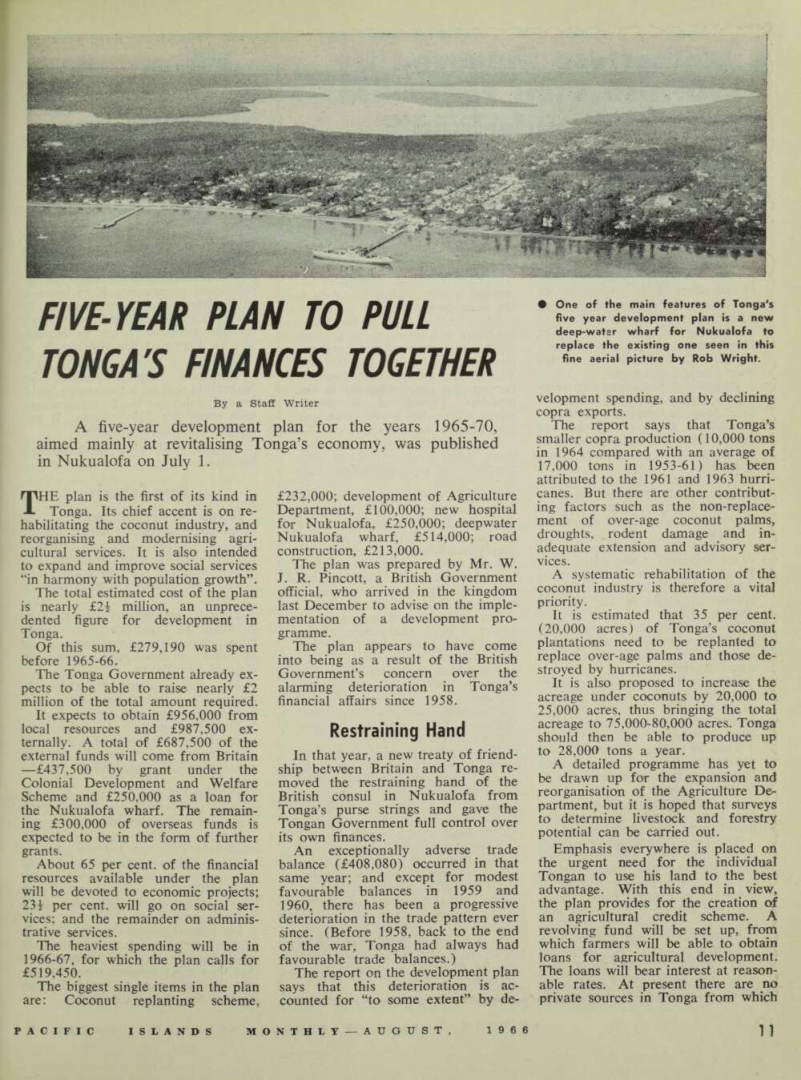
• One of the main features of Tonga's five year development plan is a new deep-watar wharf for Nukualofa to replace the existing one seen in this fine aerial picture by Rob Wright.
credit for agricultural purposes cai be obtained.
The report says that the new deep water wharf at Nukualofa (on whicl work is already well advanced) wil greatly improve the port’s capacity to handle ocean-going ships and wil allow for more efficient handling o cargoes generally.
The wharf is expected to be openec in October, 1967. Large cruise ship; will then be able to berth, insteac of standing out in the bay, and large cargo ships will no longer have tc load and unload Tongan cargo ir Fiji. Freight costs and handling charges will thus be reduced.
The chief reason for the road de velopment programme is to improve “agricultural crop extraction facili ties”. However, if additional funds become available, roads to beaches will be improved for the benefit of tourists.
The new hospital planned for Nukualofa will be a two-storey build ing of concrete block construction, with room for 200 patients. It will replace the existing hospital.
Ha apai will also have a new hospital.
New Schools
In the educational field, a new government secondary school will be built at Vavau; technical training facilities will be made available; and a new teachers’ training college and many more primary schools will be provided.
Several government departments, including the Premier’s Office, are to have new buildings; and there are to be new administrative offices in Ha’apai and Vavau.
The existing Premier’s Office in Nukualofa will be converted into a national museum and archives.
The development plan also pro poses the establishment of a statutory water board for Nukualofa and the reticulation of pure water in the town.
The introduction of the plan, ac cording to Mr. Pincott, could be the turn in the economic tide for Tonga.
But he says that great care is still needed to keep the balance of pay ments problem under control, and that, as far as possible, development funds should be spent on local sup plies and services to reduce the strain on foreign exchange.
Mr. Pincott emphasises that Tonga’s economic recovery depends ultimately on the people of Tonga themselves— that they must produce more for ex port if they want to maintain and improve their living standards.