Fiji Clears The Deck For
pp. 15-18 · Read in the full issue
Vital New Elections
From a Suva Correspondent Having opened with a sizzle of fireworks, Fiji’s Legislative Council ended its three years of fife at 3.30 p.m. on July 27, in a spate of sentimental oratory.
SPREAD over 11 days, the meeting was the longest session of the pre sent council, which has now dissolved.
Fiji will hold new elections in Sep tember under a brand new constitu tion which will give the Legislative Council for the first time a majority of unofficial members. These will be Fiji’s first “home rulers”.
The oratory in the closing 60 minutes of the July meeting was at times almost maudlin. It was like an Irish wake without the liquor, as tributes were poured all over the dying council.
The Fijian elected member for the northern constituency, Josua Rabu kawaqa, praised the official members for their integrity. Unlike the sup porters of home rule in other British possessions who hasten to get rid of their erstwhile rulers, Josua asked them to stay in Fiji. There, he hoped, they would be happy.
The honourable European member for the southern constituency, Mr.
Peter Kearsley, commenting on pro ceedings which he said were “tinged with sadness”, was lyrical about the probity of Fiji’s expatriate civil ser vants. Although Fiji, he said, got generous handouts from Britain the most precious thing it received from the old country was the “integrity of the men of the overseas civil service”.
For these men, added Mr. Kearsley dramatically, “this was their finest hour!”
Embarrassed
Even the imperturbable Attorney- General, Mr. Justin Lewis, who was acting as Speaker, looked embarrassed at this.
The Financial Secretary, Mr. Harry Ritchie, made a plea which will find an echo in many hearts when he pro posed that in the next council the time of individual speakers on both sides of the House be limited. Spokes men should be appointed for particu lar subjects.
In this council as usual there were those who wanted a say on every subject, who vapoured on through the turgid 11 days. No doubt some
of the extra gas in this session was due to the fact that the most impor tant election in Fiji’s history is on the horizon and members were busy electioneering.
The short-lived sizzle at the begin ning was brought about by the un precedented step of unofficial mem bers in opposing the first readings of both the Customs Bill and the Agri cultural Landlord and Tenants Bill.
Members wanted both bills postponed for further thinking, but the Govern ment steamroller went over the “noes”.
Unofficial Mutiny
The Government’s reason for re fusing postponement was valid. It didn’t want important matters to be come political footballs, as they would become if left until after the elections.
The unofficial mutiny did not cause the dissension one would have ex pected, and generally there was sweet reasonableness throughout the meet ing, with a minor exception or two.
Certainly the Government bent over backwards, short of full retreat, 1 to please the unofficial members: They arranged several adjournments! to smooth out with the unofficials a few of the rougher patches in both of the bills. This happened behind closed doors.
More than 30 amendments almost rewrote the controversial Customs Bill and, during the committee stage of the Landlord and Tenants Bill, the Attorney-General was up and down like a jack-in-a-box proposing 34 agreed amendments.
The Hard Pill
The hardest pill that the unofficials had to swallow in, the Customs Biff was the clause which laid it down that in a Customs offence guilty knowledge, or intent, had not to be proved.
Under pressure the Government made an amendment. If they had not, the bill would have provided ari astounding exception to the British law which says a person is innocent until proved guilty.
Among the wide changes the bill will bring about is the reversion to
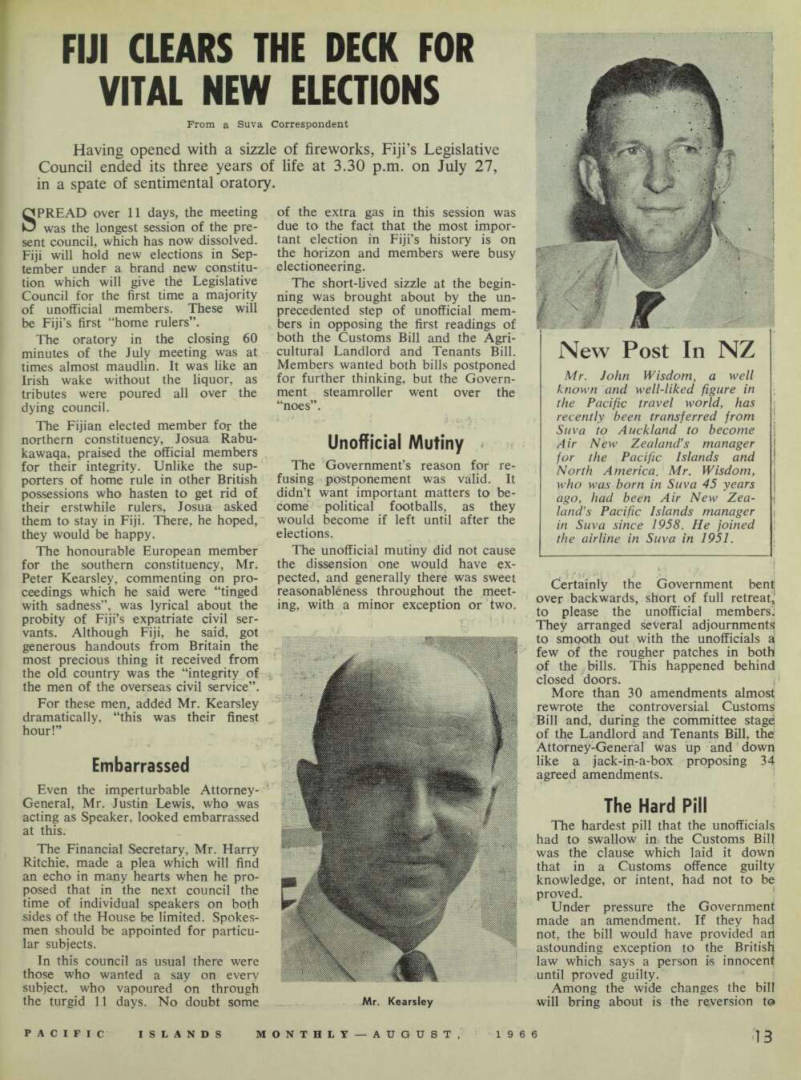
Mr. Kearsley
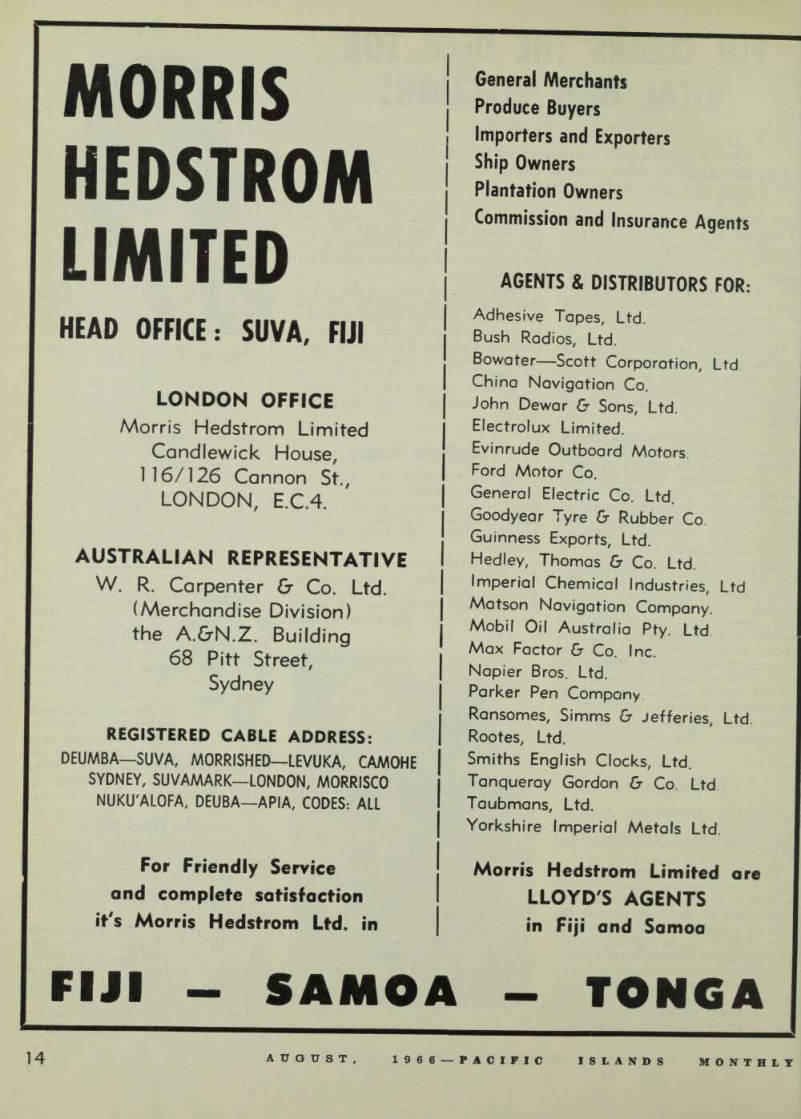
New Post In NZ
Mr. John Wisdom, a well known and well-liked figure in the Pacific travel world, has recently been transferred from Suva to Auckland to become Air New Zealand’s manager for the Pacific Islands and North America. Mr. Wisdom, who was born in Suva 45 years ago, had been Air New Zea land’s Pacific Islands manager in Suva since 1958. He joined the airline in Suva in 1951.
the FOB system of assessing duty, and the adoption of a revised system of classifications. The bill went through on the voices.
The Landlord and Tenants Bill also went through without any trouble, although with much amendment. It was one of the most important measures to come before the council.
Its main ingredient was land tenure, and for the first time an effort was made to unravel the tangled skein of Fiji land laws. Land is a racial matter in this colony.
The bill affected lease land, includ ing the land belonging to the Fijian land-owning unit, which comprises more than 80 per cent, of all Fiji land.
Security For Tenants
The bill is designed to give all tenants security of tenure for 10 years, with an opportunity of two further extensions each of 10 years— -30 years in all. The Director of Agriculture, Mr. K. J. Garnett, said this was sufficient time for anybody to get value out of his tenancy. A tribunal will decide on the renewal of the lease after the first 10 years.
The bill fixes the maximum rent at six per cent, of the market value of the land. It protects the owner against
a bad tenant, and a tenant against a bad landlord.
The council rejected perpetual leases, which Indian members wanted.
But one excellent innovation was the provision of regulations to deal with rapacious landlords involved in share cropping abuses.
The Member for Social Services, Mr. A. D. Patel, both praised the bill and pointed out some of its weak nesses. Mr. Patel’s companion on the Government benches, Member with out Portfolio James Madhavan, had something critical to say about Fijian custom.
Fijian Semesa Sikivou rose in his wrath at this and castigated both members—Mr. Patel for allegedly in dulging in acrobatics by supporting the bill and criticising it at the same time, and Mr. Madhavan for his “im pudent” reference.
More Than 20 Bills
There was quite some verbal activity, with members quoting parables. Semesa Sikivou said some thing about rats in the jungle attack ing the feet of the soldiers and Mr.
C. A. Shah, a member of Mr. Patel’s Federation Party, told the story of a big black gorilla which used to play to the gallery with a peanut. The analogy wasn’t very clear.
When it was all over, and the bill went through, the Attorney-General spoke nothing but the truth when he
said the Government had undergone a difficult exercise in navigation, avoiding rocks strewn by Fijians, Indians, tenants and landlords.
Altogether more than 20 bills were presented at the meeting, most of them amending measures and none causing very much trouble. They ranged over a wide field, including education, protection of birds, coast ing laws, trustees of estates, assur ance, township boards, markets, the Supreme Court, arms and ammu nition, pearl shell, pensions and immi gration.
The longest debate was on the new Development Plan, which may cost more than £11,000,000 and is ex pected to start Fiji on the road to prosperity.
Everyone had something to say about it. If the Government had accepted all the suggestions made for improving the plan the cost would have trebled. The Government stressed that the scheme was only a plan, that it wasn’t claimed it would turn Fiji into a paradise, and that investigations into Fiji’s potential were the vital prerequisite (see “Blue print For Paradise”, p. 71).
Towards the end of the council’s sitting when three new motions were added to the agenda, it was thought that the fireworks would now finally go off. But they didn’t.
Mr, S. M. Koya was responsive for two of the motions, one askin" for an inquiry into the hardships of
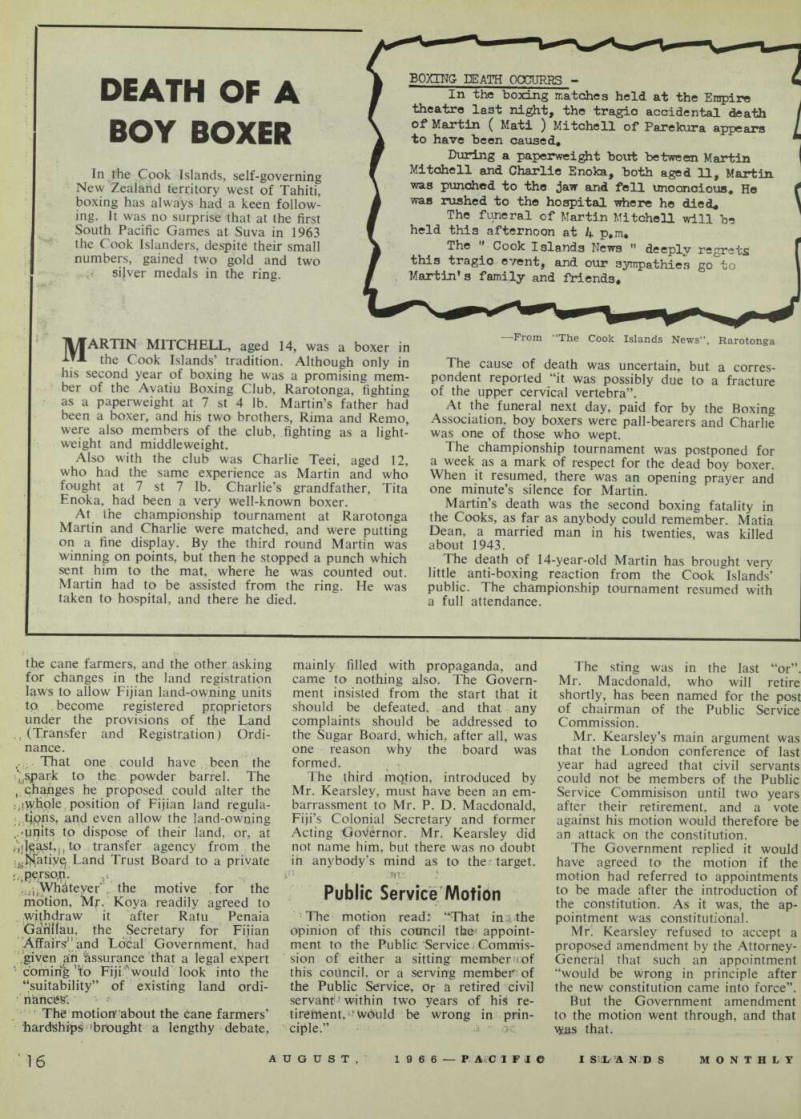
FOR VANUA LEVU TRAVELLERS: A new annex built off the Grand Eastern Hotel at Labasa, on Fiji's second largest island, Vanua Levu, provides first class accommodation for travellers. Situated close to the river, the block has three well-furnished double bedrooms each complete with tiled bathrooms, etc., and air-conditioning. The fourth section in the block is a comfortable suite. Labasa is an important sugar town.
Photo: Rob Wright.
the cane farmers, and the other asking for changes in the land registration laws to allow Fijian land-owning units to. become registered proprietors under the provisions of the Land , (Transfer and Registration) Ordi nance.
That one, could have been the spark to the powder barrel. The , changes he proposed could alter the position of Fijian land regula tions, and even allow the land-owning -units to dispose of their land, or, at ’;ijeast, jt to transfer agency from the Land Trust Board to a private ..person. .Whatever the motive for the motion, Mf. Koya readily agreed to . withdraw it after Ratu Penaia Ga'rihau, the Secretary for Fijian and Local Government, had .given ah Assurance that a legal expert coming To Fiji. s would look into the “suitability” of existing land ordi nances’.
The motion about the cane farmers’ •hardships brought a lengthy debate,
mainly filled with propaganda, and came to nothing also. The Govern ment insisted from the start that it should be defeated, and that any complaints should be addressed to the Sugar Board, which, after all, was one reason why the board was formed.
The third mqtion, introduced by Mr. Kearsley, must have been an em barrassment to Mr. P. D. Macdonald, Fiji’s Colonial Secretary and former Acting Governor. Mr. Kearsley did not name him, but there was no doubt ih anybody’s mind as to the ■ target, b ' :mr.
Public Service A/lotion
The motion read; ‘ v That in a the opinion of this council the appoint ment to the Public Service. Commis sion of either a sitting’ member fof this council, or a serving member of the Public Service, or a retired civil servant ’ within two years of his re tirement,‘-Wduld be wrong in prin ciple.”
The sting was in the last “or”.
Mr. Macdonald, who will retire shortly, has been named for the post of chairman of the Public Service Commission.
Mr. Kearsley’s main argument was that the London conference of last year had agreed that civil servants could not be members of the Public Service Commisison until two years after their retirement, and a vote against his motion would therefore be an attack on the constitution.
The Government replied it would have agreed to the motion if the motion had referred to appointments to be made after the introduction of the constitution. As it was, the ap pointment was constitutional.
Mr. Kearsley refused to accept a proposed amendment by the Attorney- General that such an appointment “would be wrong in principle after the new constitution came into force”.
But the Government amendment to the motion went through, and that W that.