yesterday
p. 91 · Read in the full issue
Although the Pacific war had been over more than nine months in July, 1946, the issue of PIM for that month con tained plenty of evidence that it would be a long time before the South Pacific territories were back to normal.
HOWEVER, the military aspect of the Pacific was beginning to disappear. Civil administration had been restored in Papua and New Guinea with the transfer on June 24 of the Rabaul and Kokopo Sub-District of New Britain from the Australian Military Forces to the Provisional Administration. And the last of the Royal Navy ships that had been based on Sydney since 1945 —a submarine flotilla—were on their way home after visiting Fiji. Tonga, the Solomons, New Hebrides and Ellice Islands.
Other items in PIM for 20 years ago were:— THE kauri timber industry on Vanikoro, Solomon Islands, which had been very valuable before the war, was expected to flourish again due to die acute shortage of good timber in the world.
THE Australian Prime Minister, Mr. Ben. Chifley, stated in the House of Representatives in late June that there would be no inquiry into the capture of Rabaul in 1942, when 300 civilians lost their lives at the hands of the Japanese. He said this after members of the Country and Liberal Parties had spent five hours in putting the case of former New Guinea residents for an investigation. Labour members had blocked a move to table secret documents on Rabaul.
A TRIAL shipment of mulberry bark was being sent from Fiji to England for examination by paper producers who were interested in it for the manufac ture of fine paper of the type used in bank notes and documents.
Costs were to be worked out to determine whether an export industry was worth developing.
Paper mulberry bark is the material from which Fijians make masi, (tapa in Polynesia). many months of A wharf strikes and other labour troubles, demonstrations against the Resident Commis sioner, and a general airing of grievances at Rarotonga. Cook
Islands, a New Zealand MP, Mr.
A. G. Osborne, visited the island in May on a fact-finding tour on behalf of the New Zealand Government. He was accompanied by Mr. C. G. R. McKay, Sec retary for New Zealand’s Islands Territories.
THE new French Minister to New Zealand, Mr. Amand Gazel, had stated that travellers were not being encouraged to visit Tahiti, although it was unlikely that they would be completely prohibited. Shortages of food and accommodation in the Society Group were still acute, and all persons wishing to remain longer than the duration of a ship’s stopover had to be properly ac credited and possess adequate funds for living expenses, he said.
THREE hundred volunteer troops of the Free French Pacific Battalion returned to Noumea, New Caledonia, on May 21, on board the MV Saggittaire. They had been serving overseas for five years.
The Saggittaire reached Noumea by way of Tahiti where volunteers from French Polynesia disembarked.
A BITTER controversy, con fined mainly to Suva and Lautoka, was raging in Fiji on whether a proposed international airport should be at Nadi or Nausori. Nadi is 71 miles from Suva by air and well over 100 miles by road while Nausori is 10 miles by air from Suva and 16 miles by road. PIM said the airport should be as close as possible to Suva, but Nadi got the airport in the end.
TWO former Governors of French Pacific Colonies had been excluded from the Legion of Honour and forbidden to wear any French or foreign decoration.
The ex-governors were Federoi Chastevet de Gery and Marcel
Marchessous. De Gery was Governor of Tahiti in mid-1940.
He tried to persuade French Oceania to abandon the war and its undertakings to fight at the side of Australia, New Zealand and Britain, He returned to Vichy France after a referendum which overwhelmingly favoured General de Gaulle. Marchessous was Governor of New Caledonia in 1936-37. Later he allegedly presided over a courtmartial at Riom, and v/as responsible for sentencing members of the French underground to prison and death.
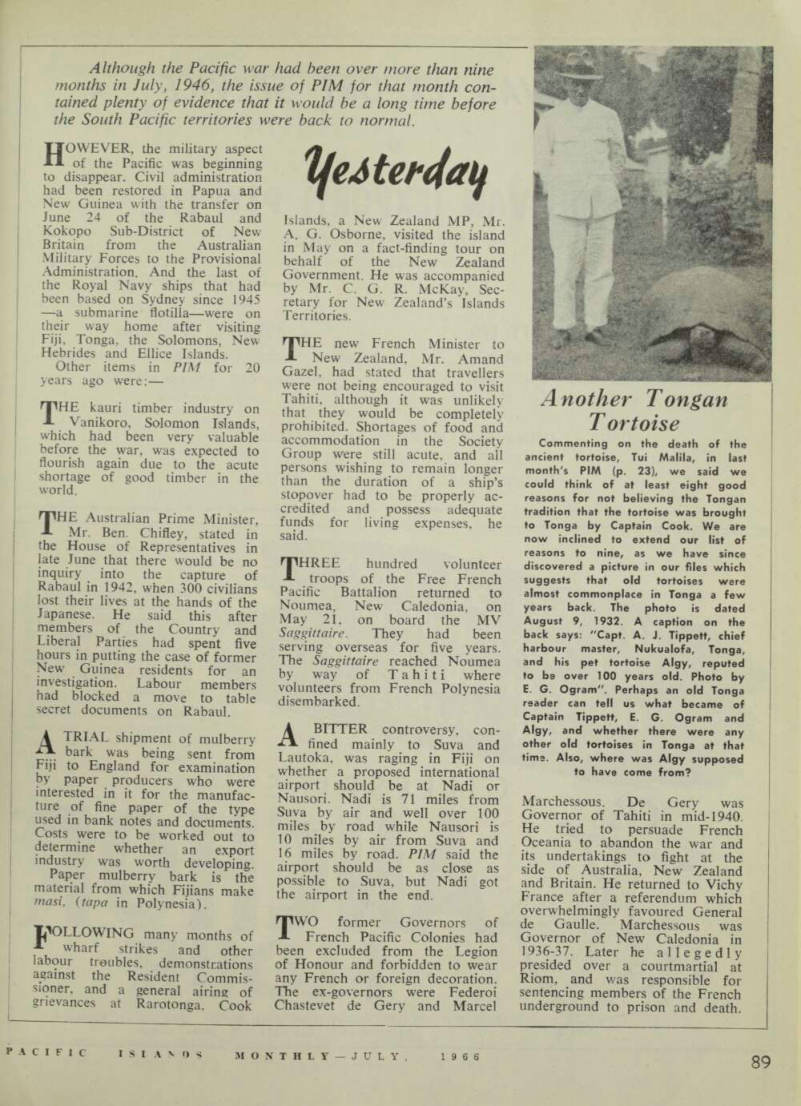
Another Tongan
Tortoise
Commenting on the death of the ancient tortoise, Tui Malila, in last month's PIM (p. 23), we said we could think of at least eight good reasons for not believing the Tongan tradition that the tortoise was brought to Tonga by Captain Cook. We are now inclined to extend our list of reasons to nine, as we have since discovered a picture in our files which suggests that old tortoises were almost commonplace in Tonga a few years back. The photo is dated August 9, 1932. A caption on the back says: "Capt. A. J. Tippett, chief harbour master, Nukualofa, Tonga, and his pet tortoise Algy, reputed to be over 100 years old. Photo by E. G. Ogram". Perhaps an old Tonga reader can tell us what became of Captain Tippett, E. G. Ogram and Algy, and whether there were any other old tortoises in Tonga at that time. Also, where was Algy supposed to have come from?