War In South-East Asia
pp. 93-94 · Read in the full issue
The Month's New Reading
Would the United States have become involved in South Vietnam in the way it has if its Government had really known what was going on there in the first place?
AMERICAN novelists William J.
Lederer and the late Eugene Burdick (co-authors of The Ugly American) do not essay to give the answer to this question in their new novel Sarkhan. But they certainly raise it, and they leave the reader with some unhappy doubts in the end.
Sarkhan is a mythical country in South-East Asia, ruled by a neutralist king who is about to abdicate in favour of his son, who has the same political outlook.
Haidho, Sarkan’s capital, is the headquarters of Edward Coldstream, an ex-American naval officer, who has built up the thriving South East Asia Trading Corporation, with trading posts all over the country.
In the course of his business, he has obtained an unrivalled knowledge of Communist efforts to infiltrate the country, and of the United States Federal Intelligence Agency’s efforts to keep tab on the Communists’ efforts.
Coldstream has a friend, Thaddeus McCauley, who is professor of Sarkhanese Studies at Cornell Univer sity. McCauley is also an agent for the US President’s Special Com mittee on Sarkhan, which was set up to avoid another Bay of Pigs fiasco.
The leader of the Communists in Sarkhan is a Sarkhanese called Tuc, who, although known to be a Com munist, is employed by Coldstream as a fish gutter.
He gives orders to the ambitious Sarkhanese Minister of Defence.
General Hajn, who is both a Com munist and a West Point graduate.
However, Hajn is not known to be a Communist by Coldstream, noi by the naive US Ambassador, nor by any other American.
Between Tuc and Hajn a plot is hatched to advance the cause of Communism in Sarkhan by getting the United States to give military aid.
Tuc’s theory is that the Sarkhanese will benefit economically from an influx of American soldiers; that the Sarkhanese will soon come to hate the Americans; and that when the hated Americans finally pull out of
Sarkhan, they will leave their valuable equipment behind them.
To put theory into practice, General Hajn’s men kidnap the prince and remove him to an isolated part of the country. Then they stage manage a phony Vietnamese in vasion of the northern province of Sarkhan, which General Hajn photo graphs from the air.
Hajn then convinces the other members of the Sarkhanese Govern ment of the necessity to seek Ameri can military aid, and, having done so, sets out to get it through the US Ambassador.
The US President calls on his Special Committee on Sarkhan to make a recommendation on this request. Thereupon, Coldstream and McCauley, the two best-informed Americans on Sarkhanese affairs, try to convince it that Sarkhan has not been invaded at all.
McCauley and Coldstream argue
that political power rather than military power is what the United States needs in Sarkhan.
McCauley says that a “Peace Corps kid” who “brings something useful” to the country would be more effective than “the sky-raider which brings a napalm bomb to your village . . . wipes out the village, blinds half the people, and leaves the rest with scars”.
Coldstream says: “We should help the Sarkhan Government create a communications system with every village, to show the Sarkhanese how their own government is better than a Communist regime. Send them rice to take care of the emergency caused by two bad crops. Send doctors who will go to the villages . . .”
Coldstream proves that at least two of the agents employed by the Federal Intelligence Agency in Sarkhan to collect information on the Communists are actually Communist double-agents . . . This, of course, annoys the head of the FIA (who is on the President’s committee) and he retaliates by smearing Coldstream and McCauley and somewhat dis crediting them.
Military Aid
The upshot is that the United States decides to send military aid to Sarkhan.
Subsequently, Coldstream and McCauley rescue the kidnapped prince from the place to which General Flajn had consigned him. and learn incidentally that Hajn is a Communist.
However, Hajn hears of the Americans’ activities before they return to the capital with the prince, and when this information is passed on to Tuc, word is passed around that the Americans were actually the prince’s kidnappers.
A mob then gathers outside the American Embassy, where Tuc shoots the prince but simultaneously raises the cry that the Americans did it. The mob thereupon tramples McCauley and Coldstream to death.
Hajn, the Communist general, is triumphant—and the Americans are backing him up to the hilt . . .
This, shorn of all its side issues, is the story that authors Lederer and Burdick have to tell.
They tell it with masterly skill; and as they assure their readers in
a prefatory note that the story has a “broad foundation of fact,” they are bound to leave them with an uncomfortable feeling about America’s performance in the South-East Asia area.
The message of the book obviously is that the political approach to Sarkhan’s problems would have been the right approach, and that the United States should now be using Coldstream-McCauley ideas in the non-mythical parts of South-East Asia, such as South Vietnam.
ABOOK to bp rpart ddp hv drip with \nrkhnr, k Wnr without Honour an inridvp inmiirv ‘nto thp in ‘ Smith hv another
L rli/r s?onP
o? ror?pll T
and B a Inprdal fl’ and a special correspondent in
°three n^J5 aper
group for three months in 1965.
The .tone of the book is established in the first paragraph.
“All wars are dirty,” Stone says.
“If the war in Vietnam seems dirtier than most, it is not because of what
is happening on the battlefields. It is because people are no longer sure whether their nations are fighting for a good and necessary cause, or a bad and unnecessary cause whether the resort to violence is warranted by the circumstances.
“The unwavering sense of right which steeled the allied publics to the death and destruction of two world wars and Korea is missing today . . .
Thorough Inquiry
“Young Americans, Australians and New Zealanders are being sent into combat for the first time this century with painful doubts about the justice of their mission. They are finding the honour of serving their countries stained with the dishonour of heaping suffering and ruin on an already impoverished Asian peasantry . . .”
Stone goes on to say that whatever choice the Western democracies make in future over continued involvement in Vietnam will cause suffering to perhaps hundreds of thousands of
South Vietnamese “whether they be those who want to keep their present government or those who sincerely believe their future lies in reunifica tion with the Communist north . . .”
Further on he says: “The ultimate judgment of the morality or im morality of the intervention will depend on whether [the Western Powers'] national interests prove to be in the long-range interests of humanity: whether the war can save future generations from an even greater, more general anguish.”
From this point, the author pro ceeds to make a thorough inquiry into the various aspects of the Vietnam conflict, looking at things particularly from the point of view of Australian involvement.
Every reader who follows him through to the end will probably finish up knowing a lot more about Vietnam than he did before, though he will not necessarily be any surer of the answers to that complicated
question.—RL.
(SARKHAN. Putnam. London. $A2.85.
WAR WITHOUT HONOUR. Jacaranda. 5A3.95.)
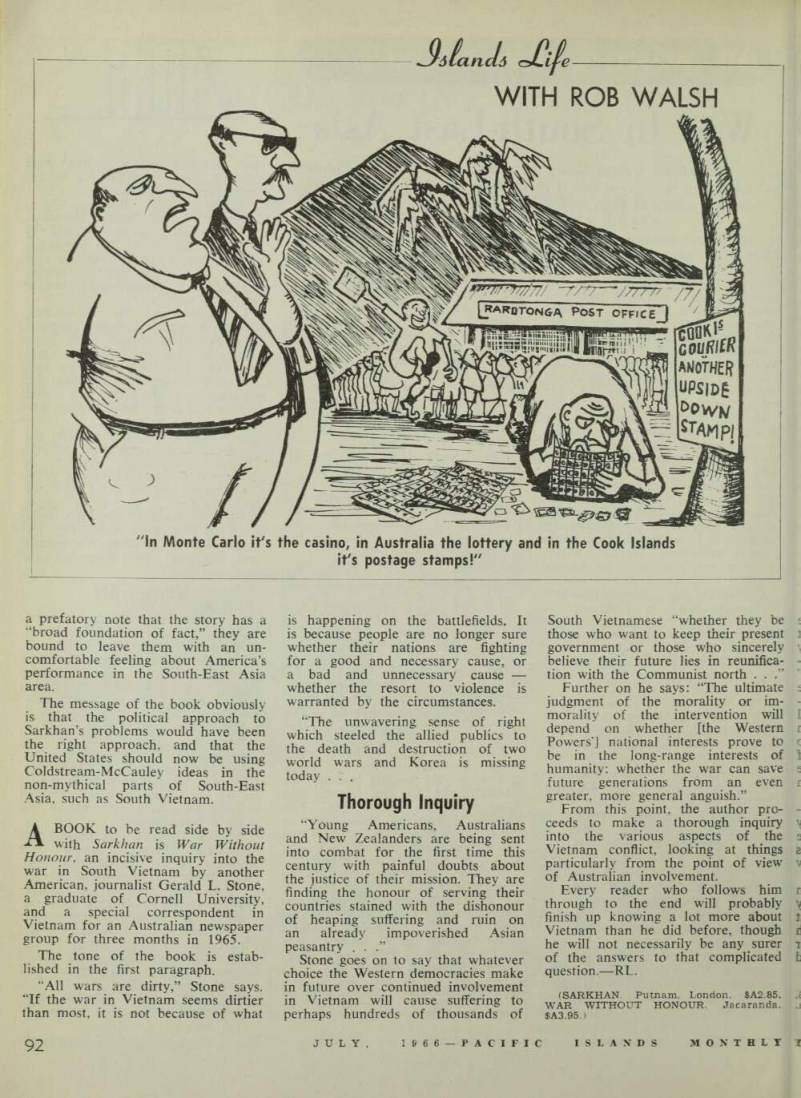
"In Monte Carlo it's the casino, in Australia the lottery and in the Cook Islands ifs postage stamps!"