Oldest Church In
pp. 87-89 · Read in the full issue
South Pacific
Stands On Site
Of Ancient
Human Sacrifices
By Robert Langdon
Several centuries ago, possibly as far back as the 16th century, a new religious cult sprang up on the Polynesian island of Raiatea and spread eastwards to Tahiti and Moorea, replacing the cult of the old god Tane.
THE god of the new cult was called Oro; and as with gods in all times and places, temples were built to worship him.
On Raiatea, which remained the Vatican, so to speak, of the new religion, the principal temple, or marae, was called Taputapuatea This was also the name of a marae at Tautira, where the cult of Oro first gained a foothold on Tahiti; and the same name was eventually applied to a marae on Moorea, originally known as Tepua-tea.
These ancient Polynesian cathedrals were made of huge blocks of coral and basalt, and were the scenes of many a human sacrifice.
The Taputapuatea of Raiatea is still in a good state of preservation, but little now remains of the other two, for they were systematically destroyed following the introduction of Christianity 150 years ago.
However, anyone who would like
to know where the Taputapuatea of Moorea once stood can find it easily enough, for the place is now the site of another temple, which is equally as interesting in itself.
This temple—a small, octagonal Protestant chapel—was the first build ing of stone to be built by Euro peans anywhere in the South Pacific.
So it is naturally the oldest building of its kind in the area.
The chapel was opened for worship in 1829 and has been in almost con tinuous use ever since. This is a record, which, as far as I know, no other European building in the South Pacific can remotely approach.
The chapel is situated near Pape toai village, a few yards from the water’s edge at the western entrance to fjord-like Papetoai (or Opunohu) Bay.
Octagonal Chapel
The building was modelled on an octagonal chapel built in Surrey, England, in 1783, for the Rev.
Rowland Hill, a prominent religious figure and ardent promoter of the London Missionary Society.
It was the London Missionary Society that sent the first Protestant missionaries to Tahiti in 1797. These missionaries established their head quarters on Tahiti. But in 1808, after their protector, the chief Pomare 11, was defeated in a civil war, they fled to Sydney—without having made a single convert.
They began drifting back to the Pacific in 1811; but as Tahiti was still unsettled, they re-established themselves for the time being at Papetoai.
By the end of May, 1812, the
mission consisted of seven couples— Mr. and Mrs. Henry Nott; Mr. and Mrs. William Henry; Mr. and Mrs.
Henry Bicknell; Mr. and Mrs.
William Scott; Mr. and Mrs. Charles Wilson; Mr. and Mrs. John Davies; and Mr. and Mrs. James Hayward— plus George Bicknell, a single man, and several children.
For the first year or two after their re-establishment on Moorea, the missionaries made no more headway in their efforts to Christianise the natives than they had during their 11 years on Tahiti.
Christianity Adopted
Then a series of encouraging developments occurred, which proved to be the harbingers of the wholesale adoption of Christianity on both Tahiti and Moorea at the end of 1815.
During the next few years, the missionaries were even busier than they had been before. They preached; taught school; organised auxiliaries of the Missionary Society; built a schooner in which to travel to the neighbouring islands; translated parts of the Scriptures into Tahitian; and printed spelling books, hymm books and the Gospels on a press shipped out from England.
In 1820, mainly through the enthusiasm of a young missionary, George Platt, who had arrived at Papetoai in 1817, they decided to build their first church of stone, along the lines of the Surrey chapel.
The chapel was to be 60 ft in diameter, with coral walls nearly 20 ft high and semi-circular doors and windows.
The Polynesian people at Pape-
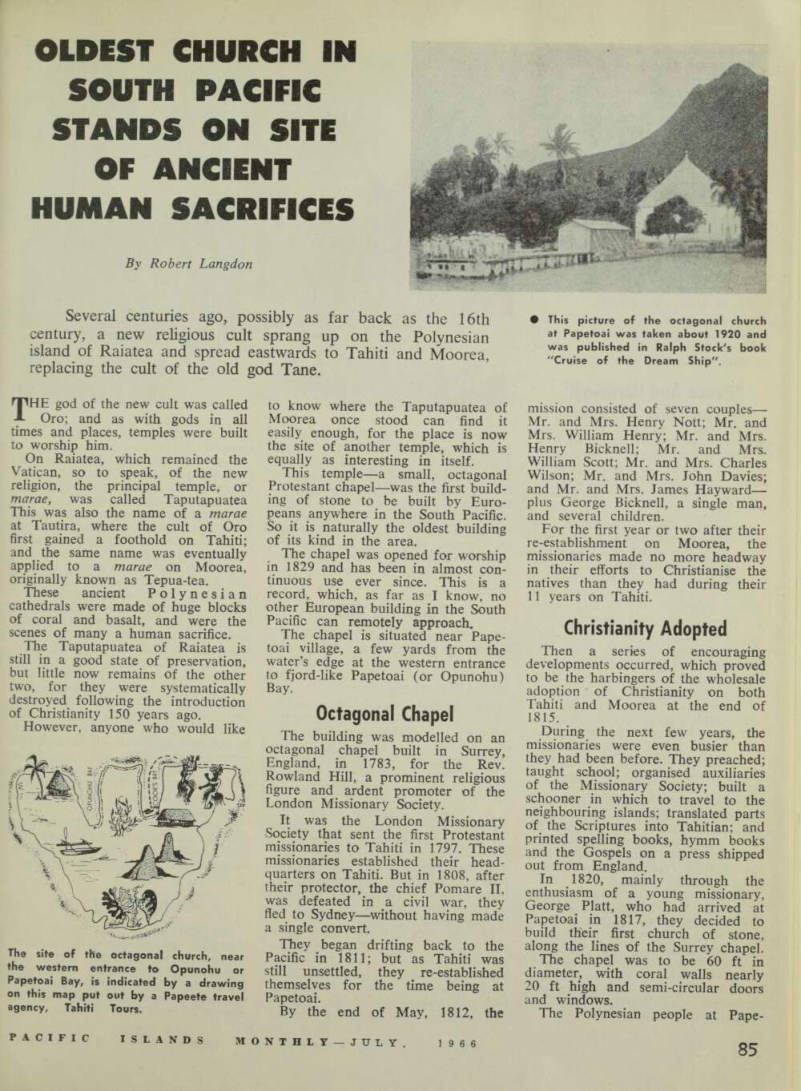
The site of the octagonal church, near the western entrance to Opunohu or Papetoai Bay, is indicated by a drawing on this map put out by a Papeete travel agency, Tahiti Tours.
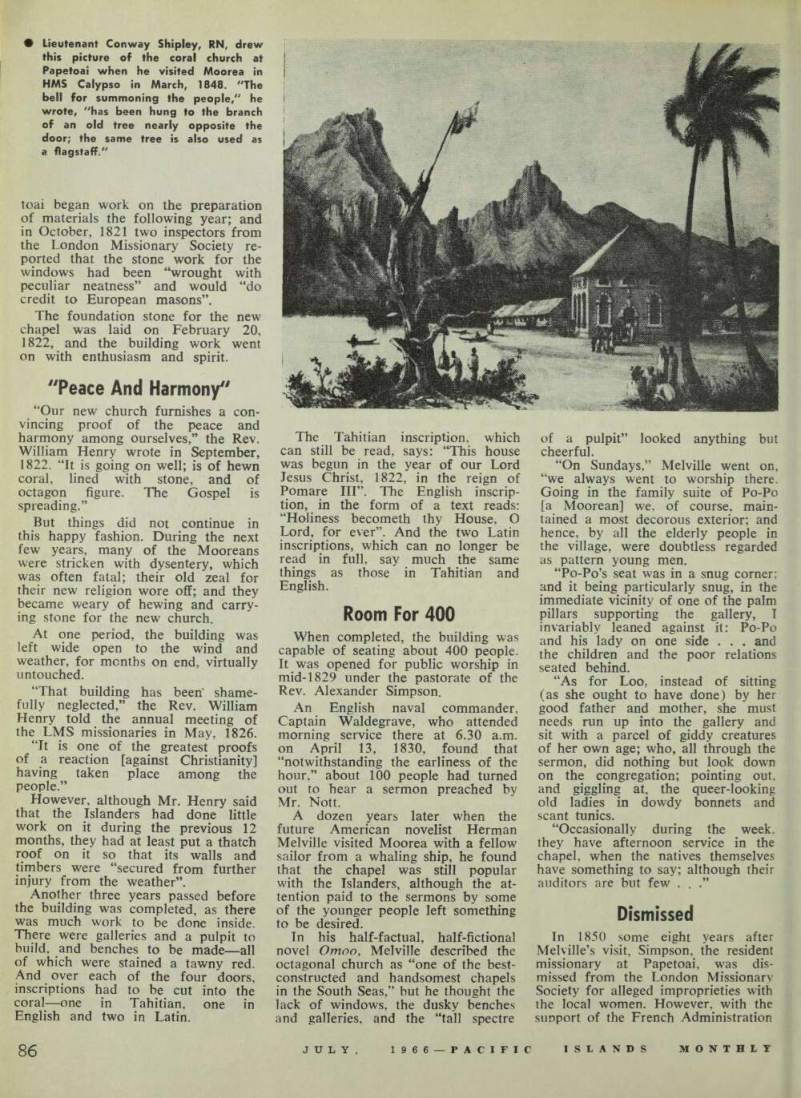
This picture of the octagonal church at Pa0petoai was taken about 1920 and was published in Ralph Stock's book "Cruise of the Dream Ship".
toai began work on the preparation of materials the following year; and in October, 1821 two inspectors from the London Missionary Society re ported that the stone work for the windows had been “wrought with peculiar neatness” and would “do credit to European masons”.
The foundation stone for the new chapel was laid on February 20, 1822, and the building work went on with enthusiasm and spirit.
"Peace And Harmony"
“Our new church furnishes a con vincing proof of the peace and harmony among ourselves,” the Rev.
William Henry wrote in September, 1822. “It is going on well; is of hewn coral, lined with stone, and of octagon figure. The Gospel is spreading.”
But things did not continue in this happy fashion. During the next few years, many of the Mooreans were stricken with dysentery, which was often fatal; their old zeal for their new religion wore off; and they became weary of hewing and carry ing stone for the new church.
At one period, the building was left wide open to the wind and weather, for months on end, virtually untouched.
“That building has been shame fully neglected,” the Rev. William Henry told the annual meeting of the LMS missionaries in May, 1826.
“It is one of the greatest proofs of a reaction [against Christianity] having taken place among the people.”
However, although Mr. Henry said that the Islanders had done little work on it during the previous 12 months, they had at least put a thatch roof on it so that its walls and timbers were “secured from further injury from the weather”.
Another three years passed before the building was completed, as there was much work to be done inside.
There were galleries and a pulpit to build, and benches to be made—all of which were stained a tawny red.
And over each of the four doors, inscriptions had to be cut into the coral—one in Tahitian, one in English and two in Latin.
The Tahitian inscription, which can still be read, says: “This house was begun in the year of our Lord Jesus Christ, 1822, in the reign of Pomare III”. The English inscrip tion, in the form of a text reads: “Holiness becometh thy House, O Lord, for ever”. And the two Latin inscriptions, which can no longer be read in full, say much the same things as those in Tahitian and English.
Room For 400
When completed, the building was capable of seating about 400 people.
It was opened for public worship in mid-1829 under the pastorate of the Rev. Alexander Simpson.
An English naval commander.
Captain Waldegrave, who attended morning service there at 6.30 a.m. on April 13, 1830, found that “notwithstanding the earliness of the hour,” about 100 people had turned out to hear a sermon preached by Mr. Nott.
A dozen years later when the future American novelist Herman Melville visited Moorea with a fellow sailor from a whaling ship, he found that the chapel was still popular with the Islanders, although the at tention paid to the sermons by some of the younger people left something to be desired.
In his half-factual, half-fictional novel Omoo, Melville described the octagonal church as “one of the best constructed and handsomest chapels in the South Seas,” but he thought the lack of windows, the dusky benches and galleries, and the “tall spectre
of a pulpit” looked anything but cheerful.
“On Sundays,” Melville went on, “we always went to worship there.
Going in the family suite of Po-Po [a Moorean] we, of course, main tained a most decorous exterior; and hence, by all the elderly people in the village, were doubtless regarded as pattern young men.
“Po-Po’s seat was in a snug corner: and it being particularly snug, in the immediate vicinity of one of the palm pillars supporting the gallery, I invariably leaned against it: Po-Po and his lady on one side . . . and the children and the poor relations seated behind.
“As for Loo, instead of sitting (as she ought to have done) by her good father and mother, she must needs run up into the gallery and sit with a parcel of giddy creatures of her own age; who, all through the sermon, did nothing but look down on the congregation; pointing out. and giggling at, the queer-looking old ladies in dowdy bonnets and scant tunics.
“Occasionally during the week, they have afternoon service in the chapel, when the natives themselves have something to say; although their auditors are but few . . .”
Dismissed
In 1850 some eight years after Melville’s visit, Simpson, the resident missionary at Papetoai, was dis missed from the London Missionary Society for alleged improprieties with the local women. However, with the sunport of the French Administration
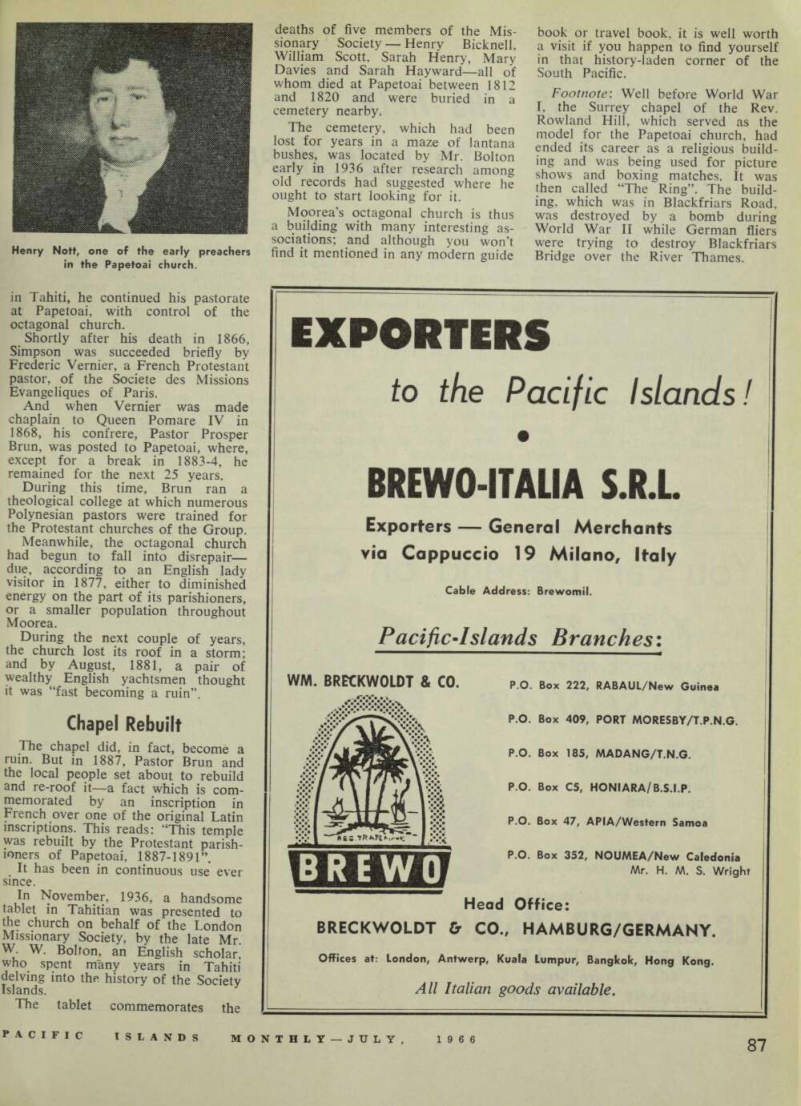
Lieutenant Conway Shipley, RN, drew this picture of the coral church at Papetoai when he visited Moorea in HMS Calypso in March, 1848. "The bell for summoning the people," he wrote, "has been hung to the branch of an old tree nearly opposite the door; the same tree is also used as a flagstaff."
in Tahiti, he continued his pastorate at Papetoai, with control of the octagonal church.
Shortly after his death in 1866, Simpson was succeeded briefly by Frederic Vernier, a French Protestant pastor, of the Societe des Missions Evangeliques of Paris.
And when Vernier was made chaplain to Queen Pomare IV in 1868, his confrere. Pastor Prosper Brun, was posted to Papetoai, where, except for a break in 1883-4, he remained for the next 25 years.
During this time, Brun ran a theological college at which numerous Polynesian pastors were trained for the Protestant churches of the Group.
Meanwhile, the octagonal church had begun to fall into disrepair— due, according to an English lady visitor in 1877, either to diminished energy on the part of its parishioners, or a smaller population throughout Moorea.
During the next couple of years, the church lost its roof in a storm; and by August, 1881, a pair of wealthy English yachtsmen thought it was “fast becoming a ruin”.
Chapel Rebuilt
The chapel did, in fact, become a ruin. But in 1887, Pastor Brun and the local people set about to rebuild and re-roof it—a fact which is com memorated by an inscription in French over one of the original Latin inscriptions. This reads; “This temple was rebuilt by the Protestant parish ioners of Papetoai, 1887-1891”.
It has been in continuous use ever since.
In November, 1936, a handsome tablet in Tahitian was presented to the church on behalf of the London Missionary Society, by the late Mr.
W. Bolton, an English scholar, who spent many years in Tahiti delving into the history of the Society Islands.
The tablet commemorates the
deaths of five members of the Missionary Society Henry Bicknell, William Scott, Sarah Henry, Mary Davies and Sarah Hayward—all of whom died at Papetoai between 1812 and 1820 and were buried in a cemetery nearby.
Thf* „,u,vu . . . lost tor years in a maze of lantana eariv eS in W m fi l0C a ? f ted B °" 0n nfrl y rppnrH^ 3^rf fter rese * rch am °ng nlmhf 6 5 2 S , u .^ ested .where he ought to start looking for it.
Mooreas octagonal church is thus a building with many interesting associations; and although you won’t find it mentioned in any modern guide
book or travel book, it is well worth a visit if you happen to find yourself in that history-laden corner of the South Pacific.
Footnote: Well before World War I, the Surrey chapel of the Rev.
Rowland Hill, which served as the model for the Papetoai church, had ended its career as a religious build ing and was being used for picture shows and boxing matches. It was then called “The Ring”. The build ing, which was in Blackfriars Road, was destroyed by a bomb during World War II while German fliers were trying to destroy Blackfriars Bridge over the River Thames.
Henry Nott, one of the early preachers in the Papetoai church.