Territories TALK-TALK
pp. 59-61 · Read in the full issue
With Tola la
Written on 6/6/66 You will notice that I have a date-line this issue. It so happened that I took up my “Talk Talk” pen today and it synchronised with “Elevenses Day”, which I mentioned in the January issue.
IHAVE had my silent toast, turned down an empty glass for the one with whom I had made an appoint ment on 5/5/55 for this day. He was a good cove and I hope he rests peacefully.
And then I opened a letter, which had come to me a few days pre viously embellished with USA postage stamps commemorating everything from a circus clown, Humane Treat ment to Animals, Professor Einstein and Franklin Roosevelt. (There’s no doubt about the US Post Office, it never misses a trick.) And then there was an inscription on the envelope: “Please do not open until Elevenses Day, 6/6/66.”
It proved to be from South Seas Wanderer, Gertrude Baker, of Cali fornia, conveying greetings and work ing out the chronological differences of time in California and Sydney to enable us to have our toast at the same time. Thanks a lot, Gertie.
Noted also the Elevenses Game seems to be growing. The Sydney Sunday Telegraph mentioned a report of an old girls’ meeting of the Ravenswood College. First meeting on 5/5/55, second meeting today, 6/6/66 and the next meeting, natur ally, on 7/7/77. Sydney’s Sun-Herald had a par on its back page “To morrow is 6/6/66, the sort of date it takes at least 11 years to reach”.
Even the South Pacific Post gave it a mention. Who knows? ... It might become a gimmick one of these days.
Take A Bow, Pidgin
KINDNESS and consideration of the University of Queensland has enabled Pidgin-English—or to give it its fancy name “Neo-Melanesian”— to regain some of its lost self esteem; lost as a result of continued attacks by some of the Administra tion heads during recent years. Now a course in the language is offered by the university’s Institute of Modern Languages.
A great pity this step was not
Pidgin Regains
Some Of Its
Self-Esteem
taken some 40 years ago. It would have saved a vastness of misunder standing, many brawls, not a few court cases and a murder or two.
When you fully consider the sub ject, it’s a wonder there were not more tragic results from misunder stood commands by the Europeans ignorant of the proper means of communication, and answers from natives to whites, often deemed in solent or rebellious when there was no such intention.
In some ways Pidgin is more cor rect than our own idiomatic English.
For example: “Master he no stop?” asks the European.
“Yes,” replies the servant, correctly agreeing that the master does not stop. In English we would usually reply “No,” ignoring the fact that two negatives make an affirmative.
Invariably the conversation con tinues: “Sing out he come. Me like talk along him.”
“Master he no stop!”
“Belong what-name you talk he stop?”
And once again the fat is in the fire. The Aussie thinks the New Guinean is deliberately lying to him; the New Guinean thinks the Aussie is just plain “long-long”.
Up to the present I have read of no comments from the vice-chancellor of the Papua-New Guinea University regarding this added curriculum to the Bananaland’s Hall of Learning.
Most people know that John Gunther has a stolid preference for pure English over the “pidgin”. One assumes it will be a brave soul who will create an echo of Neo-Melanesian resounding through his university.
I have an idea we can look for-
ward to some lively polemics up around Port Moresby when the for mer Assistant Administrator gets settled in the saddle as academic dic tator. There is no doubt he has been the life of the party in the past and it would be too optimistic al together to expect Sir Donald Cleland’s successor to be much more than a Canberra sounding-board. (Let us hope the new Administrator has the ability to smile when a Press camera clicks. It’s good for publicity to have a smiling head of govern ment).
A Mis-Nomer
IF the Pressman who reported that Lady Casey, wife of the Governor- General, had the Pidgin-English title of “mary bilong Lord Casey”, is really sincere in his statement, then Pidgin has slipped a long way since my time in the territory.
It must, presumably, refer to the Trust side of the border. In Papua, I understand, the word Sinabada is still current. In New Guinea the rather frumpish word Missus is still being used for reference to a white woman. In early days the Methodists made an attempt to adopt the Fijian word mamma for the wives of their missionaries, but it did not go over, except in mission circles.
However, even missus is a shade better than mary and let not these up and-coming southern newspaper cor
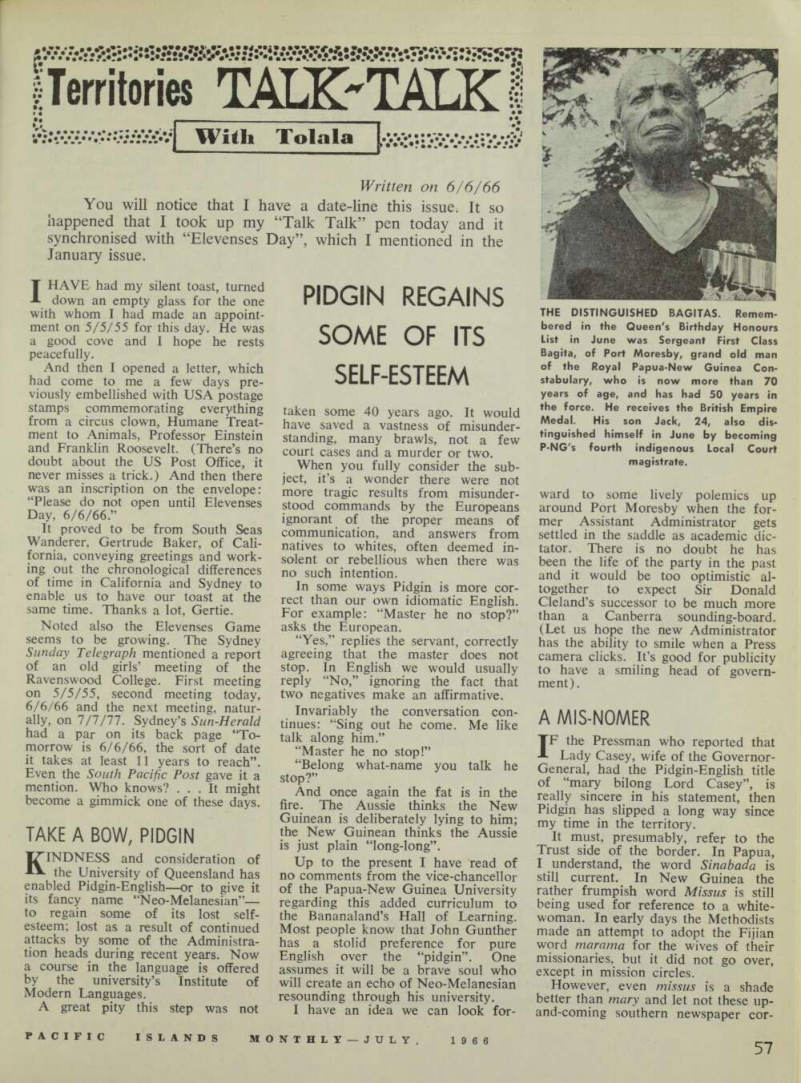
The Distinguished Bagitas. Remem
bered in the Queen's Birthday Honours List in June was Sergeant First Class Bagita, of Port Moresby, grand old man of the Royal Papua-New Guinea Con stabulary, who is now more than 70 years of age, and has had 50 years in the force. He receives the British Empire Medal. His son Jack, 24, also dis tinguished himself in June by becoming P-NG's fourth indigenous Local Court magistrate.
respondents, bursting with sensational enthusiasm, make any mistake about that.
My own mild criticism of the Casey tour is that he should have worn all his feathers and gold braid.
The people would have liked it.
The psychological evaluation of the democratic reaction, I am afraid, went over the people’s heads. They are a folk who admire chieftainship.
If you have a feather—wear it. I think it was a bit of modernism introduced a little bit too soon. John Guise might have been the only one who appreciated Lord Casey’s gesture.
However ... I don’t suppose it will affect the price of fish at Koki or keep any students away from the Port Moresby Uni.
Bagana Blows Her Top
Co Mount Bagana in Central Bougainville, not far from the Torokma area, has done the right thing again. By that I mean it has eased itself of accumulated pent-up emotions which must receive ex pression; otherwise a major seismic exhibition is rife. It happened in June.
Bagana is only 5,700-odd feet high, but it is one of those constantly steaming volcanoes, ever reminding you that it is there. Mount Balbi, on the other hand, some miles north of Bagana, reaches a height of some 10,000 feet. For some years I dwelt ’neath the shadow of Balbi when at Arigua. Only a tall, white spiral plume of smoke or steam rose each morning from its crater, but often its cold breath came down at night and gave my workers pleurisy and pneumonia.
This volcanic ash, pumice and what-not is a wonderful basis for coconut planting.
And talking about eruptions: I see where the natives lost their case when applying for the ownership of land left when Vulcan Island erupted in 1937. It has now become Govern ment land. In February, 1878, when Vulcan Island was spewed up there were no complicated land laws and the Karavia people had no trouble establishing their claim to the newly erupted land.
Opinions vary no doubt on the verdict handed out the other day favouring the Government. And one is inclined to examine more fully the meanings and intentions of the words trustee, trust and trusteeship. Just how much may a trustee avail itself of the assets of its trusteeship? . . .
The trust in New Guinea is held on behalf of whom—New Guinea, Germany or United Nations?
Just how crazy can we get?
The highlight of the Rabaul eruption in ’37 to me was wandering up the Ratavul Tunnel Road in complete dark ness at about five in the afternoon, having ditched my car on the Mala qunan Road coming from Ravuvu.
At the cross-roads I joined a band of frightened natives escaping from Rabaul. We all held hands and trudged on towards the north coast; each native was repeating the Lord’s Prayer: Tama i vevet arama ra balana bakut, boina ba da ru ra iagim.
Boina ba na wut kaum warkurai.
Boina ba da torom tam ta ra rakarakan a qunan, warqop dia torom tam arama ra balana bakut At the time the significance did not strike me so much. I was too busy trying to keep the ash from Vulcan from creeping up my nose; but later, holding a quiet post-mortem on events, I realised just how much the lotu —the Christian faith—had meant to these primitive people in their time of terror.
Put them on the spot. You find out what they’ve got.
And—just quietly—l think you’d find they have a more sincere appre ciation of the comfort of Christian religion than we whites who intro duced it to them.
Come In,
Mary Baxter-Bruce
AGONY column item: The above named, who was a friend of Miss Mabel Stevenson, of Malvern, Victoria, is wanted to communicate with Messrs. Blake and Roggall, Solicitors, 120 William Street, Mel bourne. She might be leaving her a pet canary.
Long years since I sat with Mrs.
Baxter-Bruce in the lounge of the Rabaul Hotel. She had personality plus, and her husband was one of the lesser legal eagles of Rabaul. He was there in the time of E. V. (“Bully”) Hayes, Justin Rowan and E. T. Browne; and Alan McLennan was somewhere in the background.
These were the legal gentry sitting at the bar table in the Rabaul Court and at that time (1923) one of the judges was a Drake-Brockman, a member of the West Australian family, a cranky specimen, and the husband of a very pretty wife.
We have had some interesting types of legal eagles and justices deal ing out the law in New Guinea, starting with Hahl (the German judge for the Neu Guinea Kom pagnie, who became first Governor of the colony). Then came the Aussie regime with Seaforth Mac-
Kenzie (he wrote a good history of the NG occupation) and old Daddy More, a very likeable gentleman. I wish some qualified man would write a history of New Guinea’s early clashes with the law and deliver the judgments of cases of many years They could start off with the missionary, George Brown’s case, heard before a Naval court of inquiry on a charge of murder in New Britain back in the 1870’s, and they would gradually work down the list.
Not the least interesting would be that of Ludwig Schmidt who ended p n ? the scaffold in Rabaul in the 30’s. His trial for murder was a most interesting item and had political
repercussions in Australia. He was the only white man to be hanged in New Guinea for murder. I still re member that execution at dawn up at the Police Compound, Everyone was extremely nervous, even Tom MacFarlane, sturdy ex- RNWMP that he was, and a man who pulled the trap admitted to hav ing the jitters. But he carried out the job alright. The only person who appeared unconcerned was the princi pal actor himself, Ludwig Schmidt who walked up the steps of the gallows steadily, listened to the Catholic priest quietly while he told him all about it. So far as I know I am the only survivor of that dawn incident.