Cash To The Highlands
pp. 54-57 · Read in the full issue
The White Daisy That’S Brought
From a Mt. Hagen Correspondent The task of discovering new avenues of development is not easy, and the opening of Stafford Allen’s pyrethrum extrac tion plant here at Mount Hagen, in New Guinea’s Western Highlands, is a significant occasion for the entire Highlands region.
BEFORE the establishment of the industry a large section of this region’s population felt neglected.
The Highlands as a whole had begun to establish a sound cash economy based on primary production, but a large section of the community had no share of it. People living at altitudes below 6,000 ft were obtain ing an income from such crops as coffee, peanuts and passionfruit, but there was little or nothing for their fellows living in the upper altitudes of these mountain plateaux.
The Department of Agriculture had for years been looking for a crop capable of providing a cash income for these people.
Pyrethrum (Chrysanthemum cine rariaefolium), a small white daisy which is the source of a powerful insecticide, had for a long time ap peared to be the answer, since the crop flourishes at altitudes of above 6,000 ft.
Pyrethrum seed was actually intro duced into the territory shortly after the war, but since none of the types
introduced would flower satisfactorily under local conditions, the prospects of success appeared remote.
Nevertheless, in 1955 the Depart ment of A gficulture embarked on an
tatog^^am^^toT'suited
to the territory, it was a slow and arduous process, but finally, in 1961, two suitable strains were produced.
How, then, to make it a marketing proposition? It was much more than
simply distributing seed to a suitably
grateful populace with the assurance
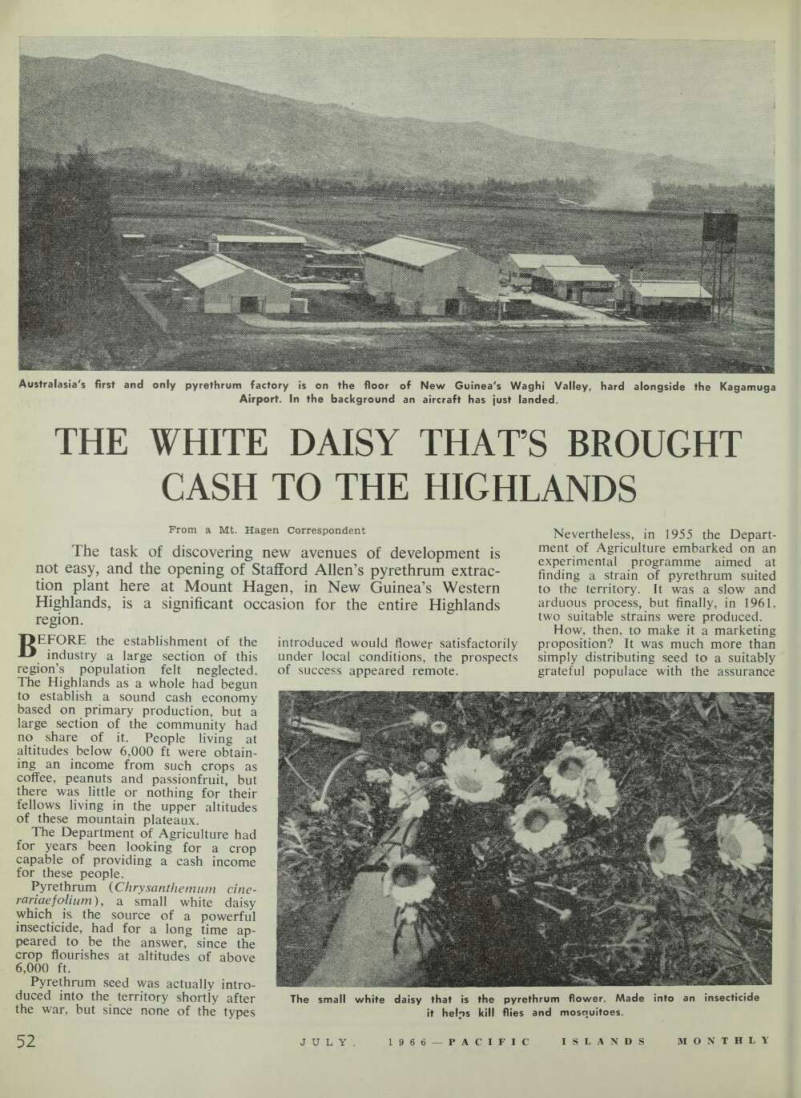
Australasia's first and only pyrethrum factory is on the floor of New Guinea's Waghi Valley, hard alongside the Kagamuga Airport. In the background an aircraft has just landed.
The small white daisy that is the pyrethrum flower. Made into an insecticide it helps kill flies and mosquitoes.
that growers would get a good price for the resulting crop.
The world demand for the insecti cide to be extracted from the flower was certainly enormous, but there was not a single pyrethrum extraction plant in the whole of Australasia.
It was a happy coincidence that Dr. William Mitchell, chief chemist with Stafford Allen and Sons in London, paid a visit to Australia shortly after the Agriculture Depart ment’s experiments had finished.
Stafford Allen is a large chemical organisation long established in the pyrethrum industry, and the Adminis tration promptly invited Dr. Mitchell to the territory.
Dr. Mitchell was greatly impressed with what he found. The two strains of pyrethrum produced by the depart ment were at least equal to any in the world in yield per acre and in the pyrethrin content of the flowers (which determines the value of the crop as a source of insecticide).
Furthermore, the New Guinea High lands offered almost ideal conditions for the cultivation of the crop.
Half Million Investment
Acting on Dr. Mitchell’s favour able report, Stafford Allen made a thorough investigation into the pros pects of establishing a pyrethrum industry in New Guinea, culminating in a decision in 1963 to form a new company—Stafford Allen (NG) Pty.
Ltd.—to collaborate with the Ad ministration in producing the crop on a large scale in the Highlands.
Stafford Allen invested $500,000 in this project and in 1964 plans were drawn up for the pyrethrum extrac tion plant at Mount Hagen. The plant was designed by a large American engineering firm, Lummus Co., who also supervised construc tion.
It was a tremendous undertaking.
All equipment, shipped from the UK to Madang, had to be flown from there to Mount Hagen. This airlift, using TAA Bristol Freighters, in volved some 250 tons of equipment and was one of the biggest ever at tempted in the territory.
Heavy rains and other setbacks delayed building operations, and at one stage the factory was two months behind schedule. Yet somehow it was completed on time, and trial runs were finished last December.
Native Impact
Since January 1 the factory has been in full production and in the past six months has processed hundreds of tons of pyrethrum flowers grown by the people of the
c , r- , Western Southern and Eastern High lands. The opening by the Governor- General, Lord Casey, on May 16, was merely an official occasion.
While some people felt that an official opening ceremony so many months after the factory had started operations was a superfluous for mality, they didn’t take into account the impact of such a ceremony on New Guinean pyrethrum growers.
Before May 16 most of the people producing the crop had little or no idea what happened to the flowers
after they had harvested them and sold them to the Department of Agriculture, The Administration selected 1,050 pyrethrum growers from all parts of the Eastern, Western and Southern Highlands and transported them to Mount Hagen to take part in the opening. This wasn’t easy. Most of them had to be housed and fed for a period of five days, and it was the Administration’s responsibility to pro vide accommodation, and Stafford Allen’s to supply the tons of sweet potato to feed the hungry throng, The sight of 1,050 Highlanders in full ceremonial tribal dress lined up to greet the Governor-General, Lord Casey, on his arrival at the factory made the operation seem well worth
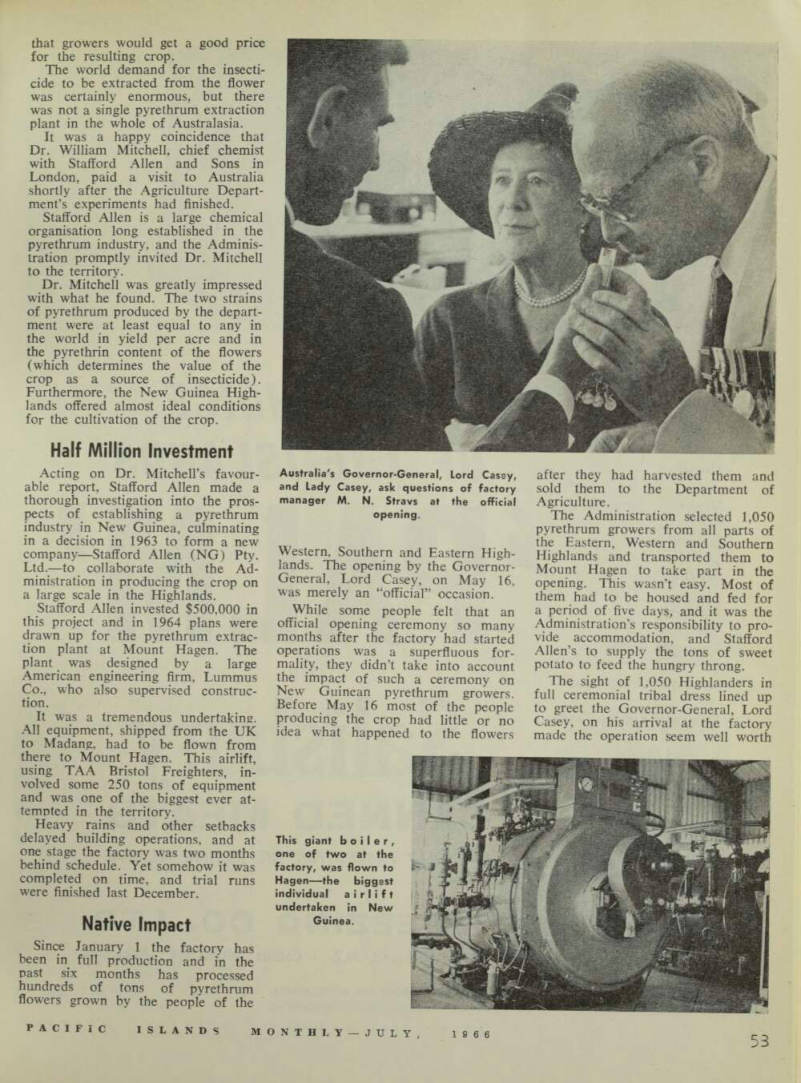
Australia's Governor-General, Lord Casey, and Lady Casey, ask questions of factory manager M. N. Stravs at the official opening.
This giant boiler, one of two at the factory, was flown to Hagen—the biggest individual airlift undertaken in New Guinea.
while. Later these growers inspected the factory and sat down to a feast of 3,000 lb of fresh beef.
Without the native growers there would be no industry. While they are themselves benefiting, it is ob vious that Stafford Allen is not in vesting $500,000 in the project out of purely altruistic motives. The growers are as necessary to Stafford Allen as Stafford Allen is to the growers.
The partnership aspect was stressed by the Stafford Allen (NG) com pany’s managing director, Mr. Peter Muller, when he called the new in dustry a “monument to the fruitful co-operation of the native people, the Administration and private enter prise”.
The Administration estimates that there are now more than 3,000 acres of pyrethrum planted by native growers.
Treatment Method
Briefly, the treatment process is one in which the sun-dried flower heads are ground to a fine powder and then placed in huge extractors.
Petroleum ether is run through these crushed flowers continuously until all the pyrethrins (the toxic compounds formed in glands at the base of the flowers) are dissolved.
The resulting solution is then rur through a still, which removes all the petroleum ether, and leaves a dart amber oily liquid, pyrethrum extract, which is sealed in drums and shipped to the UK for further processing.
The plant is also adaptable to the extraction of essential oils from many other local products. The factory’s chief chemist is experimenting with the extraction of a food colouring from the Bixa orellana tree and the distillation of peppermint oil from mint, as well as distilling a perfume from the flowers of the Cananga odorata tree.
While the plant’s chief chemist and engineer were brought out from England, and the manager, clerical assistant and one laboratory assistant are Australians, other laboratory assistants and all plant operators and general labourers are natives of the territory.
All but the general labourers are recruited from the coast, but Stafford Allen is co-operating with technical and high schools in the Highlands’ region in the selection of local men for the more skilled jobs.
The company also intends to in vestigate the possibility of training its native employees for higher profes sional and managerial duties, and is thinking of creating a scholarship for a chemist.