Craftsmen May
pp. 63-65 · Read in the full issue

Solomon Arts Are
Dying Out, But
Still Be Found
By Rev. Dr. C. E. Fox.
In house-building the Solomon Islanders excelled the New Hebridians. The original house in the Eastern Solomons was a round house which can still be seen in Santa Cruz; but
immigrants brought in the oblong form.
HPRACES of the old form can be seen in the apselike end of many of the oblong houses.
The finest example of house building was found in the great canoe houses (Kiala in Gela) which were very large, with carved posts and elaborate sago palm roofs, the sewn portions lapping very close each over the other.
The great canoe house at Wango in Arosi was a glorious work of art. As you entered it you were struck dumb with the beauty of it, both long walls elaborately decorated with paintings of fighting scenes, hunting scenes, fishing scenes, with finely carved fish, crocodiles, sharks, birds and so on. In my book the Thres
hold of the Pacific I give an account of Marouhe.
After a boy’s two years of seclusion, decked in all his ornaments, he came and sat in state on a splendid platform adorned with carvings of all sorts, and gay with streamers of grass dyed red. The great wooden bowls for puddings at feasts or for sacrifices, were ela borately carved (especially the latter) with figures of men or birds. I once made a collection of these. They are in Dunedin Museum, New Zealand, and well worth seeing.
Solomon Island canoes also were fine works of art, the boards sewn together, with high curved ends. I remember one, holding 60 men. and
inlaid beaiitifully with mother-of pearl from the nautilus, with strings of white cowries (Ovula ovuleum) round the front, and red streamers.
You might once have seen a fleet of 50 of these, each full of armed men.
Weapons were fine works of art: the black, highly polished, paddle shaped bwanata (“head splitter”) of Arosi, with its rib down the middle to turn off spears; spears of all sorts; on Malaita bows and arrows finely made; on Arosi crossbow and blow pipes.
To feasts we went in full dress, strings of white cowries below the knees (in the case of chiefs, round the forehead and in their case crescent or round ornaments from the golden-lipped pearl shell). We also wore on wrists and ankles bands of woven dyed grass and heavy shell armlets (with a sharp cutting edge in case we needed to wrestle with an enemy); also strings of red and white disks (“sunblood” and “moonblood”) made from shells, and used as money.
The centre of pottery making in the Eastern Solomons was at Pamua.
When I was there, pots some two feet high were still to be seen and shards were common in garden land.
The glaze was different from Fijian
The grand old man of the Solomons, the 85-year old missionary Rev. Dr. Charles E. Fox, has recently attacked the neglect of Solomons art. In a broad cast over the Solomon Islands Broadcasting Service he said this neglect was "shameful". Later he sup plied the Government-sponsored BSIP News Sheet with an article on the changes that he has seen in Solo mons art over the last 50 years. The article is re printed here by permission of the BSIP Government.
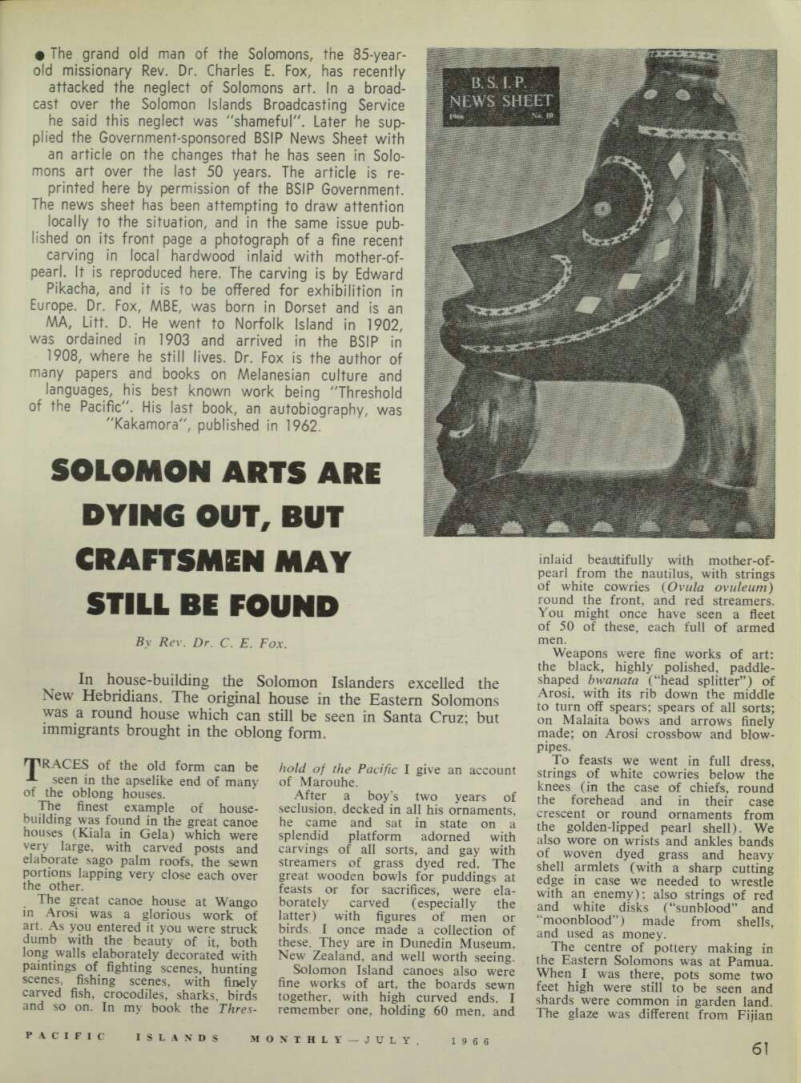
The news sheet has been attempting to draw attention locally to the situation, and in the same issue pub lished on its front page a photograph of a fine recent carving in local hardwood inlaid with mother-of pearl. It is reproduced here. The carving is by Edward Pikacha, and it is to be offered for exhibilition in Europe. Dr. Fox, MBE, was born in Dorset and is an MA, Litt. D. He went to Norfolk Island in 1902, was ordained in 1903 and arrived in the BSIP in 1908, where he still lives. Dr. Fox is the author of many papers and books on Melanesian culture and languages, his best known work being "Threshold of the Pacific". His last book, an autobiography, was "Kakamora", published in 1962.
pottery and was described in an article in the Polynesian Journal.
Readers will remember the great bushes of hair on men’s heads, some times dyed red, or parti-coloured and carefully combed with beautifully made tortoiseshell or wooden combs.
When men went bald they wore elaborate wigs of human hair. Walk ing sticks as we know them were not used, but chiefs and old men had staves about 5 ft long with carved ends of dogs or other animals.
At all feasts, and indeed on most nights of full moon, there was dancing and singing.
Men dreamed new dances and songs and then taught them. The dancers often imitated fishing or hunting or fighting (war dances) and the dancers dressed gaily, wearing ornaments; sometimes drama splendidly acted, both tragedy and comedy with devils of all forms, or a ghost dance of the dead, in which the masks and all the dress and ornaments were old and rotting.
Parties of dancers would go on a tour of the villages, performing their dances and dramas. When a finely made and decorated canoe was launched it would go on a tour round the island to receive the adminiration (and gifts) of the villagers.
Their art has been largely pre served in churches, in their carved lecterns and inlaid altars; for example in the beautiful inlaid ( reores ) work at the ends of the seats in the Norfolk Island chapel.
I remember a small church at Sapa on Ysabel so full of mother
of-pearl work on altar, lectern, prayer desk and posts that as you entered the whole interior flashed silver before your eyes. Also an old and dirty log in a swamp which Manta of Ulawa took and transformed into a very lovely pastoral staff (Shepherd’s crook) for his bishop, inlaid through its whole length with reores (mother-of-pearl) and red and blue shell work.
Santa Cruz art is different, in red, black and white geometrical patterns.
In the old days you saw no one idle. Apart from their gardens, in which they took such pride, and about which they knew a great deal, there was so much to be made (instead of European things to be
bought). Everyone spent his spare time in creating things of use or beauty, trying to make each as good as he was able—weapons for war, canoes, fishing nets, carved figures, paintings, ornaments, bowls, It is hoped when the new cathedral is built at Honiara to fill it with Melanesian art; for crafts men, though fewer in number now, are still to be found, the best perhaps in Santa Ana, Arosi, Ulawa and Ysabel.
Their old world was a world of arts and crafts, fighting, dancing, drama, singing and magic, both grim and joyous, so different from the world into which we are leading them now.
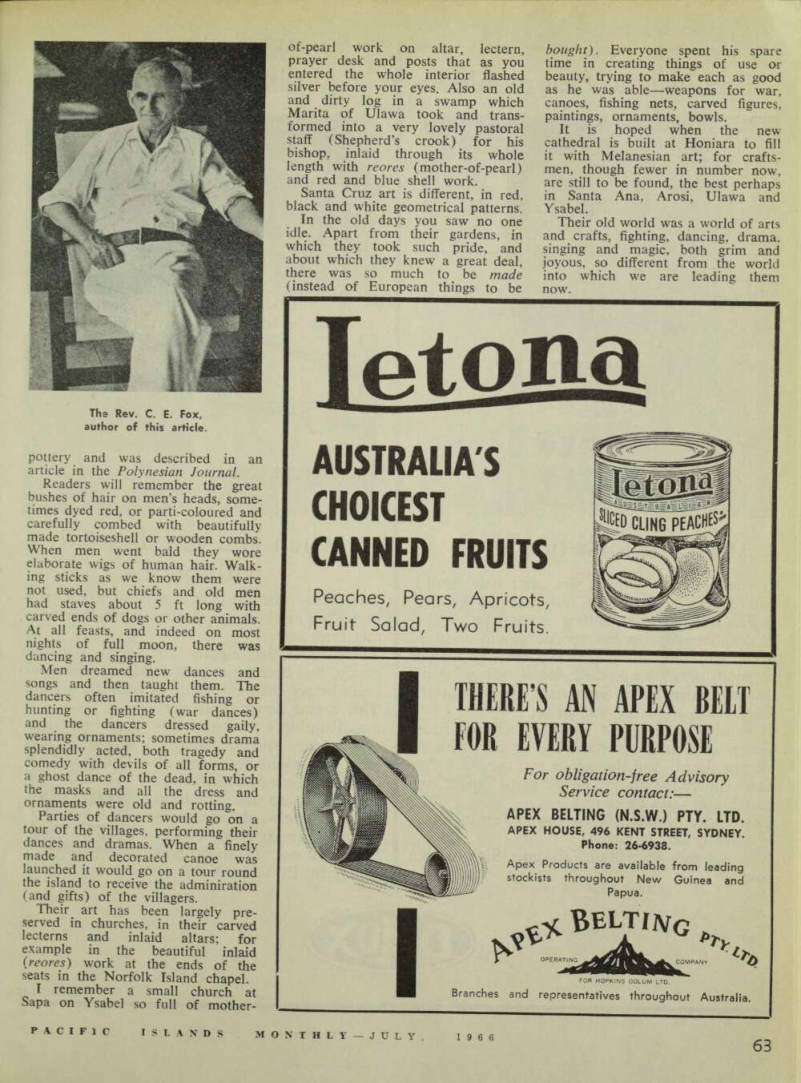
The Rev. C, E. Fox, author of this article.