Cost Of Ministerial
pp. 16-17 · Read in the full issue
Corruption In The
Cook Islands: £5O
Robert Julian Dashwood, a former Minister in the Cook Islands Government, was fined £5O in the High Court at Rarotonga on June 2 for corruptly attempting to obtain a bribe of £l,OOO. He pleaded guilty.
THE charge stated that between January 1 and April 30, 1966, Dashwood had corruptly attempted to obtain the bribe for himself or some other person ”on account of undertaking to advise Cabinet to accept an offer from an Australian firm for the issue of a commemorative crown coin”.
Dashwood, who is 66, was ordered to come up for sentence in three years if called upon. Fining him £5O, Chief Justice Fraser said that im prisonment was inappropriate in view of his health and age.
Dashwood was formerly Minister of Social Development and Police, and Associate Minister for the Post Office, Hotel and Printing Office.
He resigned from Cabinet on May 26 following an inquiry by the Advocate-General of the Cook Islands, Mr. E. J. V. Dyson, into alle gations that letters and other papers belonging to him (Dashwood) had been stolen from his room at the Hotel Rarotonga ( PIM, June, p. 19).
Dashwood was then charged with official corruption.
Later in the month, Albert C.
Dawson, who was suspended on May 27 as manager of the Hotel
Rarotonga, was acquitted in the CooT Islands High Court of a charge oc stealing two letters and other papern belonging to Dashwood, or, alternar lively, of receiving stolen documents?
Subsequently, the Cook Island* Government asked the New Zealand Government to appoint a commission' to inquire into the operation of thei High Court and to make “suctt recommendations as are deemeo; necessary to ensure an impartiac course of justice”.
Chief Judge Fraser was asked to suspend all hearings in the meantime 3 Explaining his request for a comr mission of inquiry, the Cook Island* Premier, Mr. Albert Henry, said in 2 radio broadcast on June 28 that ii had been brought to the notice oc the Government that there was an increasing lack of public confidence in the procedures of the High Courtt The New Zealand Government in July was considering the implication:! of Mr. Henry’s request to appoint s commission into the operations o:c the High Court. Meanwhile, the/ Chief Judge indicated that he woulo not suspend the court’s hearing:? should he feel that, in the interest* of justice, any case should be heardt It is understood that this mean* that a case which Dawson ha* stated he intends to bring agains? the Cook Islands Government foe suspending him from his job as holes manager will go ahead.
Close observers of the Cook Island! scene, including Noel Holmes in th'i Auckland Star, have expressed thu hope that the Cook Islands Governn ment’s immature handling of itt current problems, so soon after th»r achievement of self-government, wilii not land it in real difficulties.
The report on the Dashwood coun case in the Cook Islands News, th»r daily mimeographed news sheet pubd lished by the Cook Islands Goverm ment, consisted of only four sem fences.
The report sent out of Rarotonga by the New Zealand Press Associatioic correspondent was equally bald amr brief.
However, some further light on thri
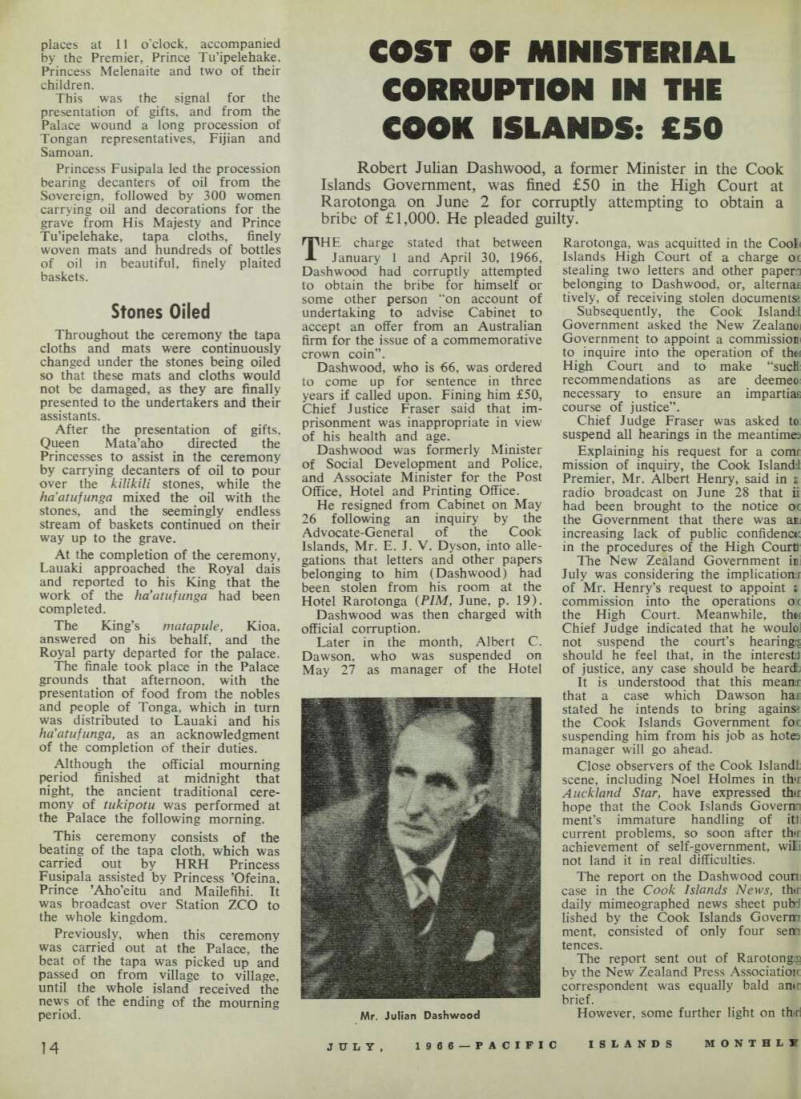
Mr. Julian Dashwood
case was given in a public address by Mr. Henry, at a meeting of 1,000 people on Rarotonga on May 19.
Samoana, the neighbouring Western Samoa newspaper, gave it an exten sive coverage on May 25.
Speaking as head of the Cook Islands Party, not as Premier, Mr.
Henry referred to the visit to Raro tonga some time ago of an Aus tralian, who had stayed at the Raro tonga Hotel overnight and had been befriended by Dashwood.
Mr. Henry said that an offer had been made to make 5/- coins to com memorate the Cook Islands Con stitution. These coins would be sold in Australia at 10/- each, and the profit of £15,000 would go to the Cook Islands pension scheme.
Such a business deal was perfectly legal, but it appeared that in “negotiations between the Minister and the company”, two sums of £l,OOO were offered or suggested for persons to lobby for the acceptance of the coin deal by the Government.
Mr. Henry said that nobody else in the Government knew about the private deal involving the bribe, but that the commemorative coin deal was good business for the islands and made sense.
Subsequently the Minister had found that some papers containing information about the bribe had dis appeared from his hotel room. He had immediately reported the matter to the police.
Radio Broadcast
In a broadcast over the Cook Islands Radio on May 25 (the day before Dashwood resigned), Mr.
Henry referred to anonymous allega tions against Dashwood, and claimed that a malicious and deliberate at tempt was being made to bring his government “into such disrepute as to undermine the whole political situation in our country”.
He went on: “The methods I refer to can be listed as follows—the viola tion of the private quarters of an individual and the removing of private documents; the making of numerous copies of these documents, in which process others were involved, in cluding those who should not have lent themselves to the purpose in hand; the circulation of these copies, still anonymously, not only to me, the police and members of our own community, but also to various per sons in New Zealand; the clandestine meetings of a group of people with the object of furthering the campaign against the Government; and the sub sequent delivery of anonymous threatening notes to me, and other senior members of my party . . .”