Golden Handshake
pp. 17-20 · Read in the full issue
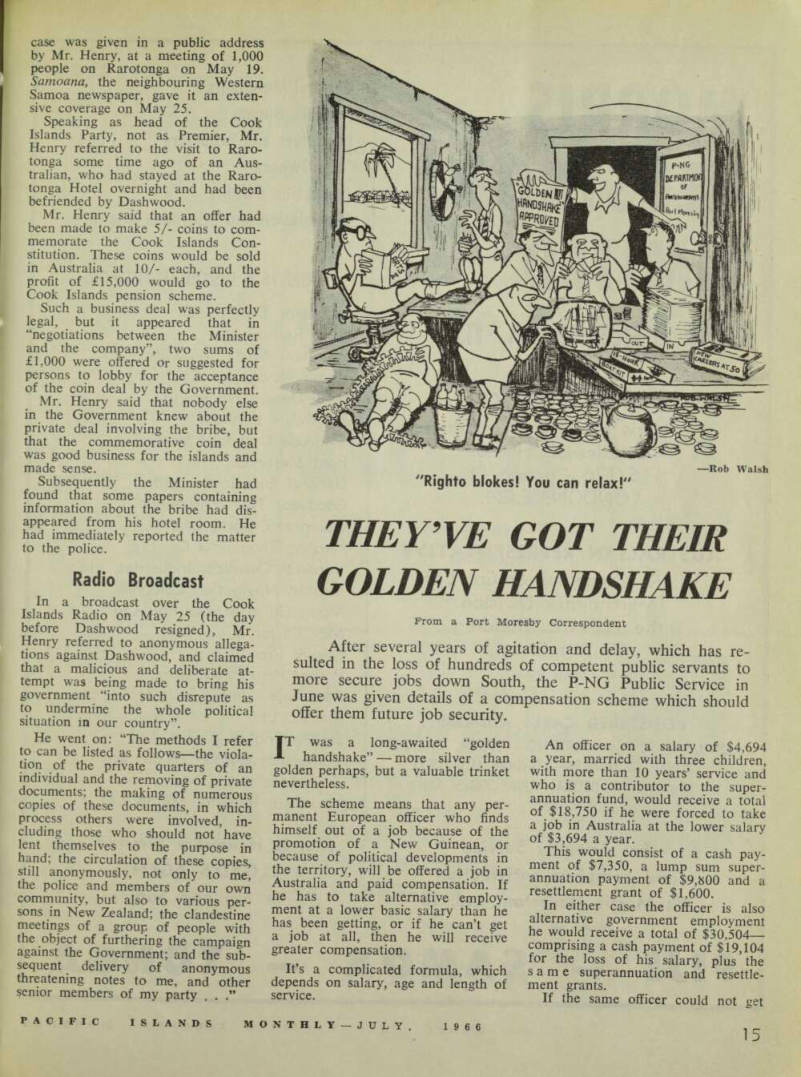
They’Ve Got Their
Prom a Port Moresby Correspondent After several years of agitation and delay, which has re sulted in the loss of hundreds of competent public servants to more secure jobs down South, the P-NG Public Service in June was given details of a compensation scheme which should offer them future job security.
TT was a long-awaited “golden handshake” more silver than golden perhaps, but a valuable trinket nevertheless.
The scheme means that any per manent European officer who finds himself out of a job because of the promotion of a New Guinean, or because of political developments in the territory, will be offered a job in Australia and paid compensation. If he has to take alternative employ ment at a lower basic salary than he has been getting, or if he can’t get a job at all, then he will receive greater compensation.
It’s a complicated formula, which depends on salary, age and length of service.
An officer on a salary of $4,694 a year, married with three children, with more than 10 years’ service and who is a contributor to the super annuation fund, would receive a total of $18,750 if he were forced to take a job in Australia at the lower salary of $3,694 a year.
This would consist of a cash pay ment of $7,350, a lump sum super annuation payment of $9,800 and a resettlement grant of $1,600.
In either case the officer is also alternative government employment he would receive a total of $30,504 — comprising a cash payment of $19,104 for the loss of his salary, plus the same superannuation and resettle ment grants.
If the same officer could not get
Rob Walsh
“Righto blokes! You can relax!"
entitled to three months’ leave, whether or not he has enough credits, and fares to Australia for himself, and family plus the cost of removal of his furniture.
The compensation scheme will apply to about 2,300 officers, who are in fact the hard core of New Guinea's 14,000 public servants.
These are men such as patrol officers and other field officers who years ago decided to make New Guinea their career. A number of them were born here.
These are the people who have accumulated a store of local know ledge which cannot easily be re placed. as many other territories have found in similar circumstances.
The “golden handshake” was worked out after negotiations with the public servants (who had also put forward a scheme, based on a Colonial Office one for Northern Rhodesia), and the result is the New Guinean men will get more than most of them had secretly expected they would get.
No final expression of opinion has been made by the P-NG Public Ser vice Association, but the rank-and file are reasonably happy. Two points of criticism are that compensation is based on basic salaries and not on salary-plus allowances, and the allowances in New Guinea are fairly generous. Rents are subsidised, for one thing.
A second point is that the scheme assumes that if a job is still avail able for an officer after independ ence then he must accept it. Most public servants would like the option of leaving at this stage, because they can visualise a period when standards would fall off and it would be “any thing goes”.
However, as the White Paper on the scheme points out, the plan may
never go into effect, and if it does it might only apply to very few officers. It is designed to “dispel their fears” against premature retirement, and the Government hopes that it “will ensure the Government’s policies of balanced development are carried out vigorously and effectively”.
The significance of this phrase has been missed by most public servants in the territory. It is simply another way of saying the Government hopes the scheme will bring a new discipline and a new enthusiasm into the public service, so that officers will give full value for money.
Morale has been low, and at head-
quarters especially, not enough work has been done this last year or two.
Much of this situation is due to the frustrations and lack of confidence caused by key staff shortages and the need for this compensation scheme, but there has also been some down right lead-swinging.
Now that a new Administrator is soon to be named, two new assistant administrators have already been named and other key appointments are shortly to be made, we shall soon know how much of the present situa tion is due to damaged morale and how much to loafing.
Since a provident scheme for con
tract officers that is, those not covered by the “golden handshake”— has also been announced in June, there now seems no reason why the Commonwealth shouldn’t expect a “vigorous and effective new look”.
Both the “golden handshake” and the provident scheme will be introduced into the House of Assembly later this year. The “golden handshake” will later go to the Commonwealth Parlia ment, which will be asked to enact a guarantee so that whatever the future political situation in New Guinea the scheme will be safeguarded.
The contract officers covered by the provident scheme are also overseas
officers. Recruiting of contract officers started in September, 1963, when per manent appointments to the P-NG Public Service ceased. They are not eligible to contribute to the super annuation fund.
Contract officers will contribute five per cent, of their salary to the scheme, and the Adminisration will pay an increased share of the con tributions as the officer’s service lengthens—two-thirds after 12 years’ service.
A contract officer on $3,600 a year would receive $3,380 if he should lose his job after eight years’ service, and $8,280 after 12 years.