Tonga Pays Final Tribute
pp. 15-16 · Read in the full issue
To Late Queen Salote
From Dorothy Lavin in Nukualofa The six months’ period of mourning for the late Queen Salote Tupou of Tonga culminated in mid-June with the ceremony of decorating her grave with black volcanic kilikili stones—which were collected at Tofua in February (PIM April, p. 12).
TT was the first time that this A ancient traditional ceremony had been performed in the lifetime of most Tongans; and it was with a great deal of interest, and much appreciation, that I was allowed to view the proceedings, being the only European woman admitted.
It is, in fact, a private ceremony, with members of the Royal family and the many undertakers and their assistants only at the graveside.
The scene at 9.30 in the morning was both spectacular and sombre, with brilliant sunshine on colourful decorations and on the traditional black of mourning.
The canopy erected over the Royal Tombs at the Mala’ekula was beautifully decorated, and across the top, picked out in black lettering, were the late Queen’s personal decorations GBE, GCVO and
Gcmg.
The whole perimeter of the Malae’kula was draped with Tongan decora tions, too, and one wondered at the hours and weeks of patient work that had gone into presenting such a picture.
Since four o’clock that morning, Lauaki, the head ha’atufunga (undertaker), assisted by 30 under takers and 300 relatives of Lauaki, had been preparing the kilikili stones!
First, they were washed in sea water in a huge wooden bowl, or sene, then placed in small baskets, woven from coconut leaves.
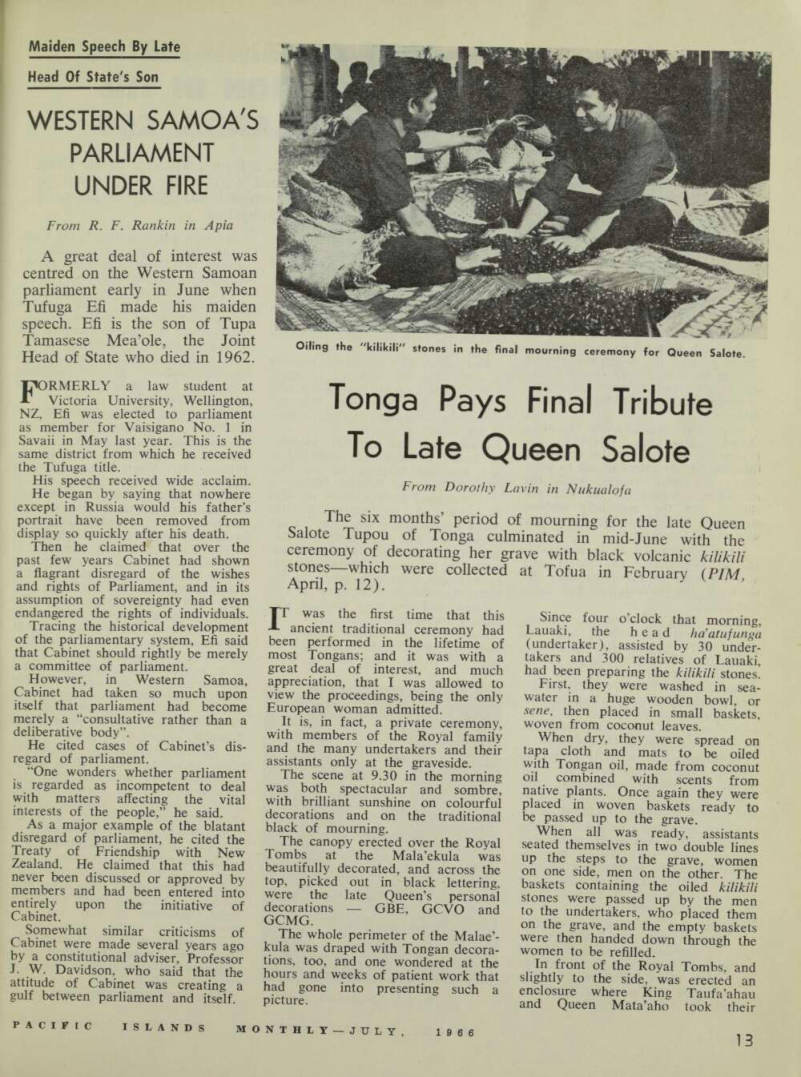
When dry, they were spread on tapa cloth and mats to be oiled with Tongan oil, made from coconut oil combined with scents from native plants. Once again they were placed in woven baskets ready to be passed up to the grave.
When all was ready, assistants seated themselves in two double lines up the steps to the grave, women on one side, men on the other. The baskets containing the oiled kilikili stones were passed up by the men to the undertakers, who placed them on the grave, and the empty baskets were then handed down through the women to be refilled.
In front of the Royal Tombs, and slightly to the side, was erected an enclosure where King Taufa’ahau and Queen Mata’aho took their
Oiling the "kilikili" stones in the final mourning ceremony for Queen Salote.
places at 11 o’clock, accompanied by the Premier, Prince Tu’ipelehake, Princess Melenaite and two of their children.
This was the signal for the presentation of gifts, and from the Palace wound a long procession of Tongan representatives, Fijian and Samoan.
Princess Fusipala led the procession bearing decanters of oil from the Sovereign, followed by 300 women carrying oil and decorations for the grave from His Majesty and Prince Tu’ipelehake, tapa cloths, finely woven mats and hundreds of bottles of oil in beautiful, finely plaited baskets.
Stones Oiled
Throughout the ceremony the tapa cloths and mats were continuously changed under the stones being oiled so that these mats and cloths would not be damaged, as they are finally presented to the undertakers and their assistants.
After the presentation of gifts.
Queen Mata’aho directed the Princesses to assist in the ceremony by carrying decanters of oil to pour over the kilikili stones, while the ha’atufunga mixed the oil with the stones, and the seemingly endless stream of baskets continued on their way up to the grave.
At the completion of the ceremony, Lauaki approached the Royal dais and reported to his King that the work of the ha’atufunga had been completed.
The King’s matapule, Kioa. answered on his behalf, and the Royal party departed for the palace.
The finale took place in the Palace grounds that afternoon, with the presentation of food from the nobles and people of Tonga, which in turn was distributed to Lauaki and his ha’atufunga, as an acknowledgment of the completion of their duties.
Although the official mourning period finished at midnight that night, the ancient traditional cere mony of tukipotu was performed at the Palace the following morning.
This ceremony consists of the beating of the tapa cloth, which was carried out by HRH Princess Fusipala assisted by Princess ’Ofeina, Prince ’Aho’eitu and Mailefihi. It was broadcast over Station ZCO to the whole kingdom.
Previously, when this ceremony was carried out at the Palace, the beat of the tapa was picked up and passed on from village to village, until the whole island received the news of the ending of the mourning period.