yesterday
p. 91 · Read in the full issue
Although it was now ten months since the end of the war, the May 1946 issue of PIM bristled with post-mortems on war incidents —reports of war trials at Rabaul, and stories of rehabilitation difficulties from all over the South-West Pacific. Among these items, the most significant, in the long term, was the statement from Australia’s War Damage Commission that it had £13,120,000 in its kitty ana claims for only £7i million, most of it from Papua and New Guinea. In fact, almost the whole of the Fund, and more, was spent on rehabilitating planters, traders and natives in P-NG, which gave them and the Territory a boost into a prosperity that had never been known before and which is still being enjoyed today.
Other items in that issue of 20 years ago were:
ALL Territories were suffering from lack of overseas ship ping due to war-time casualties among Allied ships, and some vessels still being on Admiralty service. Governments controlled all remaining vessels. There were no trans-Pacific services; Matua was the sole link between New Zealand, Samoa, Tonga and Niue; and Burns Philp vessels Morinda and the old Montoro the sole communication between Australia and P-NG. It was announced that Bulolo would be retained for a further period by the Admiralty and was not expected to be returned to BP’s until 1947. (She was not, in fact, returned to the P-NG service until August 1948 after nine years of war service).
HOWEVER things were brighter on the air front. Pan-Ameri can Airways were resuming at the end of the month the old San Francisco-Auckland service interruped by the war. They still had not got permission from Australian bureaucrats to ter minate in Sydney, but Australia, with New Zealand and the UK, was setting up the short-lived British Commonwealth Pacific Airlines to run in opposition to Pan-Am. Both airlines planned to use Skymaster aircraft. Single fare, Sydney-San Francisco, £lB4 (1966 fare £323).
TWO Japanese officers were sentenced to death at the War Crimes Court in Rabaul, for the massacre of 200 Ocean Island ers five days after Japan had surrendered to the Allied Forces.
Although in early questioning they both admitted guilt, they pleaded not guilty to the charge on the last day of their trial.
A TIDAL wave which struck Alaska caused death and destruction in the Hawaiian Islands on April 1, 1946, and affected a number of territories
in the South Pacific. At Rarotonga, Cook Islands, the harbours of Avarua and Avatiu were subject to unusually large tidal move ment which accelerated until the harbours were emptying and filling at ten-minute intervals. No great damage was reported, although during the period of greatest fluctuation, water flowed over the waterfront road of one of the harbours. Western Samoa had an unusually heavy surf and normally covered reefs and mud flats were exposed off Apia’s main beach at low tide. Half of Pitcairn Island’s 24 fishing canoes were swept away and one of the 38-foot surf boats vanished.
AN article by a planter who had returned to Papua ex pressed disgust at the enormous waste of surplus goods in Papua and New Guinea. “Enough build ing material had been dumped in Milne Bay to have rebuilt every town and all the settlers’ homes in both Territories”, he said.
Millions of pounds worth of material, tools, engines, oil, food stuffs, paints and gear that it would be impossible to buy for the next two years had been destroyed. “A fully equipped American hospital at Milne Bay,” the planter said, “was offered to ANGAU, with drugs, instruments, bedding, medical stores, etc.: but no ANGAU officer could be found with sufficient initiative to sign for it, or take it over. Finally, in disgust, the Yanks obliterated it with bulldozers and benzine.”
THE Australian Labour Govern ment was again being chal lenged to hold an inquiry into the reason why 300 civilians had been abandoned in Rabaul to fall into the hands of the Japanese in
January 1942. It was also being criticised for the appointment of Mr. Alex Wilson as Admini strator of Norfolk Island on the grounds that it was a pay-off for Mr. Wilson who, as a former “independent” member of Parlia ment, had helped to keep the Labour Government in power.
A COMPANY, Aloma Products, was being formed in Western Samoa to can coconut cream for New Zealand and Europe, The factory was to be set up on Reparation Estates land and a bright future was predicted for the product which was said to be “comparable with dairy cream”. (But like the dried-banana in dustry—“banana-figs”—that had a run for its money about this time, not much more was heard of canned coconut cream).
IT was reported by the manager of the British Phosphate Commission that war damage to phosphate working installations on Ocean Island and Nauru amounted to £1,000,000. Work of recon struction was, however, well advanced, and it was expected to commence exporting phosphate in July 1946 with a production target for the following year from both islands in the vicinity of 200.000 tons.
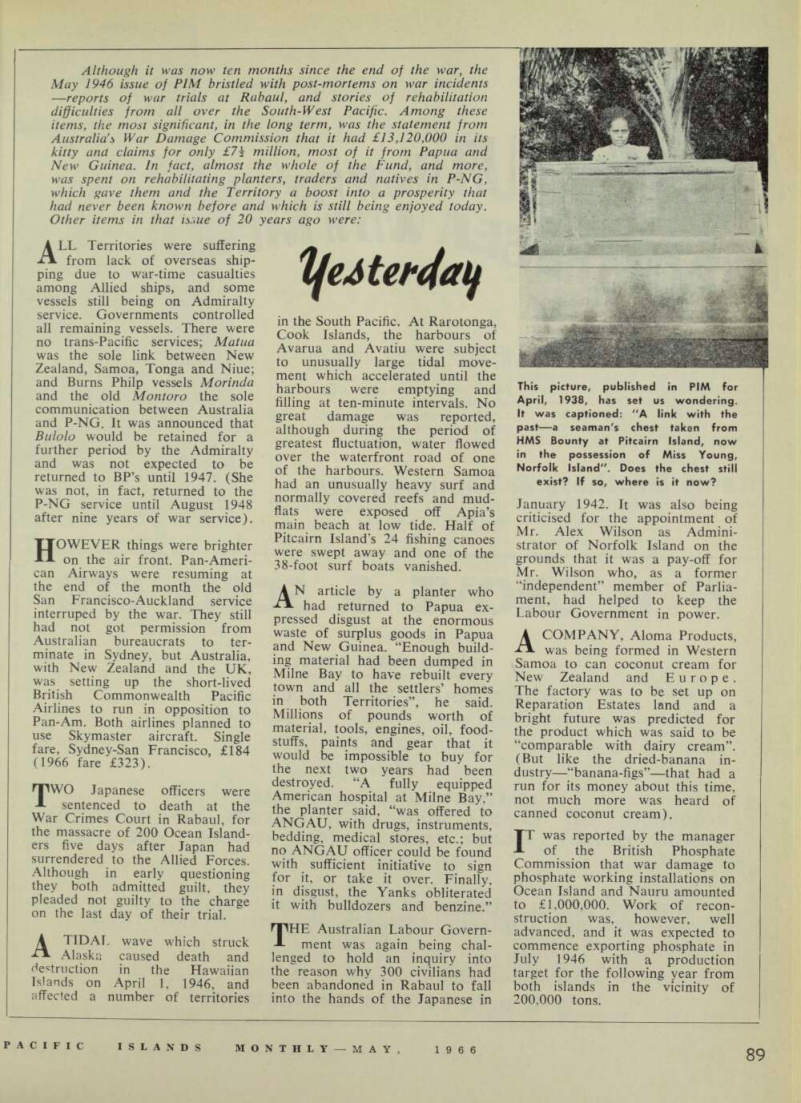
This picture, published in PIM for April, 1938, has set us wondering.
It was captioned: "A link with the past—a seaman's chest taken from HMS Bounty at Pitcairn Island, now in the possession of Miss Young, Norfolk Island". Does the chest still exist? If so, where is it now?