On Life In Tonga
pp. 93-94 · Read in the full issue
The Month's New Reading
A Perceptive Report
The limited literature on Tonga has been enriched by Olaf Ruhen’s new book, Harpoon in My Hand.
RUHEN is a word spinner, and here he is at his best, carefully selecting and polishing his phrases to create the picture of Tongan life as he sees it.
It’s a simple picture, in quiet and sincere tones, which captures the character of the Tongans—their austerity and ingenuity, their love of life and of Queen Salote (who died after the book was written), Tongan weaknesses are here, too, but reported through Ruhen’s sympathetic and perceptive eyes, so that readers will want to know more of day-to-day life in the kingdom.
Whaling Adventure
Yet Harpoon in My Hand was meant mainly as a whaling adventure.
Sydneysider Ruhen and his wife Madeleine went to Tonga in 1964 to collect material for the book. He wanted to record a season of whale hunting from small boats with hand harpoons, Tongan fashion, and his companions on the exploit were to be many of the survivors of the Minerva Reef shipwreck tragedy, which Ruhen so ably reported in his best-selling Minerva Reef.
But whales were scarce that year, and although the hunt for them dominates the book it is the person ality of Tonga itself which emerges as the central theme.
Echoes of Minerva Reef are heard frequently as the author places many of the men in their home environ ment and re-examines, in passing, their characters.
Ruhen himself is at home with the sea, and his love for it shines through these pages as he works with the Tongans on rebuilding the Velata, the boat in which they finally went whaling.
The story of the rebuilding allows Ruhen to observe Tongan character at first hand, as he shares with the men and their families the problem of getting the best boat for the least money.
Such is the shortage of cash that the boat builders do not punch the nail heads beneath the surface, for
the holes would then have to be filled with putty which nobody could afford.
It seemed that there was never more than one tool for each man working on the construction, and if there were any tasks beyond the capacity of the simple collection available then a tool was made for the purpose. Drill bits, for example, were hammered out of any handy scrap of metal. Waste was kept to a minimum. Offcuts of wood were saved to provide small fittings and the final small chips used to feed the fire.
“It was the same with every finished job in Tonga,” says Ruhen. “Ameri cans particularly were quick to criticise and comment on inadequacies they saw. But these inadequacies arose not from laziness or ignorance but from the impossibility of buying supplies. They were caused by poverty, for which Tongans have always learned to find a compensa tion”.
But friends are survival insurance
in these happy islands, Ruhen makes clear, and everyone has a surplus of insurance cover. With the Polynesian genius for improvisation, “which rises to Everest heights in Tonga”, and their endurance, the Tongans win out. The endurance of the Tongan is frequently called on to compensate for the absence of proper tools or equipment.
As the work of boat building goes on, and the whalers eventually put to sea, Ruhen continues to comment on the life around him.
Of food he writes: “The Tongans didn’t interrupt their working day to
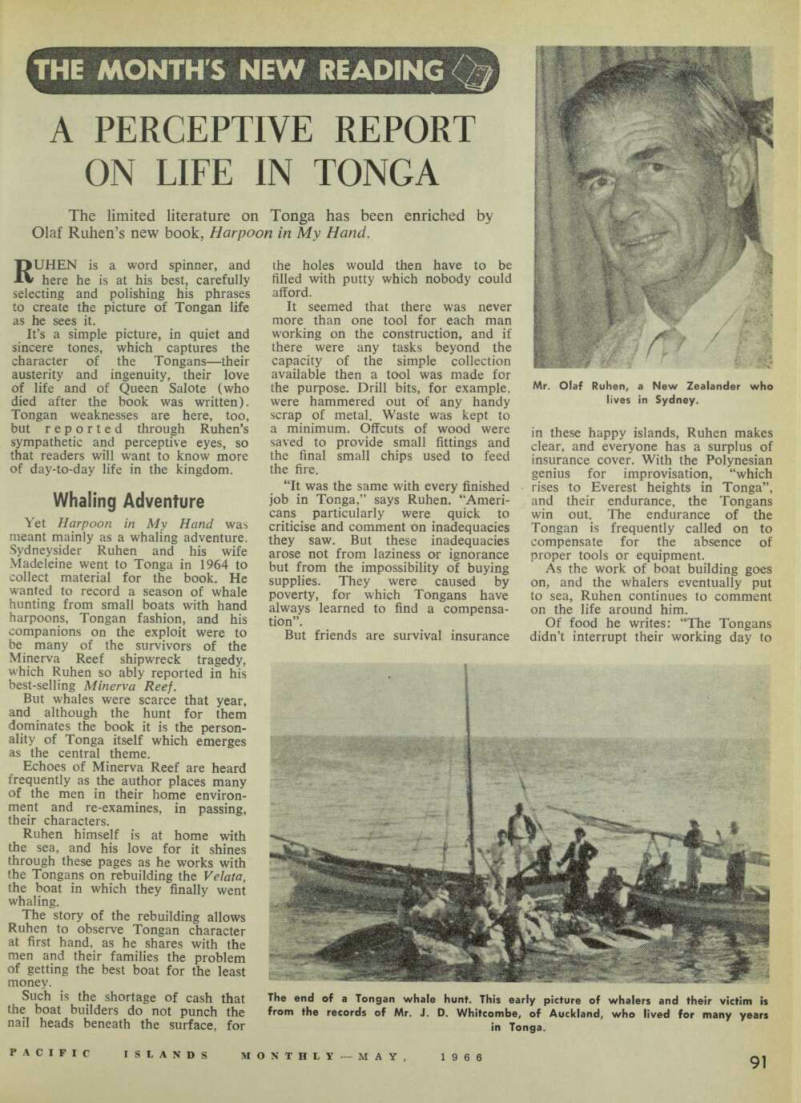
Mr. Olaf Ruhen, a New Zealander who lives in Sydney.
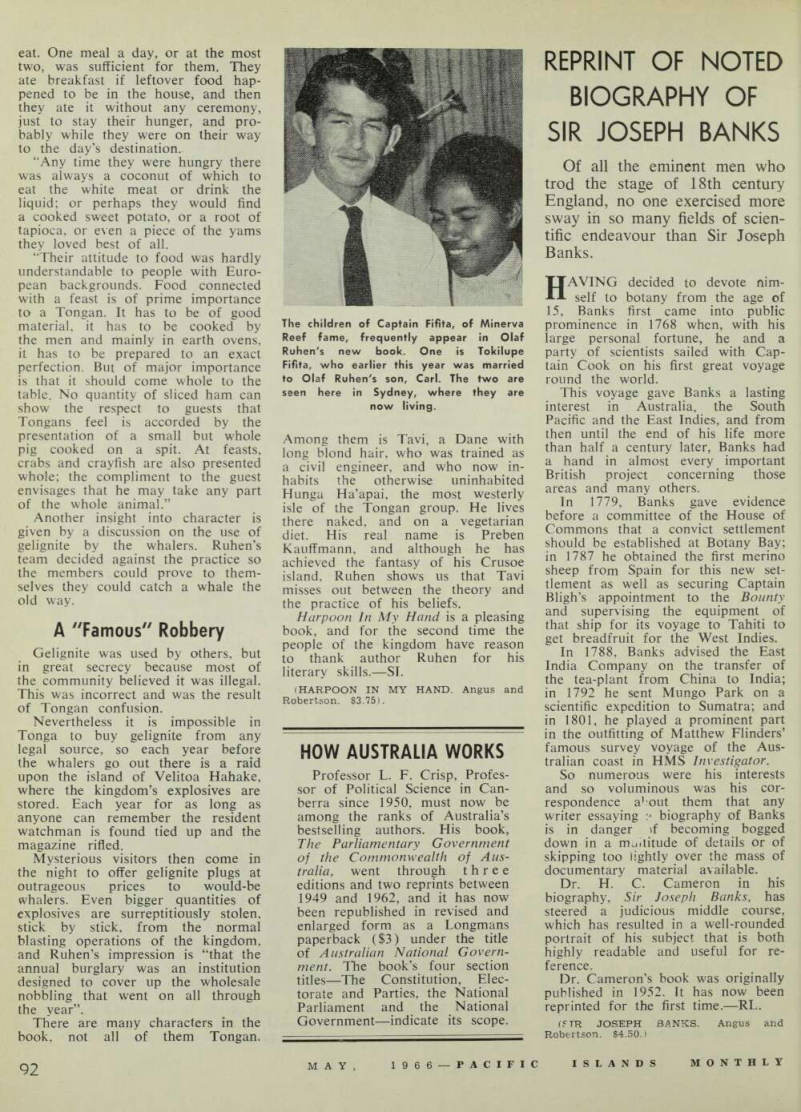
The end of a Tongan whale hunt. This early picture of whalers and their victim is from the records of Mr. J. D. Whitcombe, of Auckland, who lived for many years in Tonga.
eat. One meal a day, or at the most two, was sufficient for them. They ate breakfast if leftover food hap pened to be in the house, and then they ate it without any ceremony, just to stay their hunger, and pro bably while they were on their way to the day’s destination.
“Any time they were hungry there was always a coconut of which to eat the white meat or drink the liquid; or perhaps they would find a cooked sweet potato, or a root of tapioca, or even a piece of the yams they loved best of all.
“Their attitude to food was hardly understandable to people with Euro pean backgrounds. Food connected with a feast is of prime importance to a Tongan. It has to be of good material, it has to be cooked by the men and mainly in earth ovens, it has to be prepared to an exact perfection. But of major importance is that it should come whole to the table. No quantity of sliced ham can show the respect to guests that Tongans feel is accorded by the presentation of a small but whole pig cooked on a spit. At feasts, crabs and crayfish are also presented whole; the compliment to the guest envisages that he may take any part of the whole animal.”
Another insight into character is given by a discussion on the use of gelignite by the whalers. Ruhen’s team decided against the practice so the members could prove to them selves they could catch a whale the old way.
A "Famous" Robbery
Gelignite was used by others, but in great secrecy because most of the community believed it was illegal.
This was incorrect and was the result of Tongan confusion.
Nevertheless it is impossible in Tonga to buy gelignite from any legal source, so each year before the whalers go out there is a raid upon the island of Velitoa Hahake, where the kingdom’s explosives are stored. Each year for as long as anyone can remember the resident watchman is found tied up and the magazine rifled.
Mysterious visitors then come in the night to offer gelignite plugs at outrageous prices to would-be whalers. Even bigger quantities of explosives are surreptitiously stolen, stick by stick, from the normal blasting operations of the kingdom, and Ruhen’s impression is “that the annual burglary was an institution designed to cover up the wholesale nobbling that went on all through the year”.
There are many characters in the book, not all of them Tongan.
Among them is Tavi, a Dane with long blond hair, who was trained as a civil engineer, and who now in habits the otherwise uninhabited Hunga Ha’apai, the most westerly isle of the Tongan group. He lives there naked, and on a vegetarian diet. His real name is Preben Kauffmann, and although he has achieved the fantasy of his Crusoe island, Ruhen shows us that Tavi misses out between the theory and the practice of his beliefs.
Harpoon In My Hand is a pleasing book, and for the second time the people of the kingdom have reason to thank author Ruhen for his literary skills.—Sl. (HARPOON IN MY HAND. Angus and Robertson. $3.75).
The children of Captain Fifita, of Minerva Reef fame, frequently appear in Olaf Ruhen's new book. One is Tokilupe Fifita, who earlier this year was married to Olaf Ruhen's son, Carl. The two are seen here in Sydney, where they are now living.