Ancient Mortars Found
pp. 88-89 · Read in the full issue
In Goroka Valley
Revive Old Mystery
By R. J. Giddings
Three ancient stone mortars collected recently by an Ad ministration patrol in the Eastern Highlands District of Papua- New Guinea have revived interest and speculation among people who have seen them about their origin and use.
THE mortars were found in the Asaro Census Division, which is at the northern end of the Goroka Valley. All are believed to have been found fairly near the surface, and to have come to light after heavy rains, during gardening opera tions, or such like.
Similar mortars, and the pestles that go with them, have been dug up in various parts of New Guinea from time to time.
By far the greater number have been found in the densely populated Highlands, although some have been found nearer the coast and on the off-shore islands.
Some interesting examples are dis played in the Port Moresby museum.
That these prehistoric artifacts represent a material culture of great antiquity is vouched for by the depth at which they are sometimes found.
In the Watut River area of the Morobe District, for example, some stone artifacts, including a mortar and pestle, were found in undisturbed strata at a depth of 14 ft. In the vicinity of these finds were the bones of an extinct mammal embedded in sandstone. The Government geologist at the time estimated that the bones
were about 15,000 years old ( PIM, Nov., 1937, p. 26).
Archaeologists generally associate mortars and pestles with the existence of a grain-consuming society—the mortar being the utensil in which grain is ground into meal by means of the pestle.
The original use of the stone mortar has long been forgotten by the New Guinea people. Today, they serve no functional purpose apart from being valued as magico-religious paraphernalia in certain areas.
Tapioca Pudding
Possibly the only place in the Territory where stone pestles are still used for grinding food is at Saposa Island in the Bougainville District. There, large pestles are used to mash tapioca during the preparation of a traditional-style pudding. However, they are not used with stone mortars; the food is prepared on a wooden plate.
The most elementary type of mortar is a lump of primordial rock, generally of sandstone, into which a symmetrical cavity is gouged. A smooth river stone may act as a pestle in this case.
In Papua and New Guinea a high
degree of artistry was achieved in the carving of mortars. One specimen found in the Western Highlands and displayed at the last Mt. Hagen Show was an excellent example of this type. It was tall and elegantly shaped, having handles on both sides of the bowl. Its overall design was not unlike some of the ceramic vases excavated in Greece and in other archaelogical sites in the East.
The mortars and pestles used by modern chemists barely differ in design from their ancient counter parts, although their functional pur pose is different since they are intended for grinding chemicals in stead of food.
The three mortars found recently in the Asaro Division were without pestles.
In the Asaro language, stone mortars are called yavirise, which, freely interpreted, means “protecting stone”. Until recent years, it was commonly believed that the yavirise exerted magical influence over the station of man in his physical environment, particularly where fertility is concerned.
It was customary for a clan group to acquire a yavirise and bury it in a secluded, sacred place. Each season it would be exhumed and doused with pig fat or decorated with coloured ochres. Such decora tion not only enhanced the ap pearance of the object—the natives believed—but also appealed to and evoked the magical powers sup posedly contained within the stone.
Amid great solemnity the yavirise would then be reburied.
A native elder acquainted with the appropriate liturgy would pray over the buried yavirise and ask it
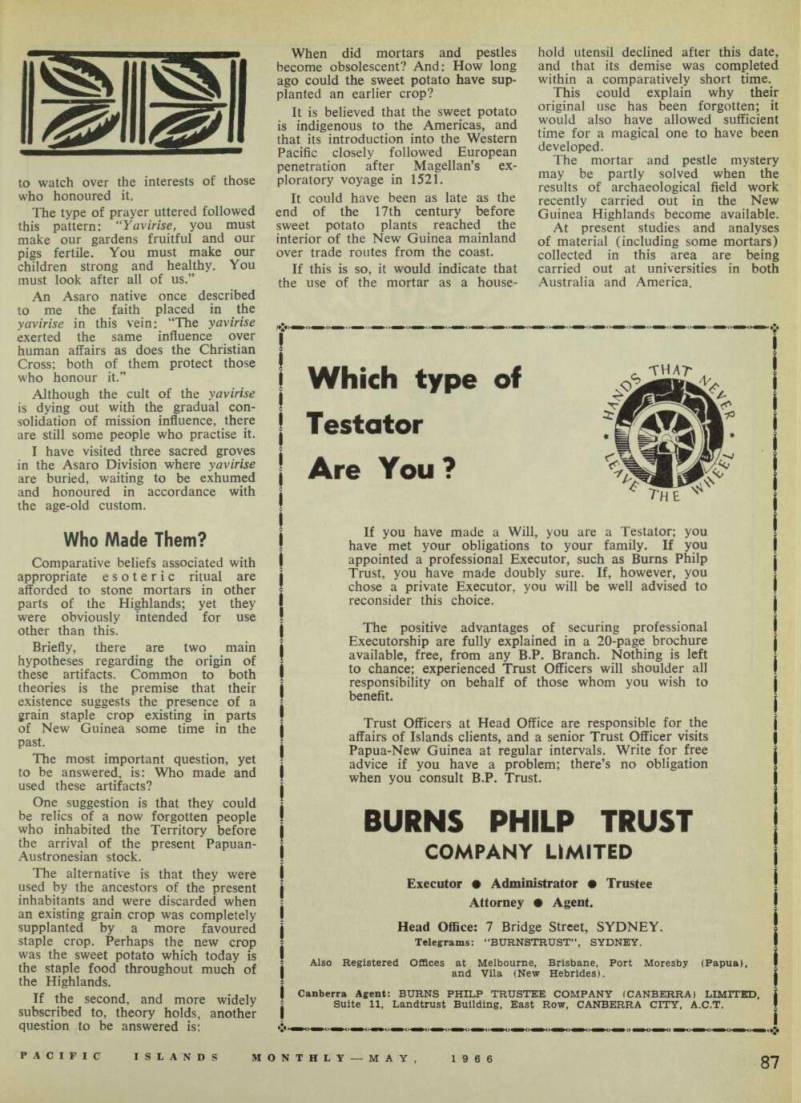
Each of the three mortars found recently in the Goroka Valley was carved from a solid lump of sandstone. The mortar on the left was found near Miruma Village during gardening operations. That in the centre was found on a hillside near Miruma Village after the surrounding soil had been washed away during a storm. The mortar on the right was uncovered when a road was being built near Nomba Plantation.
Photo: R. J. Giddings.
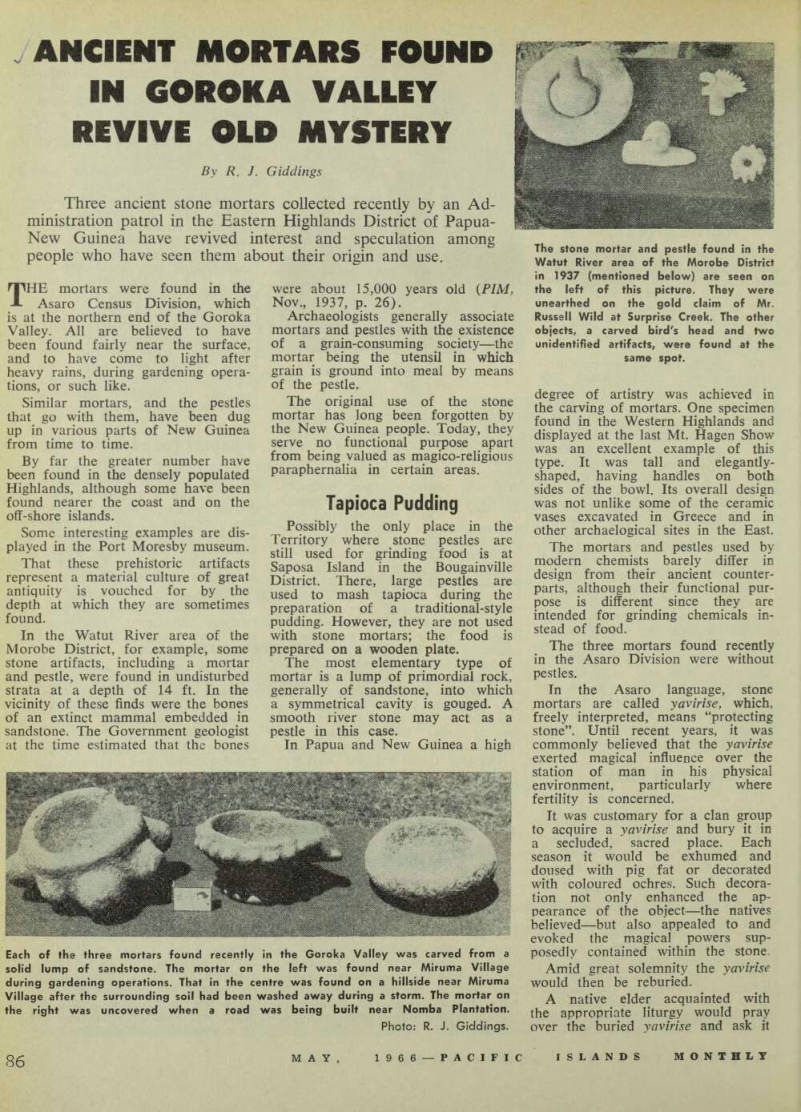
The stone mortar and pestle found in the Watut River area of the Morobe District in 1937 (mentioned below) are seen on the left of this picture. They were unearthed on the gold claim of Mr.
Russell Wild at Surprise Creek. The other objects, a carved bird's head and two unidentified artifacts, were found at the same spot.
to watch over the interests of those who honoured it.
The type of prayer uttered followed this pattern; “Yavirise, you must make our gardens fruitful and our pigs fertile. You must make our children strong and healthy. You must look after all of us.”
An Asaro native once described to me the faith placed in the yavirise in this vein: “The yavirise exerted the same influence oyer human affairs as does the Christian Cross; both of them protect those who honour it.”
Although the cult of the yavirise is dying out with the gradual con solidation of mission influence, there are still some people who practise it.
I have visited three sacred groves in the Asaro Division where yavirise are buried, waiting to be exhumed and honoured in accordance with the age-old custom.
Who Made Them?
Comparative beliefs associated with appropriate esoteric ritual are afforded to stone mortars in other parts of the Highlands; yet they were obviously intended for use other than this.
Briefly, there are two main hypotheses regarding the origin of these artifacts. Common to both theories is the premise that their existence suggests the presence of a grain staple crop existing in parts of New Guinea some time in the past.
The most important question, yet to be answered, is: Who made and used these artifacts?
One suggestion is that they could be relics of a now forgotten people who inhabited the Territory before the arrival of the present Papuan- Austronesian stock.
The alternative is that they were used by the ancestors of the present inhabitants and were discarded when an existing grain crop was completely supplanted by a more favoured staple crop. Perhaps the new crop was the sweet potato which today is the staple food throughout much of the Highlands.
If the second, and more widely subscribed to, theory holds, another question to be answered is:
When did mortars and pestles become obsolescent? And: How long ago could the sweet potato have sup planted an earlier crop?
It is believed that the sweet potato is indigenous to the Americas, and that its introduction into the Western Pacific closely followed European penetration after Magellan’s ex ploratory voyage in 1521.
It could have been as late as the end of the 17th century before sweet potato plants reached the interior of the New Guinea mainland over trade routes from the coast.
If this is so, it would indicate that the use of the mortar as a house
hold utensil declined after this date, and that its demise was completed within a comparatively short time.
This could explain why their original use has been forgotten; it would also have allowed sufficient time for a magical one to have been developed.
The mortar and pestle mystery may be partly solved when the results of archaeological field work recently carried out in the New Guinea Highlands become available.
At present studies and analyses of material (including some mortars) collected in this area are being carried out at universities in both Australia and America.