Cruising Yachts
pp. 113-114 · Read in the full issue
•AW AH NEE, 52 ft ferro cement cutter with Dr. Robert Griffith, his wife Nancy, and son Reid, aged 10, arrived in Durban on January 26.
The Griffiths have been on a world cruise since they left Honolulu in October, 1961, in a different Awahnee. This vessel was wrecked on Vahanga Atoll, French Polynesia, in January, 1964. Dr. Griffith then returned to Hawaii, and purchased the yacht America, in which he sailed to New Zealand.
In New Zealand, Dr. Griffith built the new Awahnee and continued his cruise via Niue, Samoa, Wallis Island, Futuna, the New Hebrides and Port Moresby.
Awahnee left Port Moresby on October 22 for Darwin via Thursday Island, and then went on to Christmas Island, Cocos, Chagos Archipelago, Seychelles, Madagascar and Durban.
The Griffiths plan to return to their home in Hawaii, via Capetown and Panama. • TREKKA, 20 ft yawl, well known to “yachties” through a book by her former owner, John Guzzwell, has been in Durban recently with Marian and Cliff Cain, of California.
The Cains bought her in June, 1963.
They crossed the Pacific via Honolulu and Fanning Island in 1965 on the first leg of a voyage round the world. • VALKYRIE, 31 ft ketch with 70-year-old American John Goetzche sailing solo, arrived unharmed in Singapore in early February after spending 39 days as a captive of Indo nesian pirates. Mr. Goetzche, who is on a voyage round the world from Charlotte Amalie, Virgin Islands, spent about a year in the Pacific in 1963-64.
Mr. Goetzche was sailing from Manila to Singapore when five men in an Indonesian vessel fired shots at Valkyrie. They came alongside and took him to the islet of Pulau Linang. close to Singapore, where he was held prisoner from January 7 until February 15.
Mr. Goetzche said in Singapore that while he was held on the islet, the Indonesians stole SUS3OO in currency from the ketch, plus a camera, two alarm clocks, food and cutlery.
• SEAFARI, 40 ft fibreglass trimaran, now in Europe, will be seen in the Pacific later this year with New Zealanders Roy and Betty Milford.
The Milfords arrived in Southamp ton, England, just in time to see Seafari launched. They immediately set out for Holland, Germany, Denmark, Norway, Sweden and Scotland where Mrs. Milford has relatives.
From Scotland, they plan to con tinue south to Cornwall, Spain, the Canary Islands, Caribbean, Panama and across the Pacific to NZ via Tahiti.
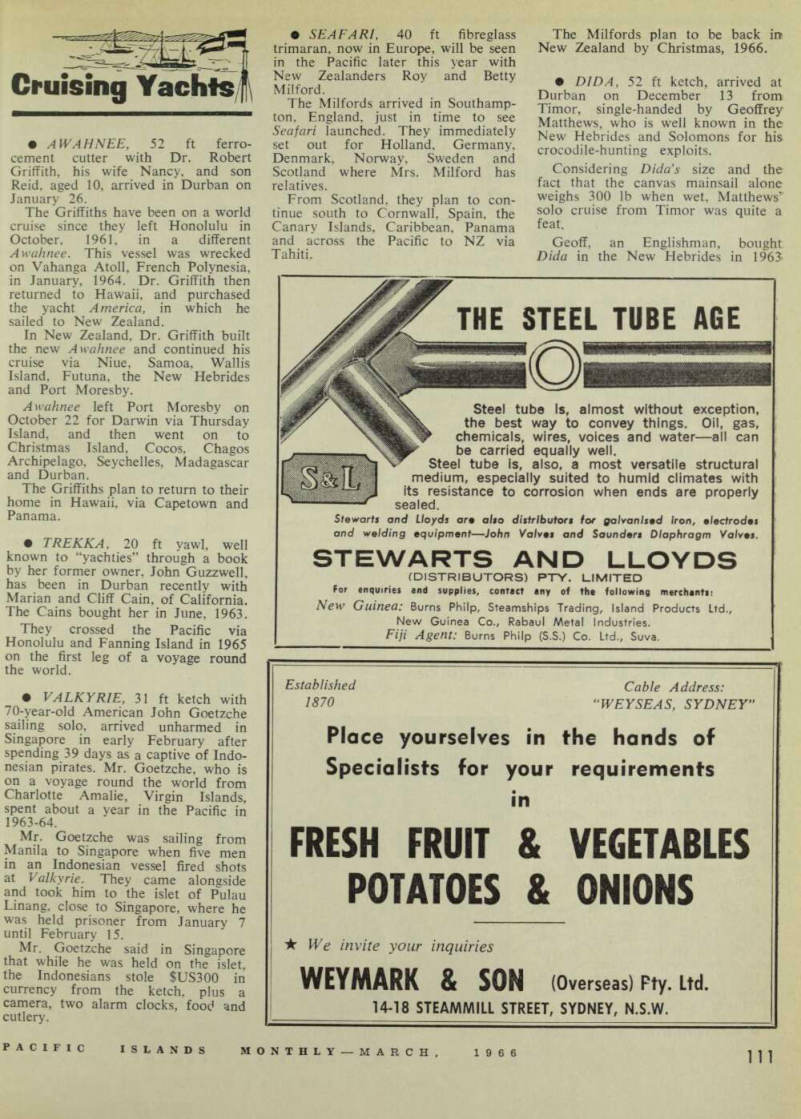
The Milfords plan to be back in New Zealand by Christmas, 1966. • DID A, 52 ft ketch, arrived at Durban on December 13 from Timor, single-handed by Geoffrey Matthews, who is well known in the New Hebrides and Solomons for his crocodile-hunting exploits.
Considering Dida’s size and the fact that the canvas mainsail alone weighs 300 lb when wet, Matthews” solo cruise from Timor was quite a feat.
Geoff, an Englishman, bought Dida in the New Hebrides in 1963-
from Mrs, Frazer, who had sailed her from Jamaica.
He left the New Hebrides in June last year with a crew of two. One left him in the Solomons and one at Portugese Timor. He then decided to build self-steering gear and carry on single-handed.
On October 31, he arrived in Mauritius where he stayed for a month before continuing to Durban.
He hopes to earn his living with the boat, sailing first to the Amazon to explore the possibility of croco dile-shooting and then to the West Indies to look into the possibilities of charter work.
• Sundowner, 24 Ft Aus
tralian ketch, skippered by Tom Harrison, left Durban recently after a stay in Africa of 21 months.
Harrison bought the ketch with the proceeds from crocodile hunting in New Guinea.
During his African sojourn, Harrison is reported to have spent eight months fighting rebels in the Congo, where he was a captain in charge of the navy.
When he returned to Durban, he spent several months changing Sundowner’s rig from a sloop to a ketch and making the interior roomier.
On leaving Durban, Harrison planned to explore the west coast of Africa, then continue to Europe and Panama. © THLALOCA, 20 ft sloop, sailed by a naturalised Canadian couple, Heinz and Sigrid Zenker, left Durban on January 19 to con tinue a round-world cruise.
The Zenkers, who were in the Pacific last year, hope to be back in Canada by August. • EASTERLING, 33 ft sloop,
single-handed by American Bruce Cutter, arrived at Durban in late December after an 18-day trip from Reunion Island. Easterling, which is on a voyage round the world, spent many months in the Pacific.
Easterling’s voyage began in October, 1962, when she left New York for Tahiti with Cutter and two crew members, Alan Forsythe and Richard Anderson. Easterling spent a year in Tahiti, during which her between the Marquesas and Tahiti, was repaired.
From Tahiti, Cutter continued alone. He plans to be home in Minnesota by Christmas, 1966. • GENEVE, 25 ft sloop, with 29-year-old Swiss sociology student Michel Mermod, arrived in Durban on January 18. Mermod left Peru in 1962 and has since single-handed his craft to the Galapagos, French Polynesia, Cook Islands, Tonga, Fiji, New Caledonia, the New Hebrides, the Solomons, Carolines, Philippines, Borneo, Singapore, Celyon, Chagos Archipelago, Madagascar and Mozambique.
He has been writing articles for Swiss newspapers since he left Peru.
He plans to be back in Switzerland in August. © SANDEFJORD, 51-year-old South African yacht, which is making a circumnavigation from Durban, reached Tahiti on January 24 from Panama, the Galapagos and Nuku hiva, Marquesas Islands.
On board are Mary Clayton, a New Zealand schoolteacher, Wally Stright, an American, Fanie Lauw, of Johannesburg, Tim Magennis, of Ireland, and owners Pat and Barry Cullen, of Durban.
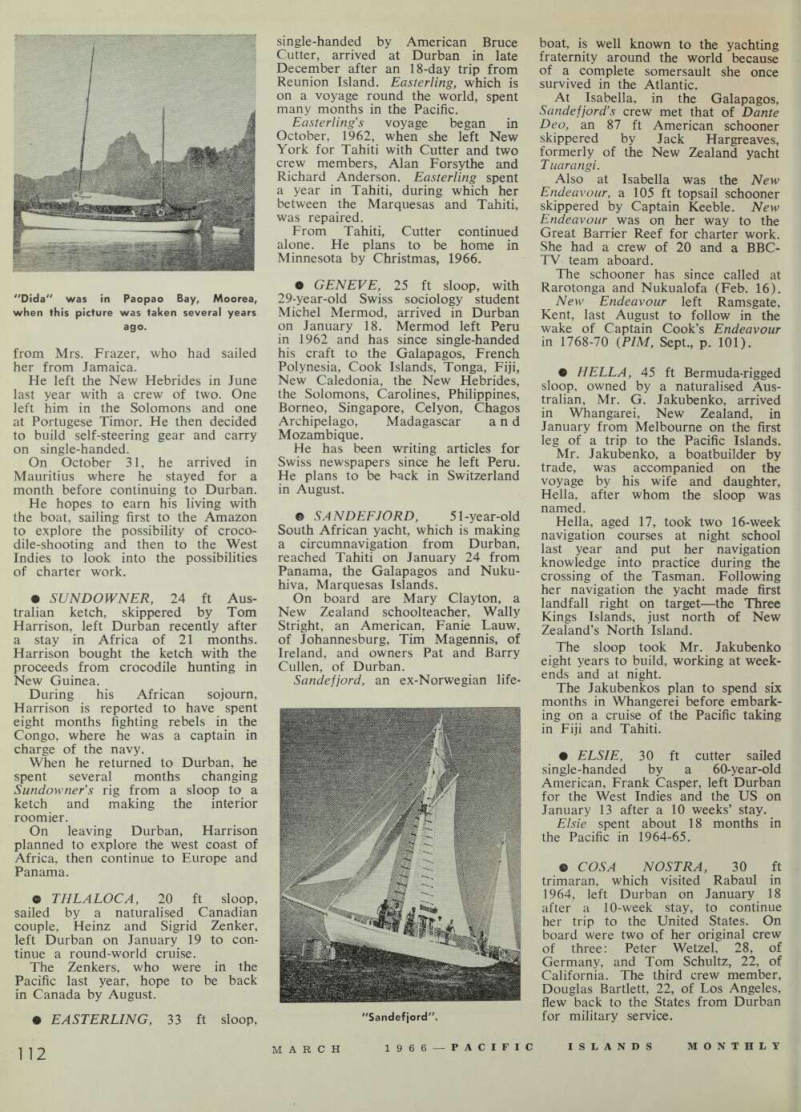
Sandefjord, an ex-Norwegian life-
boat, is well known to the yachting fraternity around the world because of a complete somersault she once survived in the Atlantic.
At Isabella, in the Galapagos, Sandefjord’s crew met that of Dante Deo, an 87 ft American schooner skippered by Jack Hargreaves, formerly of the New Zealand yacht T uarangi.
Also at Isabella was the New Endeavour, a 105 ft topsail schooner skippered by Captain Keeble. New Endeavour was on her way to the Great Barrier Reef for charter work.
She had a crew of 20 and a BBC TV team aboard.
The schooner has since called at Rarotonga and Nukualofa (Feb. 16).
New Endeavour left Ramsgate, Kent, last August to follow in the wake of Captain Cook’s Endeavour in 1768-70 ( PIM, Sept., p. 101). • HELL A, 45 ft Bermuda-rigged sloop, owned by a naturalised Aus tralian, Mr. G. Jakubenko, arrived in Whangarei, New Zealand, in January from Melbourne on the first leg of a trip to the Pacific Islands.
Mr. Jakubenko, a boatbuilder by trade, was accompanied on the voyage by his wife and daughter, Hella, after whom the sloop was named.
Hella, aged 17, took two 16-week navigation courses at night school last year and put her navigation knowledge into practice during the crossing of the Tasman. Following her navigation the yacht made first landfall right on target—the Three Kings Islands, just north of New Zealand’s North Island.
The sloop took Mr. Jakubenko eight years to build, working at week ends and at night.
The Jakubenkos plan to spend six months in Whangerei before embark ing on a cruise of the Pacific taking in Fiji and Tahiti. • ELSIE, 30 ft cutter sailed single-handed by a 60-year-old American, Frank Casper, left Durban for the West Indies and the US on January 13 after a 10 weeks’ stay.
Elsie spent about 18 months in the Pacific in 1964-65.
© Cos A Nostra, 30 Ft
trimaran, which visited Rabaul in 1964, left Durban on January 18 after a 10-week stay, to continue her trip to the United States. On board were two of her original crew of three: Peter Wetzel, 28, of Germany, and Tom Schultz, 22, of California. The third crew member, Douglas Bartlett, 22, of Los Angeles, flew back to the States from Durban for military service.
"Dida" was in Paopao Bay, Moorea, when this picture was taken several years ago.
"Sandefjord".