Cruising Yachts
pp. 99-111 · Read in the full issue
Pacific Shipping And
Weather Plays Havoc With Nauru Phosphate Shipments
i-pi . , , . , „ , Ine most prolonged period of bad weather that anybody on Nauru can remember has played havoc with phosphate cargoes over the last 12 months.
IN January and early February some ships had been waiting three weeks to take on phosphate, and one, the Olga Topic, bound for Brisbane, had waited more than a month.
More than 450,000 tons of phosphate were stockpiled on the island, waiting for the weather to clear, and 10 ships were drifting about Nauru. The record hold-up over the last 12 months was in mid -1965, when one ship waited 65 days for her cargo.
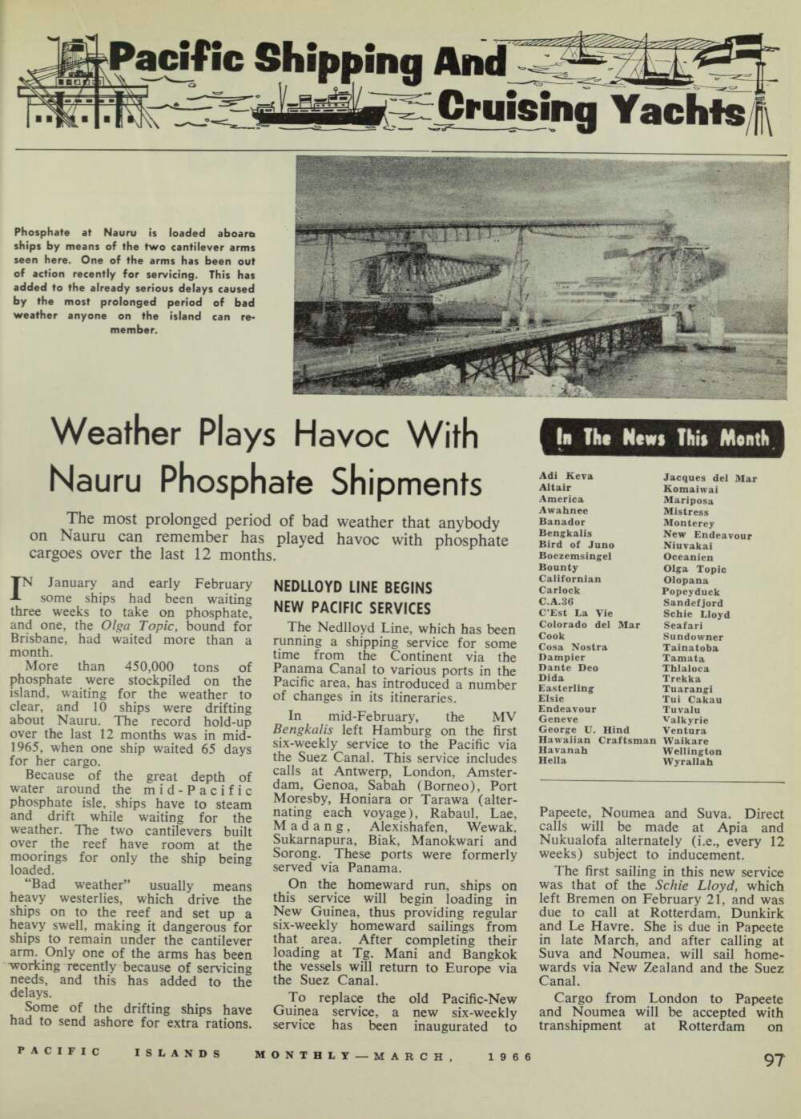
Because of the great depth of water around the mid-Pa c i f i c phosphate isle, ships have to steam and drift while waiting for the weather. The two cantilevers built over the reef have room at the moorings for only the ship being loaded.
“Bad weather” usually means heavy westerlies, which drive the ships on to the reef and set up a heavy swell, making it dangerous for ships to remain under the cantilever arm. Only one of the arms has been working recently because of servicing needs, and this has added to the delays.
Some of the drifting ships have had to send ashore for extra rations.
Nedlloyd Line Begins
New Pacific Services
The Nedlloyd Line, which has been running a shipping service for some time from the Continent via the Panama Canal to various ports in the Pacific area, has introduced a number of changes in its itineraries.
In mid-February, the MV Bengkalis left Hamburg on the first six-weekly service to the Pacific via the Suez Canal. This service includes calls at Antwerp, London, Amster dam, Genoa, Sabah (Borneo), Port Moresby, Honiara or Tarawa (alter nating each voyage), Rabaul, Lae, Mada n g , Alexishafen, Wewak, Sukarnapura, Biak, Manokwari and Sorong. These ports were formerly served via Panama.
On the homeward run, ships on this service will begin loading in New Guinea, thus providing regular six-weekly homeward sailings from that area. After completing their loading at Tg. Mani and Bangkok the vessels will return to Europe via the Suez Canal.
To replace the old Pacific-New Guinea service, a new six-weekly service has been inaugurated to
Papeete, Noumea and Suva. Direct calls will be made at Apia and Nukualofa alternately (i.e., every 12 weeks) subject to inducement, Xhe first sailing in this new service was that of the Schie Lloyd, which left Bremen on February 21, and was due to call at Rotterdam, Dunkirk and Le Havre. She is due in Papeete in late March, and after calling at Suva and Noumea, will sail home wards via New Zealand and the Suez Canal.
Cargo from London to Papeete and Noumea will be accepted with transhipment at Rotterdam on
Phosphate at Nauru is loaded aboaro ships by means of the two cantilever arms seen here. One of the arms has been out of action recently for servicing. This has added to the already serious delays caused by the most prolonged period of bad weather anyone on the island can re member.
through bills of lading at direct rates of freight.
Cargo from Apia, Nukualofa and Suva will be accepted from Con tinental ports only and rates of freight will be quoted on applica tion.
The ports of Apia and Nukualofa, if not called at directly, will be served with transhipment at Suva at direct rates of freight.
Mr. B. de Vlaming, manager for Nedlloyd Line’s New Zealand and Pacific services, was to visit Aus tralia, New Zealand and the Pacific Islands in late February and March.
His headquarters are in Holland.
Tongan Ship Breaks
Down At Sea
The Tonga Copra Board ship, Niuvakai, broke down south-west of Fiji on February 17, while on the way to Australia carrying 150,000 super feet of timber and a quantity of desiccated coconut.
An ocean-going tug, the Carlock, left Brisbane at 6 p.m. on February 20 to tow the Niuvakai to Brisbane.
The Carlock was expected to reach the Niuvakai about February 24, and it was expected it would take another 10 days to tow it to Brisbane.
It was reported in Sydney that the stern tube was fouled. Repairs will be made in Brisbane.
"Mariposa" Captain
On Final Trip
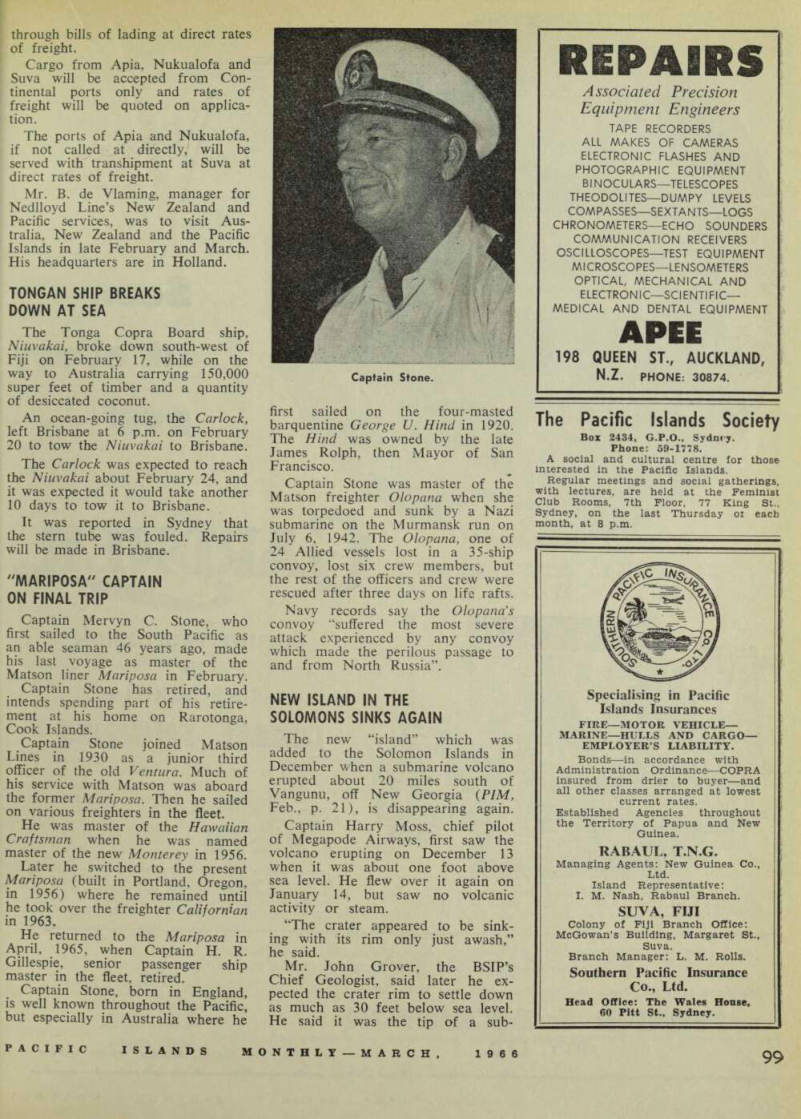
Captain Mervyn C. Stone, who first sailed to the South Pacific as an able seaman 46 years ago, made his last voyage as master of the Matson liner Mariposa in February.
Captain Stone has retired, and intends spending part of his retire ment at his home on Rarotonga, Cook Islands.
Captain Stone joined Matson Lines in 1930 as a junior third officer of the old Ventura. Much of his service with Matson was aboard the former Mariposa. Then he sailed on various freighters in the fleet.
He was master of the Hawaiian Craftsman when he was named master of the new Monterey in 1956.
Later he switched to the present Mariposa (built in Portland, Oregon, in 1956) where he remained until he took over the freighter Californian in 1963.
He returned to the Mariposa in April, 1965, when Captain H. R.
Gillespie, senior passenger ship master in the fleet, retired.
Captain Stone, born in England, is well known throughout the Pacific, but especially in Australia where he
first sailed on the four-masted barquentine George U. Hind in 1920.
The Hind was owned by the late James Rolph, then Mayor of San Francisco.
Captain Stone was master of the Matson freighter Olopana when she was torpedoed and sunk by a Nazi submarine on the Murmansk run on July 6, 1942. The Olopana, one of 24 Allied vessels lost in a 35-ship convoy, lost six crew members, but the rest of the officers and crew were rescued after three days on life rafts.
Navy records say the Olopana’s convoy “suffered the most severe attack experienced by any convoy which made the perilous passage to and from North Russia”.
New Island In The
Solomons Sinks Again
The new “island” which was added to the Solomon Islands in December when a submarine volcano erupted about 20 miles south of Vangunu, off New Georgia ( PIM, Feb., p. 21), is disappearing again.
Captain Harry Moss, chief pilot of Megapode Airways, first saw the volcano erupting on December 13 when it was about one foot above sea level. He flew over it again on January 14, but saw no volcanic activity or steam.
“The crater appeared to be sink ing with its rim only just awash,” he said.
Mr. John Grover, the BSIP’s Chief Geologist, said later he ex pected the crater rim to settle down as much as 30 feet below sea level.
He said it was the tip of a sub
Captain Stone.
marine volcano rising 6,000 feet from the sea floor.
Mr. Grover added that the erup tion of the submarine volcano was linked with a series of seismic shocks which originated deep below the New Hebrides and first reached the Solomons last July.
More recently—between January 28 and 30—the islands of Tongoa, Tongariki and Buninga, in the Shepherd Islands of the New Hebrides, were struck by a force 5-6 (Mercalli scale) earthquake.
No casualties were reported, but the walls of houses and churches in three villages collapsed.
It was the first major earthquake in the New Hebrides since the force 7-8 tremors of August, 1965, which did serious damage particularly in the Santo area.
Meanwhile, in New Guinea, the 160 people of Budua Village on Manam Island were evacuated to Dugulaba village, about three miles away, as a result of increased activity of the island’s volcano.
The volcano began erupting in late January after several months of mild activity.
An AAP-Reuter report on January 27 said that a new crater had broken through the south-western wall of the volcano and boulders and lava were being ejected from it and were flowing down both sides of the valley above Budua Village.
The Vulcanologist-in-Charge of the Rabaul Observatory, Dr. G. W.
D’Addario, inspected the volcano on January 28, and reported that a major eruption seemed unlikely in the near future. However, the volcano would be closely watched to ensure that other villages were not in danger.
The Budua people would probably not be alllowed to return to their village until the authorities were satisfied that there was no danger of an avalanche from material built up in the valley above Budua.
Dutch Ship Bought
For Fiji Trade
Island Industries Ltd., of Suva, has bought a 399-ton Dutch ship to join the Komaiwai and the Adi Keva in the Fiji inter-island trade. The ship will be operated by Island Transport Ltd. under charter.
Island Industries and Island Transport are subsidiary companies of W. R. Carpenter and Co. (Fiji) Ltd.
The latest acquisition, the Boezem singel, was built in Holland in 1961.
She will be altered to suit tropical conditions, and is expected to go into service in May or June.
The Boezemsingel has an overall
length of 159 ft, a beam of 27 ft, and a draught of 10 ft 8 in. She is powered by a 450 hp Industrie engine. Her service speed is about 10 knots.
She has a capacity for about 6,000 sacks of copra.
The Boezemsingel will be given a Fijian name.
"Tamata" In Newcastle
r np pep A IRC run kctmikj The Noumea-based ship Tamata (formerly Colorado del Mar), has been tied up in the Newcastle dockyard recently, pending a decision from the underwriters on necessary repairs.
The Tamata arrived in Newcastle from Fremantle in November. She had struck a reef near Airlie Island, off north-west Western Aus tralia in September, 1965, en route from Suva to Fremantle with about 700 tons of timber.
After being reversed off the reef, she sailed to Fremantle to discharge her cargo, and then went on to New castle for repairs to maintain her classification. a tender for repairs has been sub mitted to the ship’s underwriters, The repairs involve, basically, a new bottom.
The crew, with the exception of one, was paid off when the Tamata arrived at Newcastle. (Over)
The Tamata, built in 1934, was originally known as the Wyrallah.
She then became the Colorado del Mar, and received her present name when Mr. J. Helme, of Noumea, bought her in 1964,
Serious Allegation Over
Fiji Stranding
The Fiji Marine Board has recom mended that a formal inquiry into the stranding of the auxiliary ketch, Tainatoba, is both requisite and expedient.
If the recommendation is accepted a tribunal consisting of a magistrate as chairman and two assessors, will conduct the inquiry.
The Fiji Marine Board held a preliminary inquiry. The Tainatoba, an auxiliary ketch, ran on a reef just after 5 a.m. on November 5 while on a trip from Suva to Kadavu.
Evidence was given that a mem ber of the crew had purposely caused the ketch to ground.
"Tui Cakau" In Service
In The New Hebrides
The Islands trading vessel Tui Cakau, which Captain Athol Rusden, of Vila, New Hebrides, bought from Morris Hedstrom Ltd., of Fiji, late last year, arrived in Vila on January 14 and is now in service in the New Hebrides.
The Tui Cakau was prefabricated in England in 1937 and assembled in Suva by Millers Ltd. She is a steel hull weld job and is powered with a Deutz diesel which gives her a speed of eight and a half knots.
The Tui Cakau was the third former Morris Hedstrom vessel to be acquired by Captain Rusden. The athers are the Altair and the Tuvalu.
The Tuvalu is skippered by Captain Albert Visser, formerly Morris Hedstrom’s shipping manager in Suva.
Captain Rusden tells us in a friendly note that Captain Visser is not in partnership with him, as was stated in this section in January.
“This error gives a false impression Df my business,” Captain Rusden says. “Captain Visser is employed oy me only as master of the MV Tuvalu”
Port Of Noumea
Under Fire Again
Conditions in the port of Noumea, which have been the subject of criticism in the local Press several times in recent years, were again under fire in February. The trouble is that the depth of water in the harbour is not sufficient for some of the ships that call there.
Recently, for example, the Messageries Maritimes ship Oceanien, en route to France from Sydney, had
to anchor in the roadstead for load ing operations.
The policy of Messageries Mari times is that their passenger ships on the Sydney-Marseilles run load at Vila after touching Sydney, then double back to Noumea to avoid having to carry passengers from Noumea and feeding them during the stay in Vila.
An unusually large cargo for the Oceanien at Vila early in February settled the ship too low in the water
for her to be able to approach Noumea’s wharf or even the inner port. The result was that 180 tons of cargo, including 60 tons of metallic frames for a new drive-in cinema in Tahiti, had to be ferried out to the ship in the roadstead.
Sixty passengers went aboard in the same manner an uncomfortable journey because of the choppy seas.
Noumea’s Bulletin du Commerce commented: “It is regrettable that the port of Noumea is not yet in a state to assure arriving ships of easy facilities to carry out normal operations. Its condition and lack of equipment is giving it a sad reputa tion in maritime circles”.
FOOTNOTE: Some 18 months ago, in criticising Noumea’s port conditions, one of Noumea’s news papers said that there had been no serious dredging of the port for 25 /ears and that the maximum depth of water in the harbour was only 27 ft (PIM, Nov., 1964, p. 105).
"Bligh" Launch Found
After Seven Months
Mr. Edward Barnett, an Australian fisherman, found the 18 ft launch Bird of Juno floating partly sub merged off the coast at Wollongong, NSW, in early February, seven months after it had been abandoned n the Pacific, 150 miles off the south Queensland coast.
Bird of Juno was abandoned last iune by Douglas Olifent, a former Australian navy officer, who had loped to retrace the 3,600-mile open 3oat voyage of Captain Bligh ( PIM, hily, 1965, p. 105).
Olifent set off from Surfers Paradise, 50 miles south of Brisbane,
on June 2, with the object of reach ing the Tongan island of Tofua, then turning about and retracing Bligh’s voyage to Timor.
However, after battling heavy seas almost continually for two and a half days, he abandoned the launch with all its valuable equipment, and was taken back to Brisbane in the freighter Waikare.
Olifent’s adventure was financed by a wealthy American, Mr. Gerald Peacock.
Certificate Refused
For Tourist Vessel
The Fiji Marine Board has refused to issue a certificate of seaworthiness
for the Havanah, 200 ton twin-screw motor vessel, which was to enter the Fiji tourist trade.
Mr. R. Smith, of Stardust Cruises Ltd., had intended to lease the Havanah from her Australian owner, Mr. Trevor Doctor, for economy class cruises in the Mamanuca and Yasawa Islands.
The Havanah was slipped at Suva and inspected by Marine Board officials soon after she arrived in Fiji last year. A certificate of seaworthiness was refused unless certain work was done.
Mr. Smith said that after the survey, the surveyor declined to give a list of defects, and no reply had been received to early February, to a letter to the Marine Board.
Mr. Doctor said he had learned unofficially that to bring the Havanah to standards demanded by the Fiji Marine Board could cost more than £5,000.
The work was excessive, and un economical, and he had decided to send the Havanah back to Aus tralia.
"Roll-On, Roll-Off"
Ship For P-Ng
The Karlander New Guinea Line plans to build a new “roll-on, roll off” type of ship for service in Papua-New Guinea. Tenders to build the ship will be called in Australia, Japan, Hong Kong and Europe, It will be a revolutionary move for inter-island shipping in the Terri tory, and it will make working of many of the beach ports much easier.
The “roll-on, roll-off” ships used
Douglas Olifent.
on the Australian coast have proved successful, and the Karlander New Guinea Line considers they would be equally successful in P-NG.
The Karlander ship will be different from those on the Australian coast, for it will have “doors” in the bow which open out, whereas ships on the Australian coast open at the rear, with the stern dropping to make a ramp.
Vehicles will drive into the ship to deposit cargo in the hold.
Similarly vehicles will be able to drive in to unload the ship’s cargo.
Cargo which cannot be driven in will be handled by a special crane.
Hydraulically-operated, adjustable ’tween decks will enable this area to be expanded or contracted as re quired.
The ship will handle such cargo as earth-moving equipment, cement piles, logs, sawn timber, copra, etc.
Ketch Arrives For
Charter Work In 8.5.1. P.
WELLINGTON, an 80 ft Tas manian-built ketch with owner skipper Lyall Price, arrived in Honiara at the end of January from Brisbane.
Price plans to base her in Honiara and undertake charter work around the Solomons. Price is well-known in the Pacific as the skipper of the 22 ft CEst La Vie.
With him on the Wellington venture are Don Brug, mate (who cruised in the Mistress in 1962-63) and Carl Greenstreet.
John Fenn, Errol Wright and lan Smith were also aboard the Welling ton when she reached Honiara, as delivery men.
Wellington is registered in Ade laide, and is a stout craft which should be suitable for hard work around the Islands,
Little Hope Held For
Missing Yachtsman
Publicity in the Australian Press in January has failed to throw any light on the disappearance of lone handed yachtsman, William Proctor, who has not been heard from since he left Honiara, Solomon Islands, on July 8 for Port Moresby in his 21 ft sloop Popeyduck. There now seems to be little hope that he is safe.
Proctor, an Englishman, was sail ing solo round the world from his home in Portsmouth and planned to be back in England by June, 1966, to start building a larger craft. He figured in PlM’s yachting columns several times last year during his passage of the Pacific.
He is reported to have high blood pressure, for which he needs a con tinual supply of drugs, and also poor
eyesight, although he had only one pair of spectacles on board Popeyduck.
The only possible clues to Proctor’s disappearance have been small pieces of wood and some tattered seat covers washed up on small islands in the Laughlan Group, 450 miles east of Port Moresby.
The P-NG Marine Superintendent, Captain G. A. Hawley, said in late January that natives of Bodi Bodi Island in the Laughlans claimed that they had seen a small vessel wrecked on a reef off Bodi Bodi, and a white man disappear over the side.
The small pieces of wreckage were found when Trevor Voigt, skipper of
a small Islands vessel, investigated the Bodi Bodi reports. However, the wreckage could not be positively identified, A theory that Proctor may have by-passed Port Moresby has been discounted by Geoffrey Matthews, skipper of the yacht Dida (see p.
Ill), who said on his arrival in Durban; “I made inquiries at all the places he planned to stop and he had not been to any of them. He had not been to Thursday Island, which is only 300 miles from Port Moresby and which he would have reached in two or three days; nor in Mauritius; nor at Cocos; nor at Christmas Island.”
First Solomon Islands
Marine Pilot
Captain Paul Frey has arrived in Honiara to take up the post of pilot for the BSIP Ports Authority. He is the first man to hold this job.
Captain Frey was a cadet in a Polish merchant navy training ship on the outbreak of World War 11.
During the war he sailed in Polish ships in British trans-Atlantic convoys and to Africa and the Mediterranean.
One ship was torpedoed and sunk under him near the English coast.
Captain Frey, who became a British subject after the war, is married to an English girl and they have three children.
A Whale Of A Story
From Jim Shortall
Latest news from Jim Shortall, who originated this section of PIM, shows that he is still afloat, but expects to have a change of venue in March when his ship is sub chartered to the Salen Co., of Sweden, one of the biggest refrigera ted shipowners and fruit-carriers in the world.
When this happens the MV Banador, on which he is radio officer, could go anywhere in the world—to Antarctica to pick up whale meat, Tasmania for apples for Northern Europe, or the Caribbean for bananas for the United Kingdom.
Jim wrote from Guayaquil, Ecuador, where the Banador, a Japanese K-Line ship, was loading bananas for Toyko. He had his usual adventures to report.
“We received a big Christmas present last voyage,” he wrote. “At 10 p.m. on Christmas Eve we were passing the northernmost of the Galapagos Islands when our engines suddenly slowed to about three knots.
The engineers ran around all night, trying to figure out what was wrong because everything seemed all right down below.
“Then, at daybreak on Christmas morning, we got the answer. A 30-ft whale had wrapped itself around our bulbous bow and we had been push ing the damn thing all night.
“It was quite dead by this time, of course, but we had to stop and go astern to get clear of it.
“I’ve heard of this happening before—with a Union SS Co. ferry in Cook Strait, NZ, about 20 years ago—but it doesn’t happen too often.”
Jim said that on their current voyage to Guayaquil in late January, in calm conditions about 275 miles SSE of Midway Island, they sighted an aircraft in the water dead ahead.
It had no recognisable inter
national markings on it, but looked like a small jet, either the carrierbased type with its wings broken off, or some sort of target “drone” carrying no pilot, but controlled by radio.
The front portion was below the water, but its tail was painted orange with black trimmings. In big black letters on the high tail were “UF” and on the fuselage “VU-3”. On the top of the fuselage there was a triangular-shaped fitting which looked as though it could be used for hoisting the plane with a crane. No one was in the craft.
A message with full details was sent to the US Navy at Pearl Harbour.
Some Russian ships were within a few hundred miles, doing radar
tracking work in connection with rockets. The general opinion on board Banador was that the aircraft might have had something to do with them.
Survey Ship To
w |CIT M|;VA/ ucDpincc
Visit New Hebrides
The Royal Navy survey ship, HMS Dampier was scheduled to visit the New Hebrides in late February after a trip to New Zealand for docking, Dampier is continuing the ocean survey work carried out over several years by HMS Cook, which was badly damaged in October, 1963, when she struck a coral reef off Ellington, Fiji.