Hard Cash Needed To
pp. 53-55 · Read in the full issue
Buck Up New Guinea's
Despondent Policemen
From a Rabaul Correspondent The Royal Papua-New Guinea Constabulary are not noted for being a merry lot of souls, especially over recent years, and the current inquiry into their problems has not made them any
happier.
THIS is somewhat surprising, as most people cheer up at being given the opportunity of saying what they think, as has been the case with the police in recent weeks.
In the inquiry, a committee has been criss-crossing the territory, taking evidence in all sorts of places, inspecting barracks, tasting food, prodding at police station walls, listening to complaints from saints and sinners alike (for the public, too, have been invited to get things off their heaving chests).
All evidence is being taken in private so that witnesses may feel free to say what they think, or what they are game to put into words.
Mixed Bag
What is said probably depends on which members of the committee happen to be listening at the time, because they are a mixed bag, and they are not all travelling together.
They break into groups and head in different directions from time to time.
The chairman is Mr. W. W.
Watkins, roly-poly Secretary for Law. With him are the Police Com missioner, Mr. R. R. Cole, who took over as Commissioner after Mr. C.
Normoyle was eased out about a year ago; Mr. J. K. McCarthy, Director of District Administration (which has had its name changed, inexplicably, from that of Native Affairs); Mr. J. E. Ritchie, Acting P-NG Treasurer; Mr. D. Parrish, Acting Secretary for Labour; Mr.
Pita Simogun, MHA and Under secretary for Police; Inspector J.
Feeny, representing the Police As sociation; and Sub-Inspector W.
Tiden and Senior Constable Saun, both New Guineans in the force.
The committee is not likely to put in its report before the end of March. But enough is leaking out around the edges of the inquiry to indicate that members of the com mittee are not being told anything they hadn’t heard before.
Enough police witnesses have in dicated, outside the committee hear ings, that they don’t hold out much hope that the inquiry will do them any good, because the Administration is not really interested in building a better police force if it is going to cost money.
It is better prepared, they say, to spend time and money investigating the possibilities of TV in the ter ritory than in consolidating law and order.
Morale Low
This despondent, defeatist police attitude, which one meets with in police posts and stations throughout the country, is indicative of the state of current morale in the force. It has never been lower.
The police have been starved of money, imagination and men for years. Health and Education have taken millions, and so have Johnny come-lately departments such as Information and Extension Services (which appears, to the police, to have produced little but an occasional well-illustrated booklet extolling the virtues of the police force for out side consumption).
Hundreds and thousands have been
spent on such trappings of law and order 1 as fancy courthouses with peculiarly-constructed roofs.
But the police still remain with inadequate transport, poorly serviced because of the lack of money, a shortage of modern crime-busting equipment and technical aids, poor wages and particularly poor con ditions.
The conditions of the men are far inferior to those of the Army, whose men are better quartered, better fed (on European rather than native scales) and better clothed. This is one of the main causes of discontent, despite the Administration’s previous insistence that conditions between Army and police should not be regarded as comparable.
The police do regard them as comparable, and this has resulted in the stop-works and threatened strikes of the last year or two.
Main Hope
It is this potentially explosive situation—which is worse in such towns as Port Moresby, where costs are higher and living conditions in ferior—that finally and tardily drove the Administration to the establish ment of the current committee of inquiry.
Some things have already been done to improve the force, although it is too early for their full effects to be felt, but others will have to await the committee’s report.
The Police College, which trains
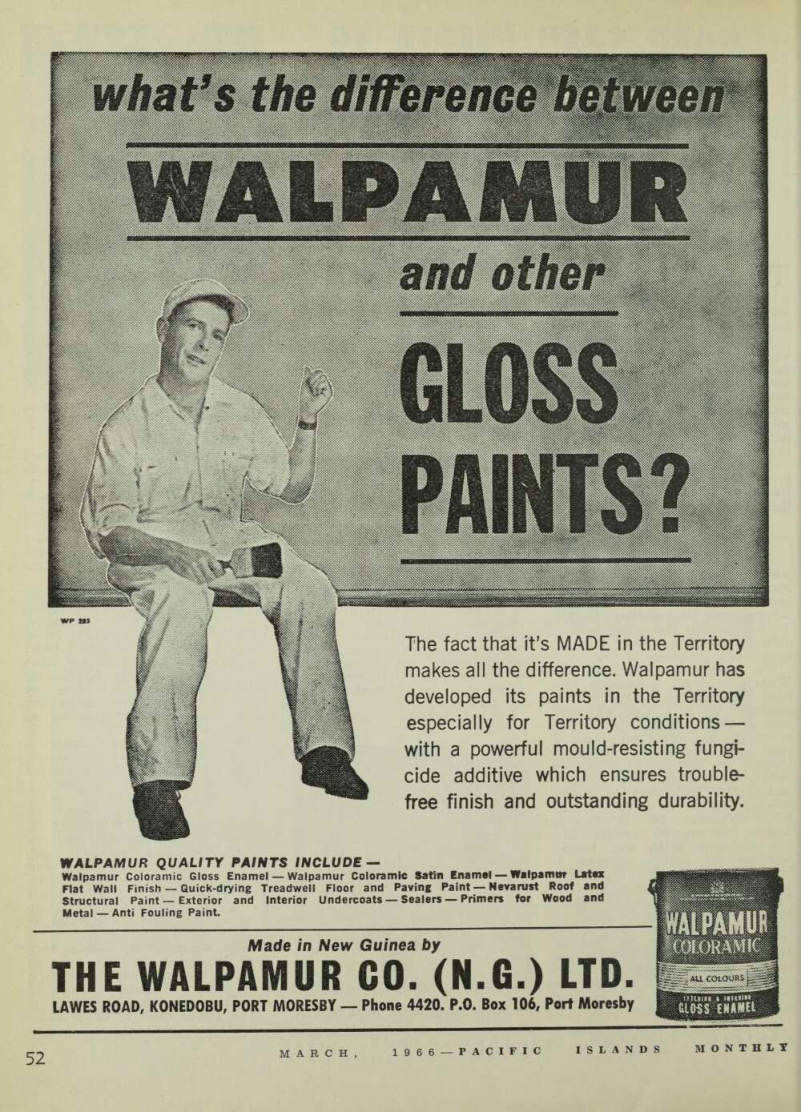
The Police Commissioner, Mr. R. R. Cole.
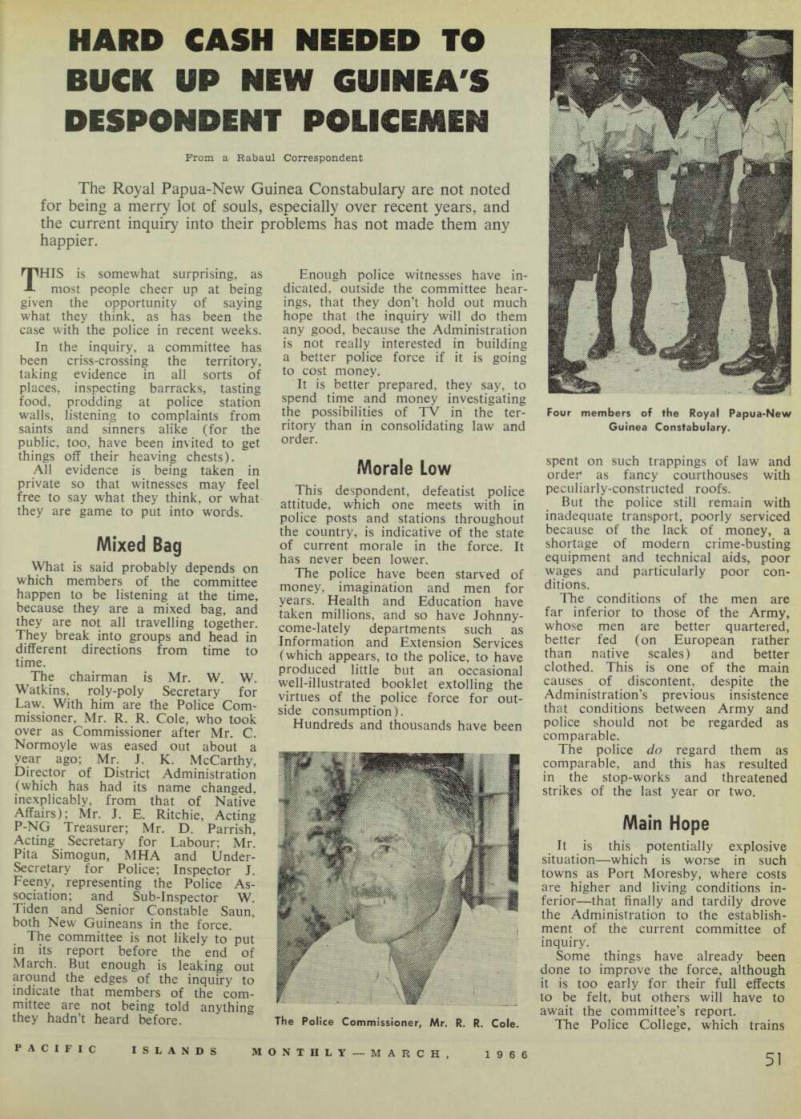
Four members of the Royal Papua-New Guinea Constabulary.
native police as officers, is a main hope for the future. The college has already produced a handful of officers to take their places among the Europeans who have held the monopoly of officer positions for so long, but the mistake was that the college wasn’t established six years ago. If it had been, the force today would have had the experience of local officers, some of whom are already displaying a refreshing keeness.
Even the first intake of the col lege was somewhat of a disappoint ment because of the number of old hands who were accepted on the basis of seniority and loyalty.
This was right and proper, but these men needed to be mixed in with a greater proportion of keen young blood with better education, who will still be on their feet, leading, when the old dependables retire to their well-earned rest in a few short years.
There is an officer problem in the force, but one hesitates to decide which came first, the chicken or some of the eggs who still staff the police stations in officer uniform.
They do not know their men— hardly bother to look at their living conditions, or satisfy themselves that they have real complaints and not imagined ones—and their knowledge of crime prevention is sometimes such that New Guinea must surely be the ideal place to pull a Great Train Robbery.
Too Urban
Other problems include the dis tinct difference between urban and country work. The constabulary is too much an urban force. Too many European police keep to the towns, but with the current shortage of officers (and with some men banking lucrative sums in overtime as a result) this won’t be easy to solve.
According to at least one of the witnesses before the committee, Mr.
Barry Holloway, MHA representing Kainantu and a former patrol officer, what the police needs is an auxiliary division for the outback.
The division would be a corps of men similar to the old village policemen, and with statutory authority only in their own areas.
They would be selected mainly be cause of their traditional qualifica tions of leadership rather than educational attainments. They would be paid, put in uniform and dis tributed one for every 200 to 500 of the population.
Holloway’s submission particularly stressed the qualities of leadership, for his point was that in the bush
the people still fail to comprehend law and order as the townspeople know it.
He told the story of the Kainantu councillors who punished an assault on a female by some local youths, by having their backsides bared and getting the locals to cane them publicly.
This settled the matter, except that the youths complained to the first fulltime local police officer and thus gained a victory when the Admini stration took the matter up. The councillors lost their new-found prestige.
Holloway suggested that the auxiliary would not be a con
tinuation of the system of direct rule, but would be an agency of law and order. This would be the best way of handling the problem at the present stage of development, he felt.
Meanwhile the inquiry goes on, and its importance is not so much in what it hears, or even in what it reports eventually, but in what action the Administration will finally be forced into taking to get the Queen’s New Guinea constabulary on its feet.
The Administration should make up its mind now that it is going to have to spend a packet, and prepare its budget accordingly.