Territories TALK-TALK
pp. 57-61 · Read in the full issue
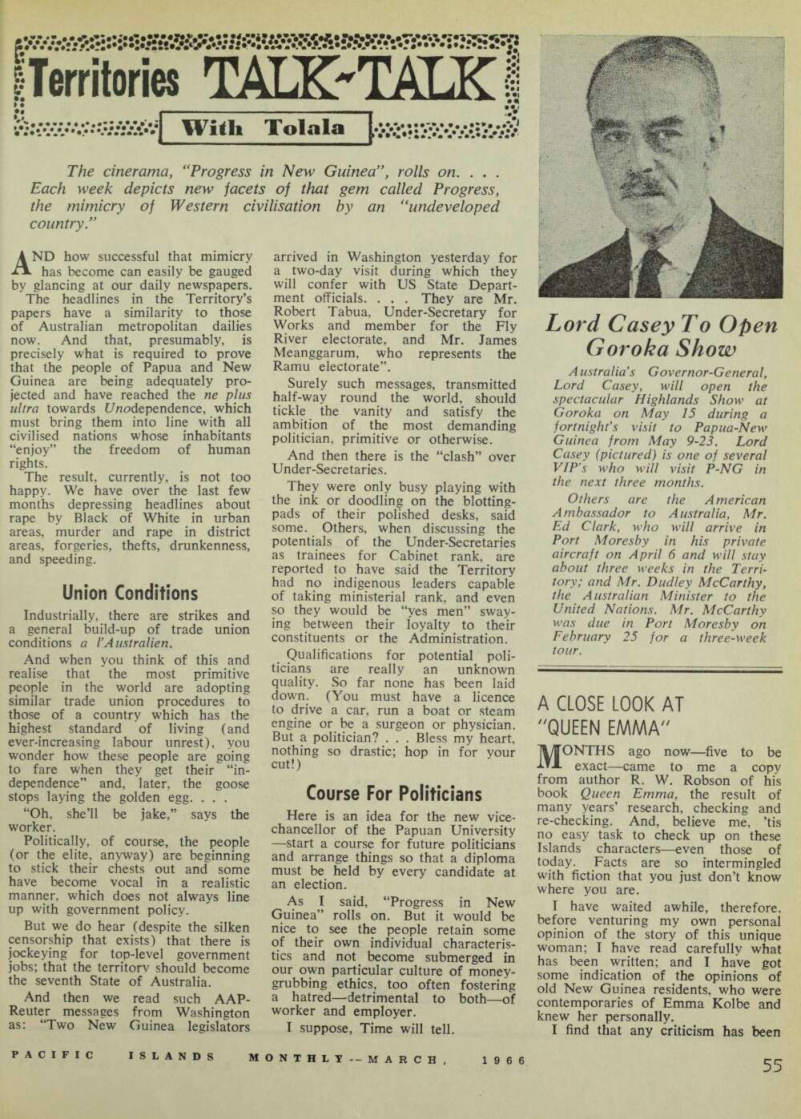
With Tolala
The cinerama, “Progress in New Guinea”, rolls on. .. .
Each week depicts new facets of that gem called Progress, the mimicry of Western civilisation by an “undeveloped country.”
AND how successful that mimicry has become can easily be gauged by glancing at our daily newspapers.
The headlines in the Territory’s papers have a similarity to those of Australian metropolitan dailies now. And that, presumably, is precisely what is required to prove that the people of Papua and New Guinea are being adequately pro jected and have reached the ne plus ultra towards t/nodependence, which must bring them into line with all civilised nations whose inhabitants “enjoy” the freedom of human rights.
The result, currently, is not too happy. We have over the last few months depressing headlines about rape by Black of White in urban areas, murder and rape in district areas, forgeries, thefts, drunkenness, and speeding.
Union Conditions
Industrially, there are strikes and a general build-up of trade union conditions a I’Australien.
And when you think of this and realise that the most primitive people in the world are adopting similar trade union procedures to those of a country which has the highest standard of living (and ever-increasing labour unrest), you wonder how these people are going to fare when they get their “in dependence” and, later, the goose stops laying the golden egg. . . .
“Oh, she’ll be jake,” says the worker.
Politically, of course, the people (or the elite, anyway) are beginning to stick their chests out and some have become vocal in a realistic manner, which does not always line up with government policy.
But we do hear (despite the silken censorship that exists) that there is jockeying for top-level government jobs; that the territorv should become the seventh State of Australia.
And then we read such AAP- Reuter messages from Washington as: “Two New Guinea legislators
arrived in Washington yesterday for a two-day visit during which they will confer with US State Depart ment officials. . . . They are Mr.
Robert Tabua, Under-Secretary for Works and member for the Fly River electorate, and Mr. James Meanggarum, who represents the Ramu electorate”.
Surely such messages, transmitted half-way round the world, should tickle the vanity and satisfy the ambition of the most demanding politician, primitive or otherwise.
And then there is the “clash” over Under-Secretaries.
They were only busy playing with the ink or doodling on the blotting pads of their polished desks, said some. Others, when discussing the potentials of the Under-Secretaries as trainees for Cabinet rank, are reported to have said the Territory had no indigenous leaders capable of taking ministerial rank, and even so they would be “yes men” sway ing between their loyalty to their constituents or the Administration.
Qualifications for potential poli ticians are really an unknown quality. So far none has been laid down. (You must have a licence to drive a car, run a boat or steam engine or be a surgeon or physician.
But a politician? . . , Bless my heart, nothing so drastic; hop in for your cut!)
Course For Politicians
Here is an idea for the new vice chancellor of the Papuan University —start a course for future politicians and arrange things so that a diploma must be held by every candidate at an election.
As I said, “Progress in New Guinea” rolls on. But it would be nice to see the people retain some of their own individual characteris tics and not become submerged in our own particular culture of money grubbing ethics, too often fostering a hatred—detrimental to both—of worker and employer.
I suppose, Time will tell.
A Close Look At
"Queen Emma"
MONTHS ago now—five to be exact—came to me a copy from author R. W. Robson of his book Queen Emma, the result of many years’ research, checking and re-checking. And, believe me, ’tis no easy task to check up on these Islands characters—even those of today. Facts are so intermingled with fiction that you just don’t know where you are.
I have waited awhile, therefore, before venturing my own personal opinion of the story of this unique woman; I have read carefully what has been written; and I have got some indication of the opinions of old New Guinea residents, who were contemporaries of Emma Kolbe and knew her personally.
I find that any criticism has been
of a minor nature, and I think—in fact, I am sure—that RWR well deserves an orchid in his lapel, con sidering that old-time Germans of the NG vintage were personalities, for the most part, who crossed every “t” and dotted every “i” and expected others to do likewise.
Despite Peter Hansen’s tactics, as described on page 202 of Queen Emma, the only reaction I noticed when I asked the worthy Peter in the early ’twenties about his days with Emma was that his reply was un printable.
Somewhere along the line antagonism had sprung up and he related to me how, when Emma’s ships passed Peter Haven (Witu), there was always an exchange of abusive flag signals.
Incidentally, and it is quite appropriate to mention it here, for some reason the natives of Garove (in the Witu Group where Peter Haven is located) had an argument with Peter in later years and decided to give him the works. Only the loyalty of his native wife saved him. He made his escape from Witu.
Years later, in the ’thirties, the Australian Administration introduced a regulation that only Europeans who were legally married could live with native women.
First To Conform
Peter was the first white man in the Territory to conform with this edict and married the woman who had saved him from the infuriated natives of Witu.
I liked Peter; I liked the little tear-drop that always hung on the lower lid of his right eye when he became emotional about the past.
And I liked his diffidence about having another drink—but he always had it.
But back to Queen Emma. One of my German friends remarks that RWR’s description of Dr. Hahl as “one of the last governors sent to New Guinea” is hardly adequate. He says that Dr. Hahl was the Governor of German New Guinea who held office for more than 20 years. His only predecessor was v. Bennigsen who acted for only a few years and his successor was Dr. Haber who was only four months in office.
Another takes issue on whether von Hansemann, head of the New Guinea Kompagnie, was the superior of von Oertzen as stated by the author, or not. von Oertzen was not Lands Commissioner but Imperial Commissioner and probably re ported independently to Berlin; A couple of things I noticed myself when going through the book; On page 197 there are references
to “Paraparatoma natives”. That is a new name to me. The area around Varzin plantation, and also another name for the plantation itself, is Paparatawa. In an old land map of mine, which I have beside me, issued by the German Government in 1908, the name Paparatawa appears several times, but not the other name. (Paparatawa in the Blanche Bay dialect means “opening of the water”, i.e., head of the water).
On page 222 Roger Barry is
credited with having translated Parkinson’s Dreissig Jahre in der Sudsee. It was Noel Barry who did the job. He was for many years a translator in the Government Lands Department, then accompanied Judge Phillips on his Land inquiries. After resigning from the Administration he was trading and also had a small store in Rabaul. Roger Barry, I have an idea, could be the name of Noel’s father, who acted for a while as rector of St. George’s Church in Rabaul in the ’thirties. (Over)
I was interested in the photo graph, opposite page 96, of the Queen and some of her friends and relatives taken about 1895. Among them is Mrs. Mirow. Not presuming to paint the lily, but merely for general information: Mrs. Mirow was a New Zealander who came up to the Colony in the early ’nineties as a sister for the Methodist Mission Society; later she married Wilhelm Mirow who became H. R, Wahlen’s No. 1 plantation man when Emma sold out. He survived deportation after World War I and later was employed by W.R.C. Ltd. His son, Hermann, managed a copra planta tion in the Madang district for several years. He died in Sydney in 1964.
Among the men in the photo is Mainka (standing on tip-toe to avoid Parkinson’s hat). He was postmaster in Rabaul in 1914 and also owned Londip plantation in the Kokopo district. He escaped expropriation (on appeal) after World War I, as, owing to the map of Europe being doddled about, he was pleased to find he was not a German but a Pole.
Bradke, also in the picture, came out to worship the sun through the coconut with August Englehart on Kabakon, but cut the painter, defected, or whatever you like to call renouncing a religious faith. He concentrated on planting and started the big Kalili estate on New Ireland.
Next to him stands Carl Diercke who married Helen, daughter of Phoebe Parkinson. Carl owned Tinputz plantation in Bougainville.
Mental Fatigue
ON page 69 of this issue is a letter from an archaeologist, I.
R. Specht, indicating his annoyance and disapprobation concerning re marks of mine in January Talk-Talk (p. 55) about prehistoric pottery on Watom Island.
He seems principally concerned because I am “badly informed” and also have “a bad memory”. Let me say how much I appreciate his concern, and if I have embarrassed him in his research work, let me apologise.
Only too well do I realise that my mental machinery is wearing out. It is not uncommon for such mental fatigue to develop after one has passed the allotted span, and one realises then that one is not infallible. . . . My memory has served me quite well in the past, as I think some of the readers of Talk-Talk over the past 20 years will agree.
Bits And Pieces
AN old time missionary’s wife of the German days, Mrs. Wenzel, has been on a visit to the Territory recently and made a special trip to the Namatanai district where she lived with her husband, Rev. H. P.
Wenzel, before and during World War I.
Friends of John Lewis Froggatt, now of Campbelltown (NSW), previously of Rabaul and Port Moresby Department of Agriculture, will be interested to know he is marrying again. The lady is an old friend, originally from Moree.