Four Territories Devastated In Worst
pp. 47-51 · Read in the full issue

South Seas Hurricane For 75 Years
Four South Pacific territories—Western and American Samoa, the Wallis and Futuna Islands and the Tokelaus—were devastated in late January by the worst hurricane to rip across the South Seas for three-quarters of a century. The hurricane also wreaked havoc in parts of the Cook Group.
THE hurricane, with winds reaching more than 125 miles an hour, tore through the Central Pacific on January 29, 30 and 31, causing hundreds of thousands of dollars worth of damage and the loss of nearly 40 lives.
In Western Samoa, where damage was estimated at £3 million, the Government sent out appeals for help to New Zealand, Australia, Canada, the United States, the Inter national Red Cross and the United Nations.
American Samoa was declared a disaster area by President Lyndon B.
Johnson of the United States who authorised relief of $US500,000.
The French Minister of Overseas Territories, Mr. Pierre Billote, ordered immediate help to be given to the French islands of Wallis and Futuna which were desolated.
The poor and overcrowded Tokelau Islands were so badly hit that the New Zealand Government, which administers them, had to fly in emergency supplies.
In the Cook Islands, only a change of course of the hurricane centre at the seemingly last possible moment
Western Samoa's
Food Crops
Hard Hit
saved Mangaia and Rarotonga from disaster.
Reporting from Apia on the situation in Western Samoa, R. F.
Rankin said that the hurricane, which struck that territory on January 29, had done more damage than any in living memory.
In the past, hurricanes had caused heavy damage in certain districts of Samoa, but this one had devastated the length and breadth of Savaii and Upolu for the first time.
It killed 10, mostly from falling trees, and cost the country an estimated £3 million in damage and loss of earnings over the next 12 months.
Not one banana tree escaped damage and pretty well every mature tree was blown down; three quarters of the breadfruit trees were destroy ed; about a fifth of the cocoa trees were blown down, and although only about 5 per cent, of the coconut trees were felled, the rest were severely battered and copra pro duction over the next year or so will show a drastic fall.
Banana exports last year earned £600,000. For the rest of this year they are expected to be non-existent.
Economic planners estimate that export earnings for 1966 will be £860,000 down compared with the £2 million earned last year.
Damage to roads, public buildings, and power and telephone lines has so far been estimated at hundreds of thousands of pounds.
Damage to the telephone system was so great that expert communica tions advice is being sought as to the advisability of scrapping the 40-year old system and installing a modern one.
First warnings of an approaching tropical storm were issued on the morning of Saturday, January 29.
Gale force winds began at about 1 p.m. that day and continued until 4 o’clock next morning with an average strength of about 55 m.p.h.
A maximum gust of 93 m.p.h. was recorded by Apia Observatory at 8 p.m. on the Saturday. Just over three inches of rain fell during the 24-hour storm period.
Electric power was cut off in the early afternoon of the 29th to prevent accidents. Before long both electric and telephone lines were broken in hundreds of places by falling trees.
Local radio station 2AP remained on the air from early Saturday afternoon to 1 p.m. on the Sunday, broadcasting recorded music inter spersed with weather progress reports
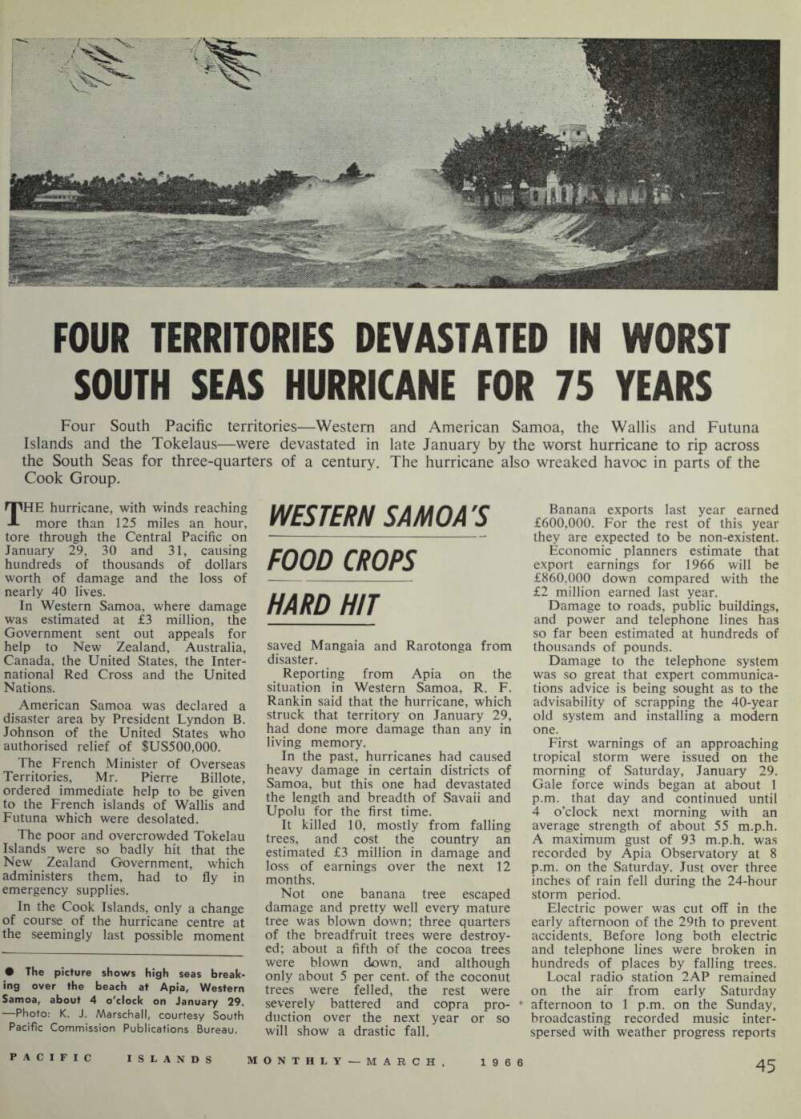
The picture shows high seas break ing over the beach at Apia, Western Samoa, about 4 o'clock on January 29.
Photo: K. J. Marschall, courtesy South Pacific Commission Publications Bureau.
from their transmitter in the h: at Afiamalu.
Risking death or injury from falli trees, PWD Transport Pool driv took up to two hours to make 1 six-mile trip to Afiamalu to delr the latest weather reports from 1 observatory at Mulinuu.
Although many houses W( damaged or destroyed, there was panic or breakdown in commun organisation The police, radio, put works, post office, observatory a hospital rose to the occasion. Af the storm villagers got to work w a will and the debris was deal from roads and villages very quid In Apia, however, officials f the worst is to come. With staple food crop, bananas, aim entirely destroyed and not able produce more fruit for at least 1 months, and the secondary sta food, breadfruit, 75 per ce destroyed, authorities predict serious food shortage in the next months.
With plantations not producing £ labour being laid off, and the regu cash income from bananas no lon available, villagers furthermore \ not have any cash with which to t food to supplement their diet.
Food Needed
In an official report to the N Zealand High Commissioner O.
Gabites, Prime Minister Mata estimated that over the next months the country would be a to produce only enough food 35.000 people, roughly one third the population.
He calculated that to avoid si vation, Samoa would have to imp an extra 20,000 tons of fish, 10,( tons of meat, 20,000 tons of flour, i 15.000 tons of rice. He said t because of Samoa’s limited finam much of this would have to come an outright gift.
Despite this grim outlook, th was no immediate evidence of wo among the villagers.
A member of Prime Mink Mataafa’s Hurricane Relief Cc mittee, formed to co-ordinate i distribute aid, was shocked to f villagers playing cricket wherever went.
“The people just don’t realise h serious the position is,” said IV Mataafa, president of the Red Cr and Women’s Committees, and a a member of the Relief Commitl “In all their lives they have ne known what it is to be hungry.”
Meanwhile, Mataafa issued directive forbidding village cric to be played except on Wednesd and Saturdays, but many villag ignored it.
Despite the devastation, the hur ricane could, in some ways, prove to be a blessing.
It could provide a shot in the arm for the Agriculture Department’s coconut replanting programme, and the devastation of the banana planta tions has provided a golden op portunity in the bunchy top cam paign to eradicate diseased plants and replant healthy ones.
Heavy Property
Damagejn
American Samoa
ON Ameiican Samoa, winds of up to 125 m.p.h. brought death and destruction throughout the territory, including isolated Swains Island, and in the surrounding seas.
The hurricane was the first to damage property on Tutuila since 1936, although that island has had some near misses in recent years, one of which did damage in the Manu’a Group in 1959.
Property damage in the latest hurricane was estimated at SUS 2 million.
Scores of fales and Western-style houses were destroyed, Government
facilities were extensively damaged, phone and power lines were brought down, and as much as 95 per cent, of the taro, bananas and breadfruit crops on Tutuila and Manu’a was wiped out.
For several days, Tafuna Inter national Airport was out of use or open only during daylight hours.
Acting Governor James F. Flan nery, who was in change of the Administration when the hurricane struck, declared a state of emergency; and when Governor H. Rex Lee, who had been overseas for a tourism conference, returned to Pago a few days later, he immediately asked the US Governmment to declare the ter ritory a disaster area.
Emergency food and other sup plies began arriving in Pago from a number of sources within a few days of the hurricane.
Meanwhile, a top-level team of US Federal disaster experts, under Mr. Ralph D. Burns, arrived in Pago Pago to prepare a large scale rehabili tation programme.
Ed Johnson reported from Pago
Pago on February 2 that the hur ricane “came on January 29 and reluctantly left the following day after striking practically every village in Tutuila”. He went on: “Houses along Leone’s waterfront were demolished and the road from Leone into the Bay area of Pago is a scene of wrecked or partially-wrecked buildings.
“Laulii, Alao and Tula to the east took considerable punishment and property damage. Houses on the Fagasa Road in Pago Pago were smashed or partially caved in as were many homes in Fagatogo and Utulei.
“The hills around the Bay area look as if they have undergone heavy artillery shelling. All large trees are either down entirely or savagely rip ped, with remnants of limbs clinging to smashed trunks. Breadfruit, banana and fruit crop trees are nearly all wiped out.
“Numerous Government buildings have torn roofs and electric wiring is completely out of commission.
“Hundreds of families are without homes and are sharing crowded conditions with friends and relatives.
“Heavy seas today are pounding the coast and warnings have been sent out to use the roads only at a minimum for boulders are being thrown up on them by the waves.”
On February 3, an RB 50 aircraft from the US Air Force Mapping Wing on Tutuila flew a mercy mis sion to Swains Island to drop 14 parachute loads of food for the 136 residents of that island who had
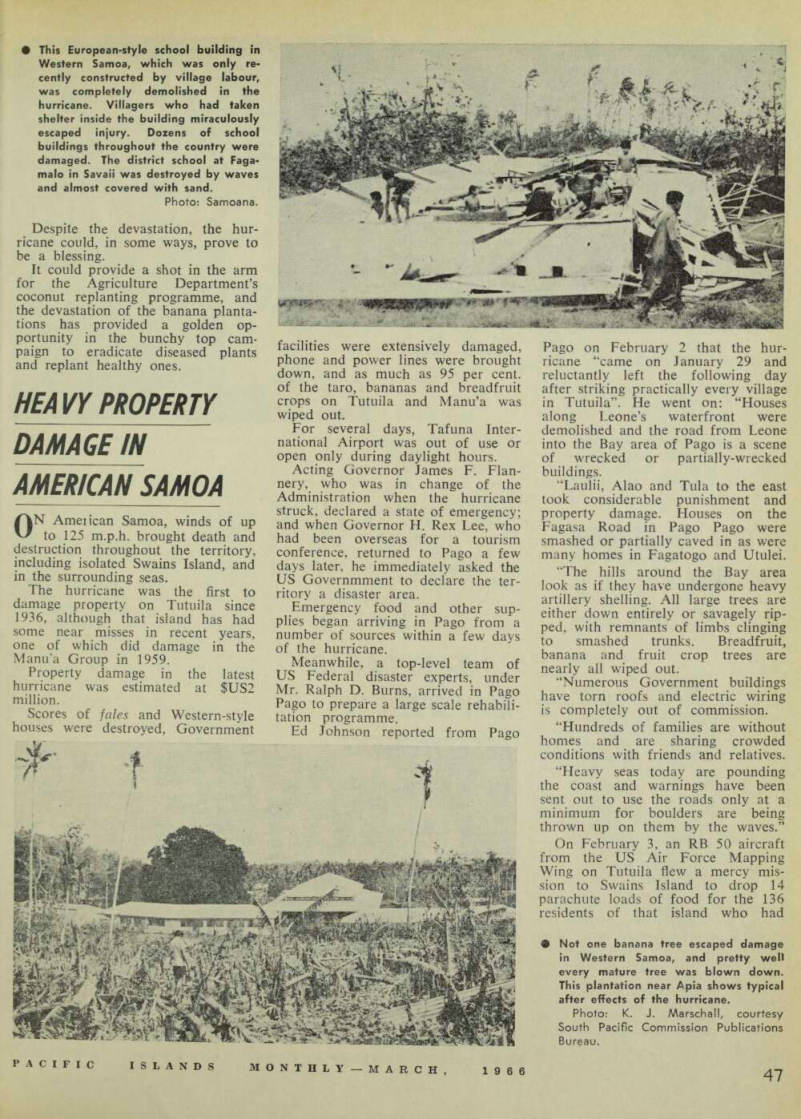
This European-style school building in Western Samoa, which was only re cently constructed by village labour, was completely demolished in the hurricane. Villagers who had taken shelter inside the building miraculously escaped injury. Dozens of school buildings throughout the country were damaged. The district school at Faga malo in Savaii was destroyed by waves and almost covered with sand.
Photo: Samoana.
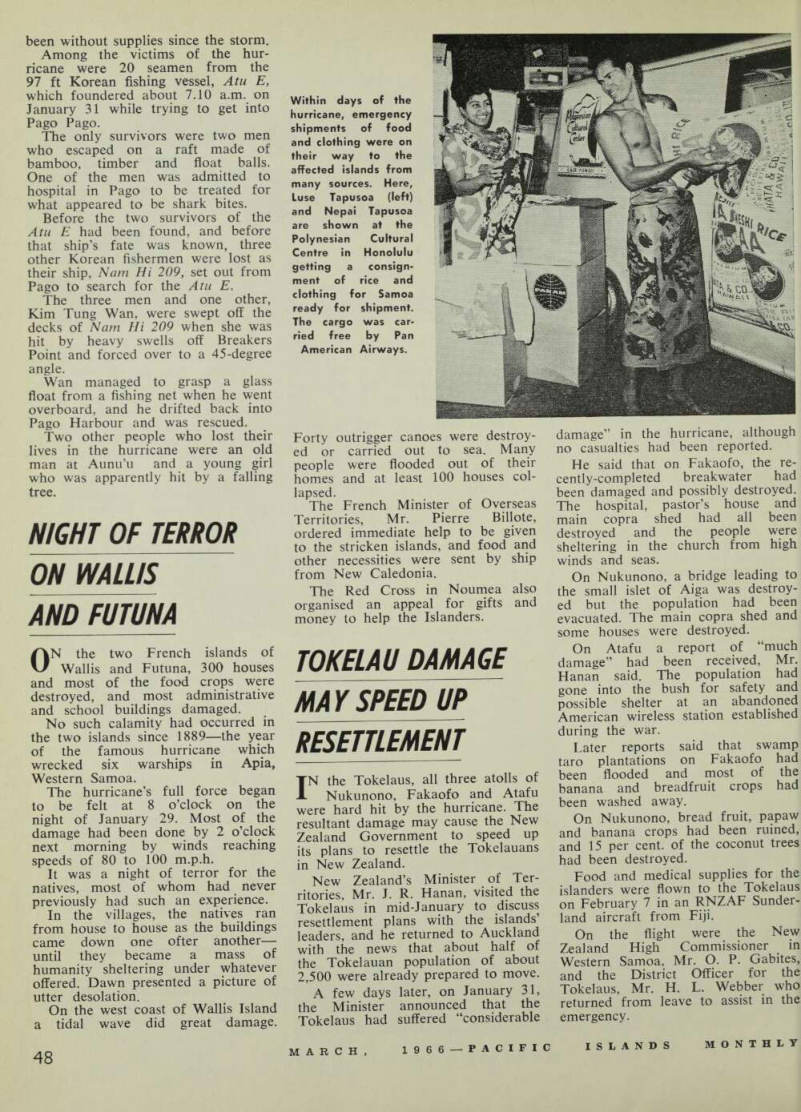
Not one banana tree escaped damage in Western Samoa, and pretty well every mature tree was blown down.
This plantation near Apia shows typical after effects of the hurricane.
Photo: K. J. Marschall, courtesy South Pacific Commission Publications Bureau.
been without supplies since the storm.
Among the victims of the hur ricane were 20 seamen from the 97 ft Korean fishing vessel, Atu E, which foundered about 7.10 a.m. on January 31 while trying to get into Pago Pago.
The only survivors were two men who escaped on a raft made of bamboo, timber and float balls.
One of the men was admitted to hospital in Pago to be treated for what appeared to be shark bites.
Before the two survivors of the Atu E had been found, and before that ship’s fate was known, three other Korean fishermen were lost as their ship, Nam Hi 209, set out from Pago to search for the Atu E.
The three men and one other, Kim Tung Wan, were swept off the decks of Nam Hi 209 when she was hit by heavy swells off Breakers Point and forced over to a 45-degree angle.
Wan managed to grasp a glass float from a fishing net when he went overboard, and he drifted back into Pago Harbour and was rescued.
Two other people who lost their lives in the hurricane were an old man at Aunu’u and a young girl who was apparently hit by a falling tree.
Night Of Terror
On Wallis
And Futuna
ON the two French islands of Wallis and Futuna, 300 houses and most of the food crops were destroyed, and most administrative and school buildings damaged.
No such calamity had occurred in the two islands since 1889—the year of the famous hurricane which wrecked six warships in Apia, Western Samoa.
The hurricane’s full force began to be felt at 8 o’clock on the night of January 29. Most of the damage had been done by 2 o’clock next morning by winds reaching speeds of 80 to 100 m.p.h.
It was a night of terror for the natives, most of whom had never previously had such an experience.
In the villages, the natives ran from house to house as the buildings came down one ofter another — until they became a mass of humanity sheltering under whatever offered. Dawn presented a picture of utter desolation.
On the west coast of Wallis Island a tidal wave did great damage.
damage” in the hurricane, although no casualties had been reported.
He said that on Fakaofo, the re cently-completed breakwater had been damaged and possibly destroyed.
The hospital, pastor’s house and main copra shed had all been destroyed and the people were sheltering in the church from high winds and seas.
On Nukunono, a bridge leading to the small islet of Aiga was destroy ed but the population had been evacuated. The main copra shed and some houses were destroyed.
On Atafu a report of “much damage” had been received, Mr.
Hanan said. The population had gone into the bush for safety and possible shelter at an abandoned American wireless station established during the war.
Later reports said that swamp taro plantations on Fakaofo had been flooded and most of the banana and breadfruit crops had been washed away.
On Nukunono, bread fruit, papaw and banana crops had been ruined, and 15 per cent, of the coconut trees had been destroyed.
Food and medical supplies for the islanders were flown to the Tokelaus on February 7 in an RNZAF Sunder land aircraft from Fiji.
On the flight were the New Zealand High Commissioner in Western Samoa, Mr. O. P. Gabites, and the District Officer for the Tokelaus, Mr. H. L. Webber who returned from leave to assist in the emergency.
Forty outrigger canoes were destroy ed or carried out to sea. Many people were flooded out of their homes and at least 100 houses col lapsed.
The French Minister of Overseas Territories, Mr. Pierre Billote, ordered immediate help to be given to the stricken islands, and food and other necessities were sent by ship from New Caledonia.
The Red Cross in Noumea also organised an appeal for gifts and money to help the Islanders.
Tokelau Damage
May Speed Up
Resettlement
IN the Tokelaus, all three atolls of Nukunono, Fakaofo and Atafu were hard hit by the hurricane. The resultant damage may cause the New Zealand Government to speed up its plans to resettle the Tokelauans in New Zealand.
New Zealand’s Minister of Ter ritories, Mr. J. R. Hanan, visited the Tokelaus in mid-January to discuss resettlement plans with the islands’ leaders, and he returned to Auckland with the news that about half of the Tokelauan population of about 2,500 were already prepared to move.
A few days later, on January 31, the Minister announced that the Tokelaus had suffered “considerable
Within days of the hurricane, emergency shipments of food and clothing were on their way to the affected islands from many sources. Here, Luse Tapusoa (left) and Nepal Tapusoa are shown at the Polynesian Cultural Centre in Honolulu getting a consign ment of rice and clothing for Samoa
ready for shipment.
The cargo was car ried free by Pan American Airways.
Cook Islands
Lucky To Ms
Worse Battering
THE Cook Islands began to feel the “breath” of the hurricane on January 31 when Palmerston Island, home of the famous Marsters clan, reported heavy seas and winds up to 70 m.p.h.
W, H. Percival reported from Rarotonga that the Palmerston people carried portable effects inland as invading seas and roaring wind uprooted trees and destroyed nine boatsheds.
As the storm continued, three houses and six outdoor cookhouses were washed away and there was constant danger from falling coco nuts. An estimated 12,000 nuts fell on the atoll’s only inhabited islet where about 80 people live, and about 60,000 others fell on the five major islets. (However, this hurricane was mild compared with that of 1926 when all the buildings except the fort-like house of the original William Marsters and the heavily timbered church were destroyed. The result was that many of the Islanders had to be resettled elsewhere).
A radio report from Pukapuka stated that seas whipped up by the hurricane did extensive damage to taro and puraka plots, and that previous heavy rains had flooded the taro swamps, so that much of the taro will probably rot before it can be used.
Taro Inundated
About 50 termite-ridden coconut trees were blown down, two houses, a kitchen and a boatshed were swept away on the main island of Wale; and the causeway connecting the villages of Yato and Roto, both on the permanently inhabited island of Wale, was destroyed.
The inundated taro swamps are not expected to produce again for between six and 12 months.
The small atoll of Rakahanga reported that most of the taro and puraka swamps near the sea had been destroyed by flooding, that the Roman Catholic church had been damaged, and that a new road to the wharf was washed away.
Rarotonga sustained some damage on the northern coast where heavy seas pounded the Union Steamship Company’s wooden wharf, snapping
piles and buckling the entire struc ture.
A section of the concrete sea wall near the USS company’s cargo sheds was reduced to rubble, and the fore shore and main road in front of Hotel Rarotonga, the office of the Agriculture Department, and Mr.
D. C. Brown’s trading store, were cluttered with coral rocks.
Trees were uprooted and some power poles fell. The coastal road was blocked at Black Rock until hard-working PWD gangs cleared the obstruction, then went on to clear the coral-cluttered main road in the heart of Avarua.
The seas carried the wrecked Yankee further on to the reef. Salt spray, carried by a 70 m.p.h. wind, reached a quarter of a mile inland at Nikao, withering grass, plants and tree foliage.
Many banana trees were blown down, and at least one grower lost over 1,000 young trees.
People Too Calm
A few native dwellings were blown down at Nikao, but there was little other property damage and no casualties.
Radio Rarotonga remained on the air throughout the period of the two days and nights emergency period, reporting on local conditions and the progress of the storm.
Most Rarotongans took the situation calmly— too calmly per haps, leaving the standard precautions of nailing up shutters and roping down roofs until the last moment.
Before the “final warning” had been lifted groups of young men and women strolled nonchalantly along Avarua’s coastal road. Other young men took advantage of the rough seas to surfboard in the shallow lagoon, and the more practical minded went beachcombing, picking up shell fish torn from the reef and washed ashore.
Rarotonga had experienced only gale force winds and slight damage, but at one stage of the emergency the hurricane was headed directly for Mangaia and Rarotonga.
Only a meteorogical fluke—a change of course of the hurricane centre at the seemingly last possible moment, saved Mangaia and Raro tonga from disaster.
The destructive hurricane, which covered a vast area, swung away to the south-east and missed Rarotonga by about 100 miles.
The last hurricane to strike the Cook Islands with major force was in 1942, when Suwarrow, Pukapuka and Palmerston Islands were badly damaged. The last “big blow” at Rarotonga was in 1935.