Goroka Valley
pp. 87-89 · Read in the full issue

When Snow Fell In The
By R. J. Giddings
The presence of fallen snow is part of the natural physical order in many parts of the world at certain times of the year.
Although we tend to associate snow with the temperate and frigid zones, it is known to fall in the tropics, but generally only at very high altitudes.
SNOW falls each year on Mt.
Kenya (17,058 ft.) in equatorial Africa; and the highest peaks of the Andean mountains, which straddle the equator in South America, are perpetually covered with it.
On the New Guinea mainland, occasional snowfalls occur on some of the highest peaks, notably on the Carstensz Peaks (16,000 ft.) in West New Guinea and on Mt. Wilhelm (15,400 ft.) in the Trust Territory.
However, it is said that “every rule has its exception”, and this
would appear to have been the case when snow fell in the Goroka Valley about 50 years ago.
Undulating Grasslands
The Goroka Valley forms part of the Eastern Highlands District of central eastern New Guinea. The valley floor has an elevation of just over 5,000 ft and it comprises rich, undulating grasslands drained by the large Ben a and Asaro Rivers.
The valley is encompassed on all
JVa fives Have Vivid Memories Of Hare Ph enont ea a a
sides by mountain ranges rising in places to over 8,000 ft.
The town of Goroka that lies within it is the thriving commercial and administrative centre of the New Guinea highlands.
Many of the natives who witnessed the snowfall in the Goroka Valley as children are still alive today, and their reminiscences about it agree on the major points.
Furthermore, they all claim that there is no tradition of snow having fallen in the valley before then, and certainly none has fallen since.
As the event took place some 20 years before initial penetration of the area by Europeans, there is no official record of it, although hail has fallen on parts of the valley sides in recent years.
One of the old men who described the snowfall to me is Emenuke, of Namaro hamlet, who was a child of about 10 when the event occured.
He said that early one morning, before daybreak, the people were awakened by the sound of hailstones on the thatched roofs of their houses.
Although hail was known to have fallen in other parts of the valley,
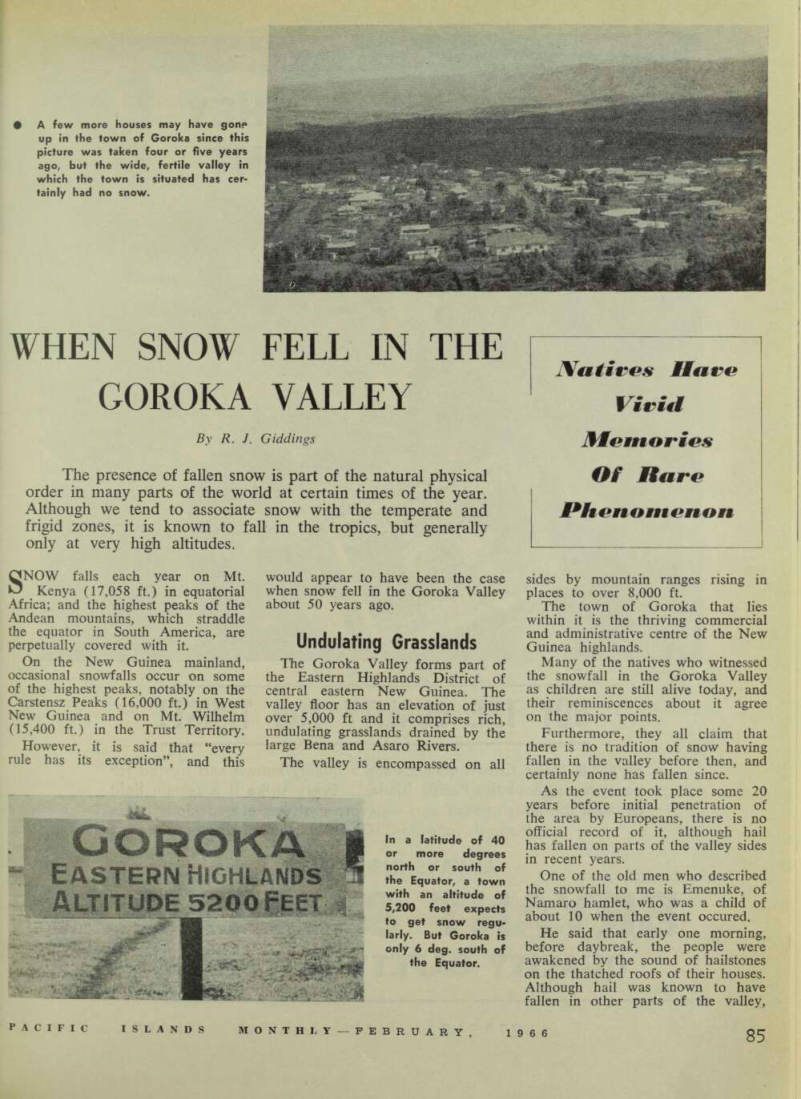
A few more houses may have gonp up in the town of Goroka since this picture was taken four or five years ago, but the wide, fertile valley in which the town is situated has cer tainly had no snow.
In a latitude of 40 or more degrees north or south of the Equator, a town with an altitude of 5,200 feet expects to get snow regu larly. But Goroka is only 6 deg. south of the Equator.
they had not seen it fall over their land before.
After the hailstorm had finished, snow began to fall, and this con tinued on until daybreak. At dawn the sky was overcast and heavy with dark, grey clouds. Many of those sleeping in their houses expected the dawn to be heralded by shafts of sunlight filtering inside, but as every thing was dark some slept on well into the morning.
The sky is said to have been so dark that many of those venturing aut of doors had to light torches to see their way. This may be a slight exaggeration, but, by the same token, the atmospheric conditions must have been exaggerated for snow to have fallen at all.
No Word For It
When the menfolk first ventured outside (they confined the women and children to their houses), they were astounded to see the country side covered with what they called white “powder”, as they had no word For “snow” in their language.
They also noticed that the tall kunai grass growing on the plains bad been beaten down—no doubt by the hailstorm.
On making their way to their gardens, they saw to their horror that the leaves of their staple food plant, the sweet potato, were withering under the intense cold, as were the leaves of their other food crops.
The people were understandably perplexed, not knowing what to do, or expect, next. Some thought that the end of the world had come for them, while others envisaged their entering an age of tremendous social and physical hardships.
At some hamlets in the northern end of the valley, the people sacri ficed white and tan-coloured pigs in
supplication to the spirits whom they believed protected and guided their lives.
The selection of these colours, as opposed to sacrificing the common black pig, possibly had a symbolical meaning—the white pigs representing the snow and the tan pigs represent ing the desired return of heat.
For two full days, snow lay in the valley, and during that time the sky remained dark and foreboding.
On the third day the sun broke through the clouds and the snow melted. The women and children were then allowed to leave their houses and the people set about re planting their gardens. A severe food shortage resulted from the de predation of the gardens caused by the intense cold of the snow.
Stories about the time the snow fell are still told by the old people and they pass on to their grand children the lessons they learnt from their harsh experience.
Recently a councillor from the southern end of the valley told his constituents that they should save their money and bank it. They would need it, he said, to buy food if “something” should destroy their gardens in the future. No more needed to be said; the rest was im plied and the whole meaning under stood.
His words were another reminder that one day, quite unexpecedly, “powder” could fall from the sky and destroy their gardens and so bring about another time of hunger and hardship.
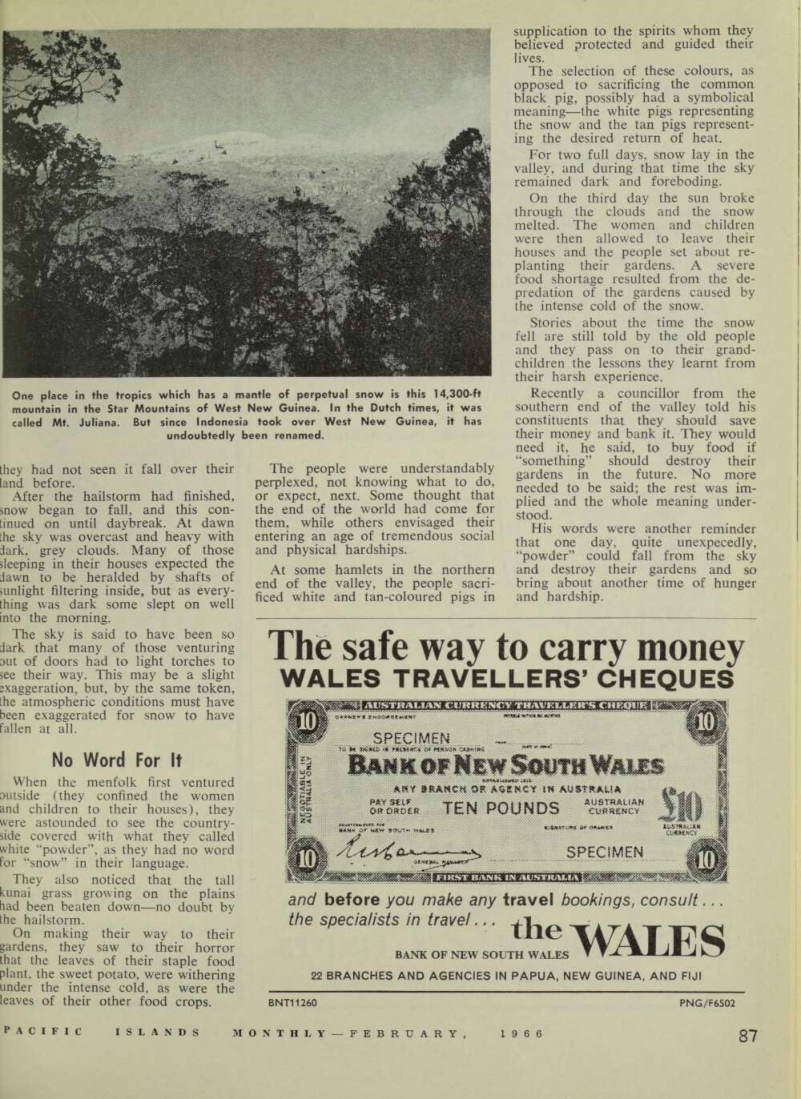
One place in the tropics which has a mantle of perpetual snow is this 14,300-ft mountain in the Star Mountains of West New Guinea. In the Dutch times, it was called Mt. Juliana. But since Indonesia took over West New Guinea, it has undoubtedly been renamed.