Companion
p. 85 · Read in the full issue
Hunter Of Bird
Of Paradise
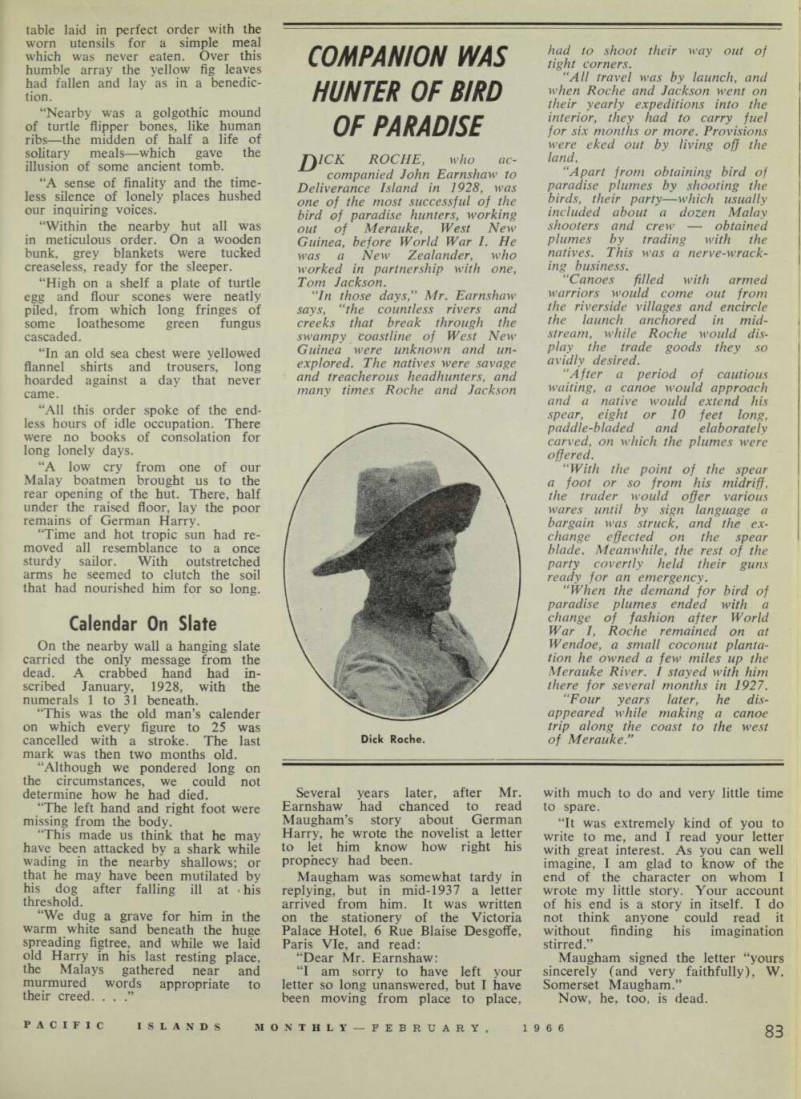
£)ICK ROCHE, who ac companied John Earnshaw to Deliverance Island in 1928, was one of the most successful of the bird of paradise hunters, working out of Merauke, West New Guinea, before World War I. He was a New Zealander, who worked in partnership with one, Tom Jackson.
“In those days,” Mr. Earnshaw says, “the countless rivers and creeks that break through the swampy coastline of West New Guinea were unknown and un explored. The natives were savage and treacherous headhunters, and many times Roche and Jackson
had to shoot their way out of tight corners.
“All travel was by launch, and when Roche and Jackson went on their yearly expeditions into the interior, they had to carry fuel for six months or more. Provisions were eked out by living off the land.
“Apart from obtaining bird of paradise plumes by shooting the birds, their party —which usually included about a dozen Malay shooters and crew obtained plumes by trading with the natives. This was a nerve-wrack ing business.
“Canoes filled with armed warriors would come out from the riverside villages and encircle the launch anchored in mid stream, while Roche would dis play the trade goods they so avidly desired.
“After a period of cautious waiting, a canoe would approach and a native would extend his spear, eight or 10 feet long, paddle-bladed and elaborately carved, on which the plumes were offered.
“With the point of the spear a foot or so from his midriff, the trader would offer various wares until by sign language a bargain was struck, and the ex change effected on the spear blade. Meanwhile, the rest of the party covertly held their guns ready for an emergency.
“When the demand for bird of paradise plumes ended with a change of fashion after World War I, Roche remained on at Wendoe, a small coconut planta tion he owned a few miles up the Merauke River. I stayed with him there for several months in 1927.
“Four years later, he dis appeared while making a canoe trip along the coast to the west of Merauke.”
Dick Roche.