Yesterday
p. 91 · Read in the full issue
When “PIM” for February, 1946, went to press, World War II had been over for six months, but its aftermath was still being felt in the South Pacific, as some of the items from that issue of 20 years ago show.
CONSIDERABLE progress had been made by the Australian Administration and the British Phosphate Commissioners in the rehabilitation of Nauru following its occupation by Japanese forces from August, 1942, to September, 1945. Phosphate shipments were expected to be resumed by July 1, 1946. Meanwhile, arrangements were being made to repatriate the Nauruans whom the Japanese had deported to Truk.
INVESTIGATIONS by Austra lian and British forces on Ocean Island had revealed that six Europeans and hundreds of Islanders had died on the island during the Japanese occupation.
The Europeans were: C. G. F.
Cartwright, Government Secretary; R. W. Third, Government radio operator; H. A. Mercer and a Mr, Cole, members of the British Phosphate Commission; Father Pujebet and Brother Brummell, Roman Catholic missionaries.
THE Australian Minister for Territories, Mr. E. J. Ward, had refused PlM’s editor a permit to visit Papua-New Guinea, but had stated that the ban would be reviewed in six months. This prompted the editor to comment
that although a visit to the Ter ritory was unlikely in 1946, PIM would visit it “many, many times after Minister Ward, and the quaint Socialistic structure he has erected in the Territories, have been consigned to the limbo of forgotten politicians”.
FOOD crops and orange trees throughout the Cook Islands had been severely damaged by a cyclonic storm that swept through the group in January, 1946. Later in the month, several villages were washed away by torrential rains in the northern and eastern dis tricts of Fiji’s main island of Viti Levu.
WHARF labourers on Rarotonga had been on strike for better pay. They demanded 8/a day, and 2/- an hour for over time; 10/- a day on Sundays; increased food rations; and no work in rough or wet weather.
Existing wages were 4/6 a day and 9d an hour overtime. When demands were laid before the Union Steam Ship Co. and the Administration, a counter offer of 6/- a day and 1/- an hour over time was made. This offer was turned down, and a deadlock existed until leading local traders
agreed to make up the difference 80 that the Maui p °mare could be unloaded - A LL wartime emergency liquor restrictions had been repealed in Fiji and one could again drink from 10 a.m. to 10 p.m.—so long as supplies held out. fITHE choice of Honiara as the A capital of the Solomon Islands had been acclaimed “by those who like room to move around and build”, but it had not been well received by shipping interests, who preferred the old capital of Tulagi. The Bishop of Melanesia, Dr. Baddeley, was also a sharp critic of Honiara. It was the depth of absurdity, he said, that in a group where there were many excellent harbours, the new capital should be placed on what was practically an open beach, T>APEETE’S new mayor, Mr.
A Alfred Poroi, had started a town-cleaning campaign, paying particular attention to food shops in the market place.
Dan American Airways’
XT service between the United States and Auckland, via Hawaii, Canton Island, Fiji and Noumea was expected to resume in a few weeks. But the “dithering” Aus tralian and New Zealand Govern ments had made little progress with their plans for a British trans-Pacific service.
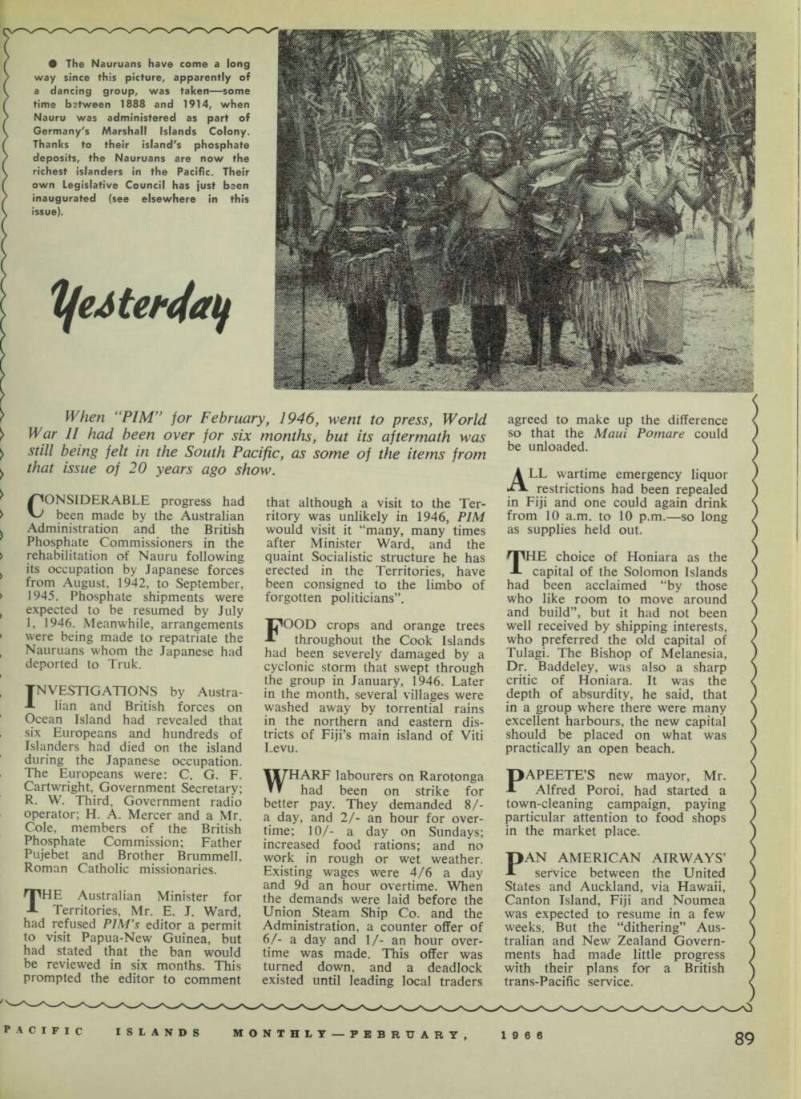
The Nauruans have come a long way since this picture, apparently of a dancing group, was taken—some time between 1888 and 1914, when Nauru was administered as part of Germany's Marshall Islands Colony.
Thanks to their island's phosphate deposits, the Nauruans are now the richest islanders In the Pacific. Their own Legislative Council has just baen inaugurated {see elsewhere in this issue).