Rudolph Wahlen—"King of
pp. 88-89 · Read in the full issue
the Western Islands"
• Stirred by some history in the recently-published book, "Queen Emma", that tireless chronicler, Fred A. Archer, of Rabaul, here describes life in New Guinea's North-West Islands, some 60 years ago. Mr. Archer maintains a correspondence with Mr. H. R.
Wahlen, who made a fortune in the North-West Islands before World War I. He is still a resident of Hamburg and is very much alive at the age of 95.
From Fred Archer , in Rabaul.
I have been having a look recently at the Wuvulu and Aua Islands, and old H. R. Wahlen has been most interested in hearing of them. A couple of his old retainers—yes, a fact! write him letters and get replies. These go and come through me.
I TOOK a plane to Wewak and there caught a ship to Wuvulu, and went ashore and talked to them all, and endlessly shook hands with them. They (old-timers) had heard I was still alive—a legendary figure like Davy Crockett or something— and when I walked among them they could hardly believe their (somewhat dimmed) eyes, and they treated me as one risen from the dead. I, walk ing amongst them said (in Pidgin), “Be not afraid —’tis I!”.
It was interesting to see the old bungalow where I had lived long years ago—built by Wilhelm Leonardt in Wahlen’s day—and there was Leonardt’s grave under the casuarina trees, and that of another German who died not long after Wilhelm— both of blackwater.
One day Dr. Cilento sat on my verandah there and asked if I took quinine regularly. I said I did. He then remarked, “Better not neglect it —or you’ll join those chaps over there”, and he jerked his thumb towards the graves.
Last time I was in Sydney I had a morning meal with a smiling Sir Raphael Cilento, and asked him if he remembered the occasion. He said he did, and added “It was the best advice you could have had, anyway!”
Certain funds in Germany have been made available in various-sized sums to assist backward peoples, and some of this has come to New Guinea —mainly to places that formerly were part of “the German times”.
I suggested to HRW that he,
having been a prominent resident in bygone days, might ask for some assistance for the Wuvulu and Aua people—the erection of a hospital, or a community meeting house, or a school house and teachers’ house. He thought that “the memory of old German days has been about erased but said he would send a letter to the German Foreign Office.
To his surprise the FO came back with a letter saying that the matter would be inquired into. So something may have developed and, if I see H. E. Dr. Ritter I will make bold to ask him; also, to give him a few details of the old “Wahlen in the Western Islands, and about “the
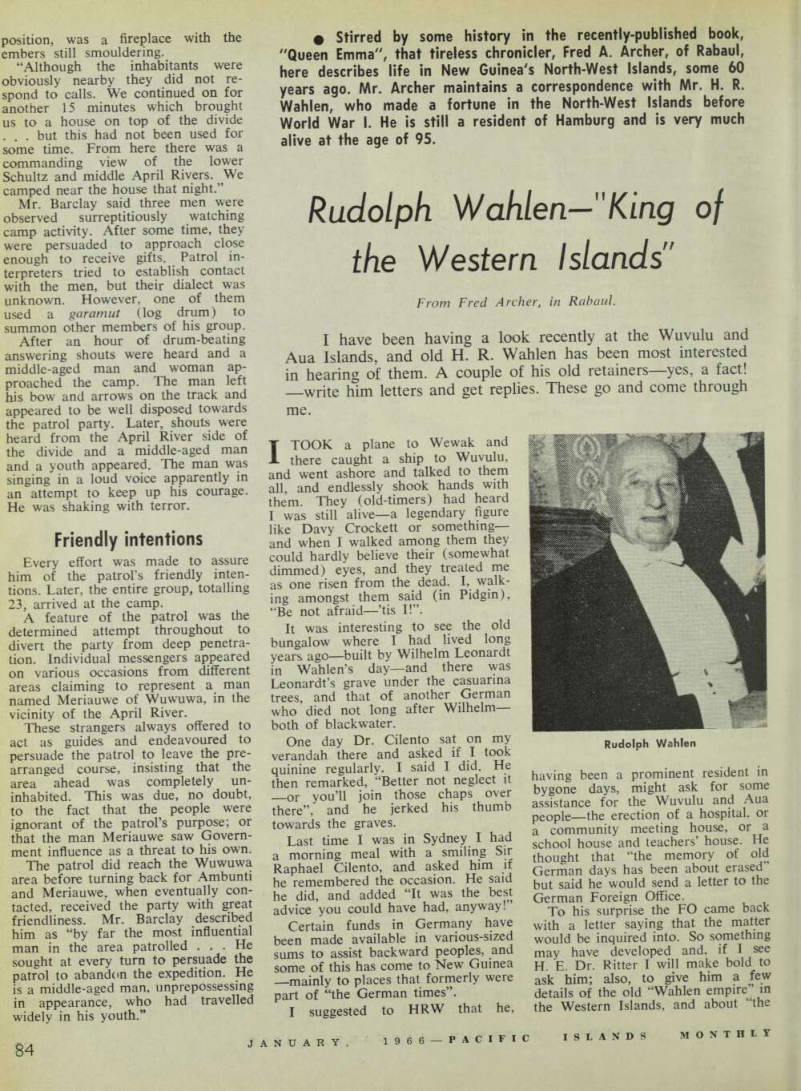
Rudolph Wahlen
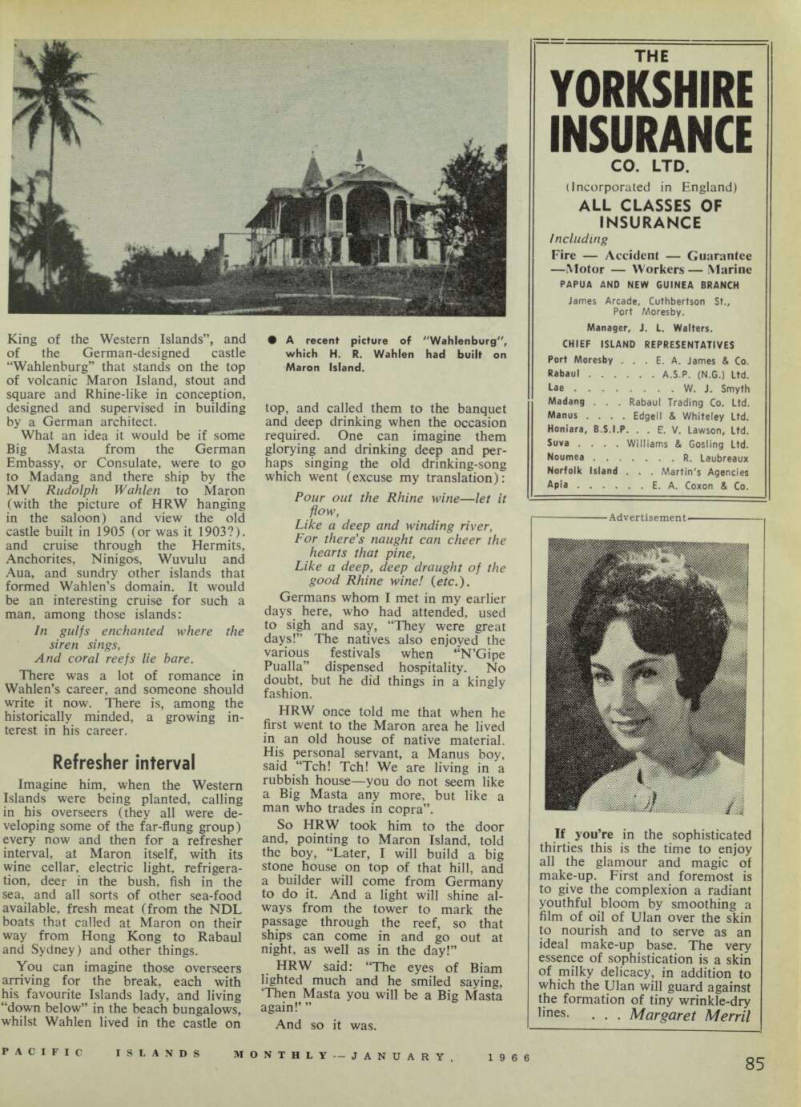
King of the Western Islands”, and of the German-designed castle “Wahlenburg” that stands on the top of volcanic Maron Island, stout and square and Rhine-like in conception, designed and supervised in building by a German architect.
What an idea it would be if some Big Masta from the German Embassy, or Consulate, were to go to Madang and there ship by the MV Rudolph Wahlen to Maron (with the picture of HRW hanging in the saloon) and view the old castle built in 1905 (or was it 1903?). and cruise through the Hermits, Anchorites, Ninigos, Wuvulu and Aua, and sundry other islands that formed Wahlen’s domain. It would be an interesting cruise for such a man, among those islands: In gulfs enchanted where the siren sings, And coral reefs lie bare.
There was a lot of romance in Wahlen’s career, and someone should write it now. There is, among the historically minded, a growing in terest in his career.
Refresher interval
Imagine him, when the Western Islands were being planted, calling in his overseers (they all were de veloping some of the far-flung group) every now and then for a refresher interval, at Maron itself, with its wine cellar, electric light, refrigera tion, deer in the bush, fish in the sea, and all sorts of other sea-food available, fresh meat (from the NDL boats that called at Maron on their way from Hong Kong to Rabaul and Sydney) and other things.
You can imagine those overseers arriving for the break, each with his favourite Islands lady, and living “down below” in the beach bungalows, whilst Wahlen lived in the castle on
top, and called them to the banquet and deep drinking when the occasion required. One can imagine them glorying and drinking deep and per haps singing the old drinking-song which went (excuse my translation): Pour out the Rhine wine—let it flow, Like a deep and winding river, For there’s naught can cheer the hearts that pine, Like a deep, deep draught of the good Rhine wine! (etc.).
Germans whom I met in my earlier days here, who had attended, used to sigh and say, “They were great days!” The natives also enjoyed the various festivals when “N’Gipe Pualla” dispensed hospitality. No doubt, but he did things in a kingly fashion.
HRW once told me that when he first went to the Maron area he lived in an old house of native material.
His personal servant, a Manus boy, said “Tch! Tch! We are living in a rubbish house—you do not seem like a Big Masta any more, but like a man who trades in copra”.
So HRW took him to the door and, pointing to Maron Island, told the boy, “Later, I will build a big stone house on top of that hill, and a builder will come from Germany to do it. And a light will shine al ways from the tower to mark the passage through the reef, so that ships can come in and go out at night, as well as in the day!”
HRW said: “The eyes of Biam lighted much and he smiled saying, ‘Then Masta you will be a Big Masta again!’ ”
And so it was.
A recent picture of "Wahlenburg", which H. R. Wahlen had built on Maron Island.