Montevideo’S Pacific
pp. 91-92 · Read in the full issue
“Treasure Trove”
By Robert Langdon
Montevideo, capital of the small South American republic of Uruguay, would appear to be an unlikely place in which to find a valuable treasure from the Pacific Islands of nearly two centuries ago.
YET it is there, I learned recently, that a most informative journal kept by an officer of the last impor tant Spanish naval expedition to the Pacific—in the last decade of the 18th century—has been preserved.
The journal contains, among other things, a long description of the expedition’s stay of a fortnight in the Vavau archipelago of Tonga, and a vocabulary of Tongan words.
The man who kept the journal was Lieutenant Francisco Javier de Viana, who served under Captain Alejandro Malaspina on his voyage to the Pacific from 1789 to 1794 in the corvettes Descubierta and Atrevida.
As outlined in a previous article (PIM, Feb., 1962, p. 19), Malaspina’s expedition left Cadiz on July 30, 1789, with the object of preparing hydrographic charts and investigating the commerce and political situations of the places visited.
The two ships rounded the Horn in December, 1789, and spent about two years on the western coast of America before crossing the Pacific to the Philippines. From there, they sailed to Sydney via the New Hebrides and Dusky Sound, New Zealand.
Vavau Visit
After a couple of weeks in Sydney, Malaspina headed for Vavau to take possession of it for the Spanish Crown—the archipelago having been discovered 12 years previously by the Spanish navigator Antonio Maurelle.
From Vavau, Malaspina continued westward to Lima, Peru, rounded the Horn again, touched at Montevideo, and returned to a hero’s welcome in Cadiz on June 21, 1794.
Subsequently, Malaspina was pro moted to the rank of brigadier by the Spanish king and publicly praised by Godoy, the Prime Minister. But
about a year later, while he was visiting his native Lombardy (Italy), he fell out of favour at Court; and on his return to Spain in November, 1795, he was arrested and imprisoned together with a priest, Father Manuel Gil, who had been editing his ex pedition’s journals, charts, drawings and reports for publication.
Simultaneously, the King gave orders that all the papers of Malaspina’s expedition were to be seized and withheld from publica tion.
Malaspina languished in prison for 7i years before being deported to Lombardy and forbidden to return to Spain under pain of death. He died there in 1809.
Meanwhile, the fruits of his ex pedition mouldered in the Spanish archives, and it was not until 1885 that Malaspina’s journal was pub lished in Madrid—in a volume of nearly 700 pages, edited by a Spanish admiral, Novo y Colson.
However, the veil of mystery that had long surrounded his work in the Pacific and elsewhere had already been lifted by the publication in the small Uruguayan town of Cerrito de
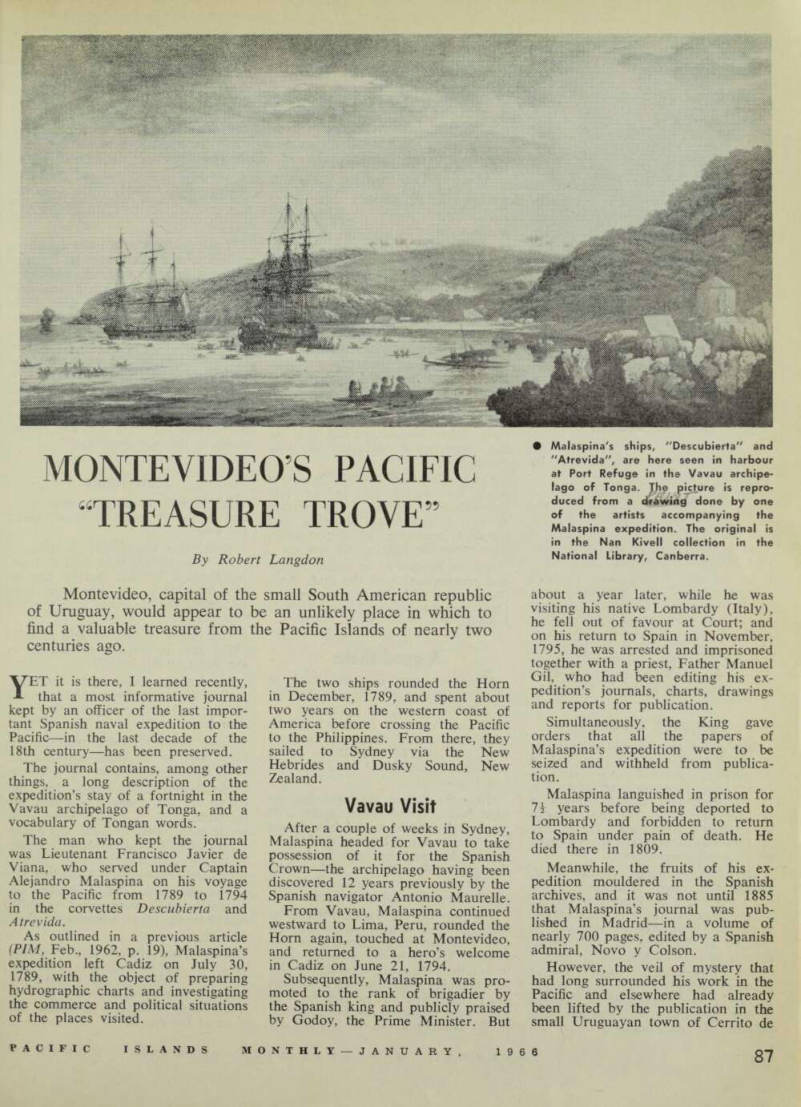
Malaspina's ships, "Descubierta" and "Atrevida", are here seen in harbour at Port Refuge in the Vavau archipe lago of Tonga. The picture is repro duced from a drawing done by one of the artists accompanying the Malaspina expedition. The original is in the Nan Kivell collection in the National Library, Canberra.
la Victoria of the journal kept by Lieutenant Viana.
Cerrito de la Victoria, now a suburb of Montevideo, was then the seat of government of the Partido Blanco (White Party), which played a prominent part in the civil wars that plagued Uruguay at that time.
It is not known how Viana’s journal escaped the general seizure of the Malaspina documents ordered by the Spanish king, but the title page of the published version states that it was submitted to the pub lishers, the Imprenta del Ejercito (Army Press), by Viana’s sons. They were apparently living in Uruguay.
Language specialist
News that the original manuscript of the journal was still preserved in Montevideo reached me from an Uruguayan language specialist, Dr.
Olaf Blixen, who used it recently to prepare a study of the Tongan vocabulary it contains for the Boletin de Filologia of Montevideo’s Institute de Estudios Superiores.
Dr. Blixen’s paper, of about 50 pages, will draw attention, among other things, to numerous errors which appeared in the vocabularies published with Viana’s journal in Cerrito de la Victoria and Mala spina’s journal in Madrid.
Dr. Blixen has spent several months recently making a study of the honorific language of Oceania in the University of Honolulu and Hawaii’s Bishop Museum.
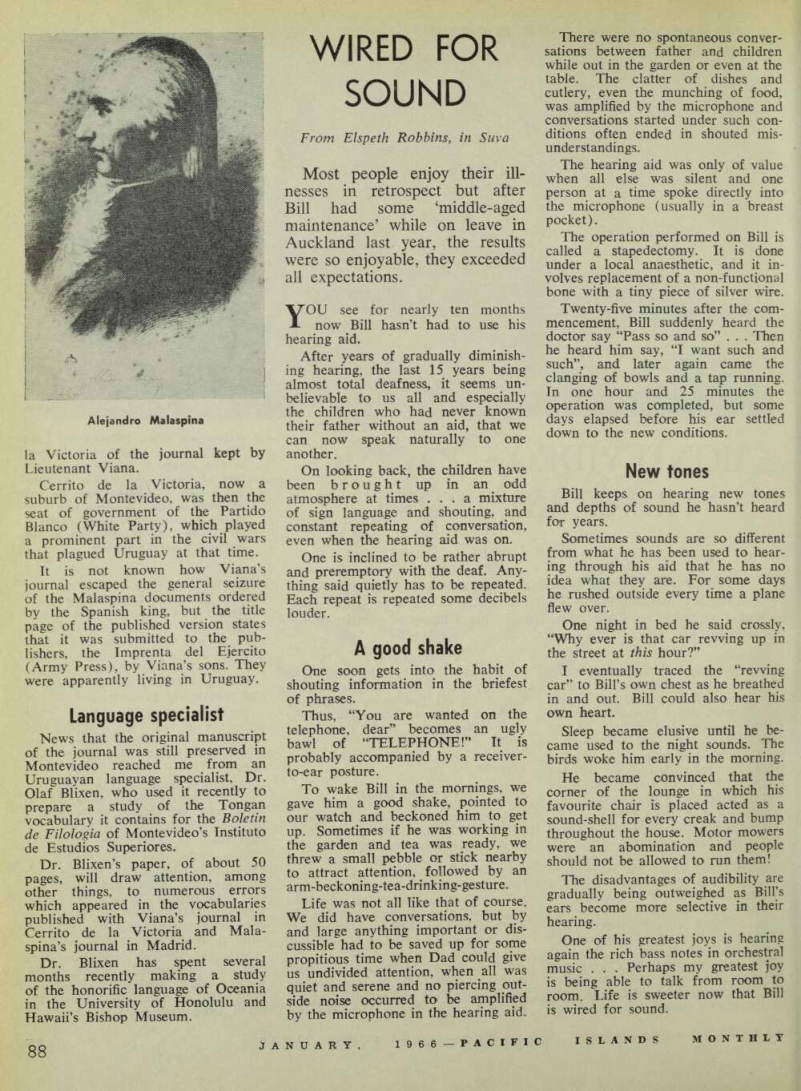
Alejandro Malaspina