Foot-Slogging For
pp. 85-88 · Read in the full issue

There's Still Plenty Of Old-Fashioned Foot-Slogging For New Guinea's Officers Of The Law
From a Port Moresby Correspondent
Papua-New Guinea may be rapidly nearing
some form of self-government but, in places, the work of bringing the law to the land goes on in much the same way that it did 20 or even 40 years ago.
LONG patrols on foot are as arduous as ever; and New Guinea terrain still remains largely in the perpendicular.
An 80-day patrol that had all the old-time difficulties was recently undertaken by Mr. R. I. Barclay, Assistant District Officer of Ambunti on the Sepik River. He was accom panied by Cadet Patrol Officer K.
Taylor, five members of the Royal Papua and New Guinea Constabu lary, 56 carriers, three interpreters and an aid post orderly.
The patrol would have been of even longer duration than it was, but 66 days out Mr. Barclay was forced to call off further exploration because aircraft, on which the patrol was de pendant for food-drops, were unable to locate the party.
Airdrops fail
The patrol was from Ambunti southward into the headwaters of the Leonard Schultz and April Rivers, which rise in the Central Range on the border between the Sepik District and the Western Highlands District.
The system of supplying the patrol by airdrops of tinned food and rice failed when the party reached the higher mountain regions near the divide between the Leonard Schultz and April Rivers. Fog and heavy cloud obscured the ridges for lone periods. At times, also, the patrol experienced considerable difficulty in finding any sort of drop sites at all.
In the early part of the patrol, taro and bananas were purchased from the inhabitants of the lower reaches of the Leonard Schultz River.
In these relatively open valleys the
air-dropped supplies were successfully recovered and the patrol proceeded at a good pace. Later, when conditions became too difficult for airdrops and no fresh food was available, the weary members of the patrol slept with empty stomachs and just tightened their belts.
The patrol was organised following the discovery during a helicopter survey early last year of new, isolated groups of people in the folds and gorges of the Central Range.
The object was to explore the Leonard Schultz to its headwaters, continuing across the range to the headwaters of the April, and in ad dition to contact the elusive, semi nomadic people who live in the area.
Good camp sites and tracks were to be prepared for subsequent patrols.
Although the patrol was curtailed, the mam purpose was achieved and future patrols will follow to consoli date the first contact, and extend Ad ministration influence to the area.
Almost 600 people were sighted during Mr. Barclay’s patrol although
he estimated a total population figure of 1,200, based on the number of deserted houses and gardens seen during the patrol.
He described the people as timid and sometimes suspicious, although they showed no signs of hostility.
Attempts to contact all groups in the area were hampered by limited knowledge of the various dialects.
One of the groups contacted identified themselves as Kolu people of the Taiwan clan.
Elongated topknots
Describing the unusual headdresses of the Kolu men, Mr. Barclay said: “Almost all the men wore elongated topknots varying in length from three to 15 inches. These topknots were made of bark except for a few in stances when cloth was used. Many of the headdresses were decorated with cassowary plumes attached to the front and spread out fanwise.
“Through the septum and ear lobes, short, carved lengths of lawyer cane
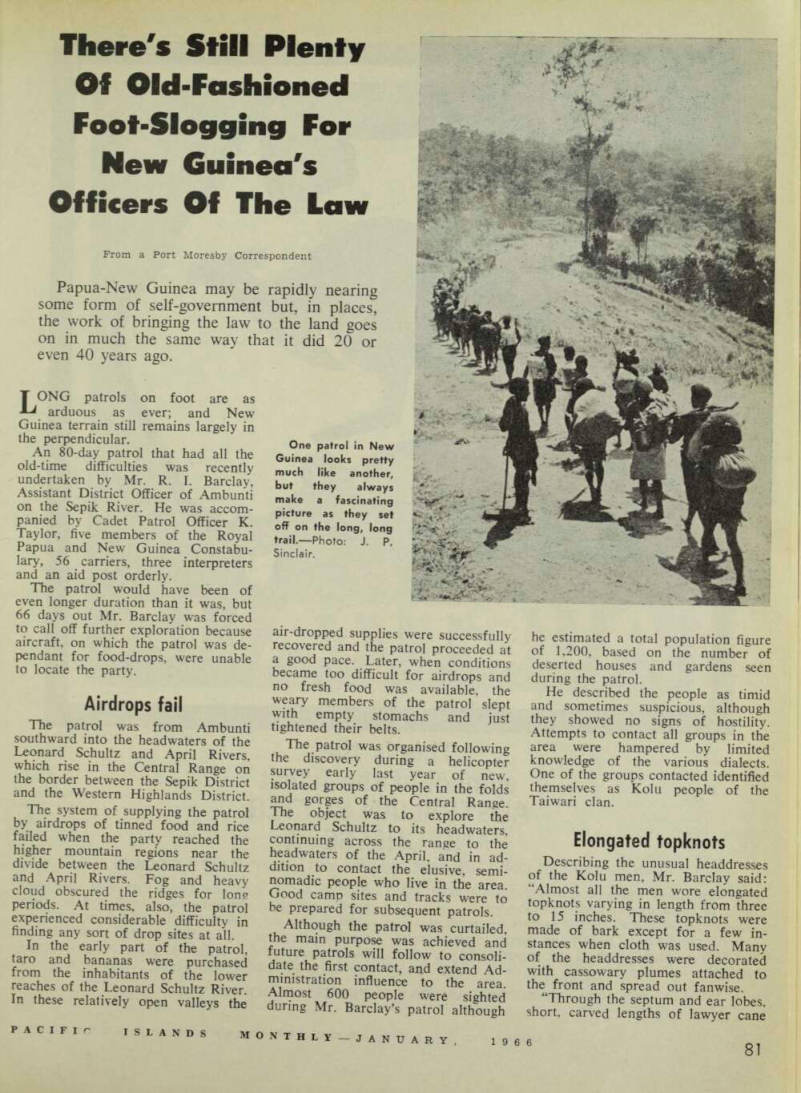
One patrol in New Guinea looks pretty much like another, but they always make a fascinating picture as they set off on the long, long trail.— Photo: J. P.
Sinclair.
protruded. Women also wore these ornaments.”
He said the Kolu men wore long lengths of lawyer cane, about i inch in diameter, around their waists. The women wore grass skirts which covered their bodies from waist to knee.
The Kolu people gave the patrol taro and bananas in exchange for salt, razor blades, fishing lines and hooks, mirrors and small knives.
Commenting on the physical con dition of the people, Mr. Barclay said they were surprisingly healthy looking, apart from a few with yaws and tropical ulcers. These sufferers submitted, after a practical demon stration, to the aid post orderly’s injections. Subsequently, evidence of the success of this treatment was in dicated by the number of people in other groups who volunteered for similar injections. The Kolus had passed the story on ahead of the patrol.
A Kolu guide accompanied the patrol to another Taiwari group known as Aiyumo.
Mr. Barclay said: “We inspected the largest house of this group . . . a formidable structure measuring about 30 ft by 20 ft built on 15 ft stilts. The building had the appear ance of a fortress.
Narrow corridor
“Entrance was by way of a ladder to a narrow corridor running the length of the house. A hole, 4 ft by 2 ft, situated in the wall half-way down the corridor, led to the main room. In the centre of the main room a pole 4 inches in diameter sup ported the ceiling. The pole pierced the floor and was embedded in the earth 15 ft below.”
The people danced around the pole underneath the house during sing sings when they feasted on ceremonial occasions.
Other features of the house were the 3 ft square fireplaces sunk into each corner of the room; also, the storing racks which extended the length of the house and were stacked with firewood, smoked pigmeat, fish, taro, bananas, and bundles of dried tobacco leaves. The walls of the room were decorated with pig jaw bones and skeletons of fish. The fish had been caught on crude hooks made of bone and shell, on lines made from bush vines. Some of the fish skeletons were 2 ft long.
The people showed none of the artistry displayed by Sepik River craftsmen. Three drums in the house bore no traditional carvings or
decorations in any way. Arrows stacked in the house in large bundles were also unadorned. A second aperture off the main room led to a small verandah. From the verandah it could be seen that the house had been built into a large tree trunk.
On the way to contact another group, Mr. Barclay’s party spent 5i hours trying to ferry cargo across a river on a raft. The river was in flood and a strong current defeated attempts to swing across with the party’s stores. Four attempts by the strongest swimmers failed to take the raft to the opposite bank of the swollen river. Finally it was floated down river until it was eventually intercepted at a bend and pulled across.
On another occasion the party forded a river, at knee to chest height, 42 times in nine hours to reach the junction of a large tribu tary in the vicinity of which they planned to select a site for an air drop. They had exhausted food sup plies the previous day and continued foodless for the two following days.
A week earlier they had been with out food for four days. An additional strain on the already reduced physical strength of the party was the search for suitable sites, which sometimes involved hacking a path through
thick jungle, several miles off the pre-arranged course.
Near the April-Schultz divide the patrol sighted several deserted houses a few miles apart from each other.
One of them showed signs of recent occupation. Near the house was a lean-to shelter in which a human skull was found. The jaw bone lay nearby. Both had been coloured a pinkish shade, probably with a paste made from clay.
No response
The patrol’s interpreters called out, hoping for a response from the owners of the house but to no avail.
The party then moved on to one of the other houses. “Progress was very slow,” reported ADO Barclay, “because of a poor track and steep gullies. After 30 minutes we came across an overgrown garden area about three acres in extent. We continued for another 40 minutes and encountered a second garden area about the same size as the first.
The garden had been newly planted with taro.
“A house about 8 ft square and 3 ft above the ground was situated at the eastern end of the garden. It had a sago palm thatched roof and bark walls. Inside, in a central
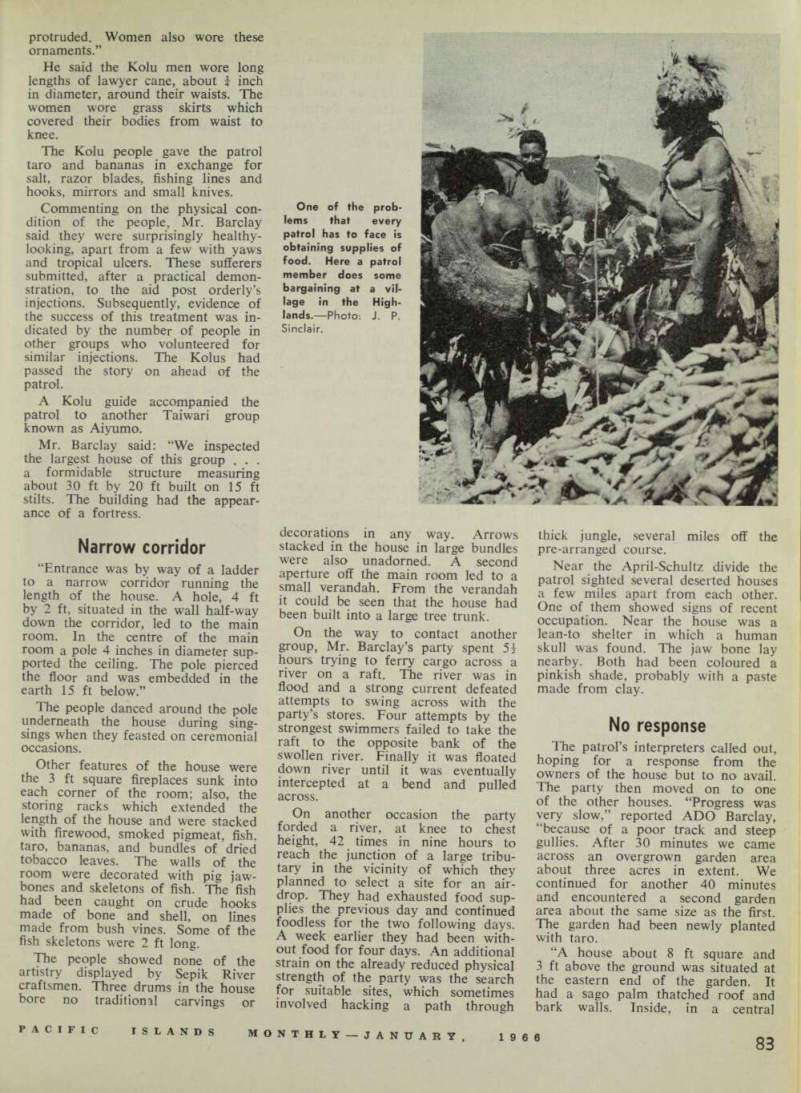
One of the prob lems that every patrol has to face is obtaining supplies of food. Here a patrol member does some bargaining at a vil lage in the High lands. —Photo: J. P.
Sinclair.
position, was a fireplace with the embers still smouldering.
“Although the inhabitants were obviously nearby they did not re spond to calls. We continued on for another 15 minutes which brought us to a house on top of the divide . . . but this had not been used for some time. From here there was a commanding view of the lower Schultz and middle April Rivers. We camped near the house that night.”
Mr. Barclay said three men were observed surreptitiously watching camp activity. After some time, they were persuaded to approach close enough to receive gifts. Patrol in terpreters tried to establish contact with the men, but their dialect was unknown. However, one of them used a garamut (log drum) to summon other members of his group.
After an hour of drum-beating answering shouts were heard and a middle-aged man and woman ap proached the camp. The man left his bow and arrows on the track and appeared to be well disposed towards the patrol party. Later, shouts were heard from the April River side of the divide and a middle-aged man and a youth appeared. The man was singing in a loud voice apparently in an attempt to keep up his courage.
He was shaking with terror.
Friendly intentions
Every effort was made to assure him of the patrol’s friendly inten tions. Later, the entire group, totalling 23, arrived at the camp.
A feature of the patrol was the determined attempt throughout to divert the party from deep penetra tion. Individual messengers appeared on various occasions from different areas claiming to represent a man named Meriauwe of Wuwuwa, in the vicinity of the April River.
These strangers always offered to act as guides and endeavoured to persuade the patrol to leave the pre arranged course, insisting that the area ahead was completely un inhabited. This was due, no doubt, to the fact that the people were ignorant of the patrol’s purpose; or that the man Meriauwe saw Govern ment influence as a threat to his own.
The patrol did reach the Wuwuwa area before turning back for Ambunti and Meriauwe, when eventually con tacted, received the party with great friendliness. Mr. Barclay described him as “by far the most influential man in the area patrolled ... He sought at every turn to persuade the patrol to abandon the expedition. He is a middle-aged man, unprepossessing in appearance, who had travelled widely in his youth.”