Deadheads On
pp. 93-94 · Read in the full issue
They're Not All
Malekula
ome recollections of pre-war days
By Basil Hall.
The owner of the trade store n the southern coast of Male ula, New Hebrides, called it a dead ’cad” for my benefit. But,
eing a Frenchman, he thought
f it as “tete de mort”.
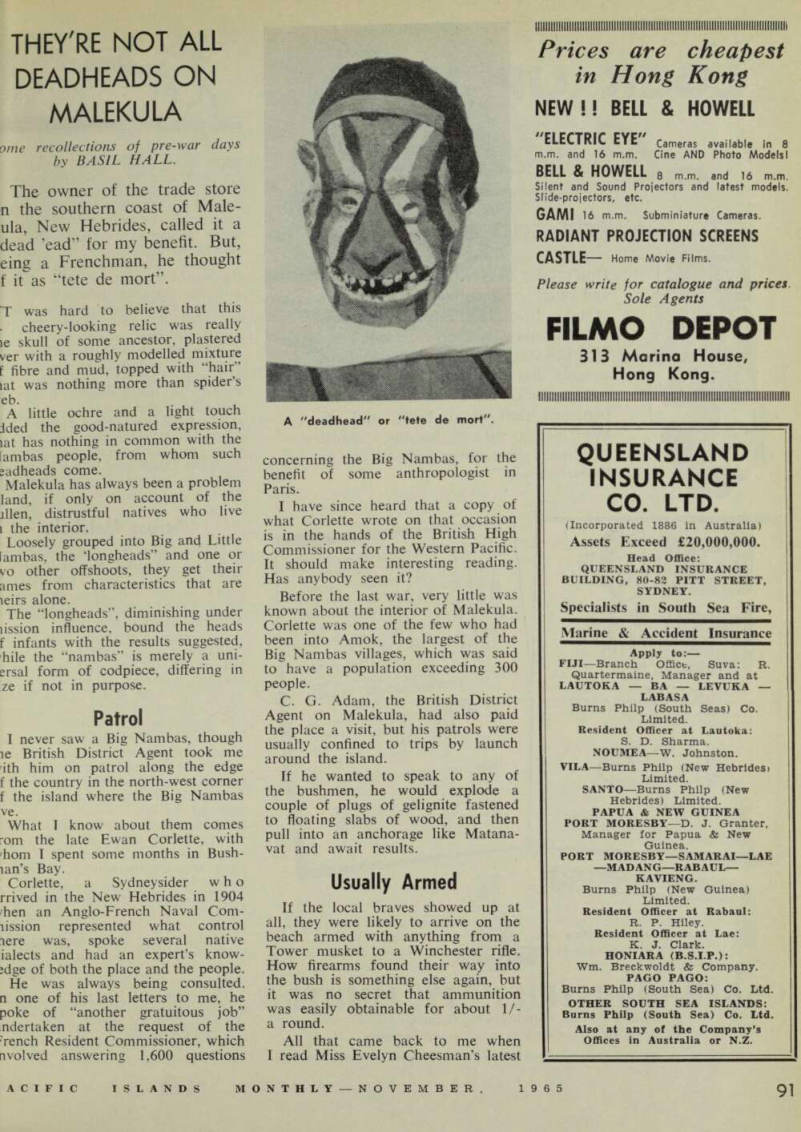
T was hard to believe that this cheery-looking relic was really le skull of some ancestor, plastered ver with a roughly modelled mixture E fibre and mud, topped with “hair” lat was nothing more than spider’s eb.
A little ochre and a light touch
Jded the good-natured expression,
lat has nothing in common with the [ambas people, from whom such sadheads come.
Malekula has always been a problem land, if only on account of the illen, distrustful natives who live i the interior.
Loosely grouped into Big and Little lambas, the ‘longheads” and one or vo other offshoots, they get their ames from characteristics that are ieirs alone.
The “longheads”, diminishing under fission influence, bound the heads f infants with the results suggested, hile the “nambas” is merely a uni ersal form of codpiece, differing in ze if not in purpose.
Patrol
I never saw a Big Nambas, though ie British District Agent took me ith him on patrol along the edge f the country in the north-west corner f the island where the Big Nambas ve.
What I know about them comes rom the late Ewan Corlette, with 'horn 1 spent some months in Bush ian’s Bay.
Corlette, a Sydneysider who rrived in the New Hebrides in 1904 Ten an Anglo-French Naval Com lission represented what control acre was, spoke several native ialects and had an expert’s know jdge of both the place and the people.
He was always being consulted, n one of his last letters to me, he poke of “another gratuitous job” ndertaken at the request of the Tench Resident Commissioner, which avolved answering 1,600 questions
concerning the Big Nambas, for the benefit of some anthropologist in Paris.
I have since heard that a copy of what Corlette wrote on that occasion is in the hands of the British High Commissioner for the Western Pacific.
It should make interesting reading.
Has anybody seen it?
Before the last war, very little was known about the interior of Malekula.
Corlette was one of the few who had been into Amok, the largest of the Big Nambas villages, which was said to have a population exceeding 300 people.
C. G. Adam, the British District Agent on Malekula, had also paid the place a visit, but his patrols were usually confined to trips by launch around the island.
If he wanted to speak to any of the bushmen, he would explode a couple of plugs of gelignite fastened to floating slabs of wood, and then pull into an anchorage like Matana vat and await results.
Usually Armed
If the local braves showed up at all, they were likely to arrive on the beach armed with anything from a Tower musket to a Winchester rifle.
How firearms found their way into the bush is something else again, but it was no secret that ammunition was easily obtainable for about 1/a round.
All that came back to me when I read Miss Evelyn Cheesman’s latest
A "deadhead" or "tete de mort".
book, Who Stand Alone, which was reviewed in PIM in August (p. 94) Miss Cheesman stood alone i anyone did, for, as a bug-hunter em ployed by the British Museum, sh< spent months at a time in the bus! entirely by herself.
“Cassa” Townsend, then DO or the northern coast of New Guinea told me that his police boys onc( reported a prau approaching Aitape m which there was “a strange mar m a brown suit”.
It turned out to be Miss Cheesman who, after collecting in the Cyclops Mountains behind Hollandia, was shifting to the Torricelli Range on our side of the border.
The trouble was that she had told of one of her intentions. She had no entry permit, no medical clearance from the Dutch, and was a bit peeved when the subject of quarantine was raised.
Across Malekula
Miss Cheesman always took her own line. When I was in the New Hebrides, they were still talking about an occasion when she pushed off without a word, walked across Malekula from east to west.
No other European would have dreamed of doing that sort of thing, but all Miss Cheesman had to say about it was that the track appeared to be well used, but that she hadn’t seen a native all the way. However, the grapevine had it that she had been followed by a party of Big Nambas warriors.
Corlette believed that she was safe enough as long as she kept moving, for women have no tribal standing amongst the Big Nambas.
In fact, these people, who are none too particular as to what they eat, will not normally look at flesh taken from any female animal. And that includes women!
PlM’s review of Miss Cheesman’s book was illustrated by a photograph of her in a working rig, consisting of a blouse and shin-length trousers.
Some people, on seeing her in this rig, might well ask how anyone would know she was a woman.
The grapevine had the answer to that one as well, though it’s not for me to pass it on. It’s enough to say that the Big Nambas are not all dead heads.