Polynesian Treasure
p. 91 · Read in the full issue
sland Sold And [?]he Newspapers Missed It!
By Robert Langdon
Tupai, a 2,500-acre South Sea
land, which rarely figures
i the news, received a ttle of prominence in the ew Zealand Press recently, hen one of the island’s part ners, an English baronet, sold s interest in the island for 80,000. |UT in reporting this sale, the newspapers surprisingly did >t do Tupai full justice, for they nitted to say that the island is the puted cache of millions of pounds Chilean pirate loot.
The treasure is said to have been ft on Tupai by a band of ruffians ho mutinied aboard the Chilean ival vessel Araucano in 1822.
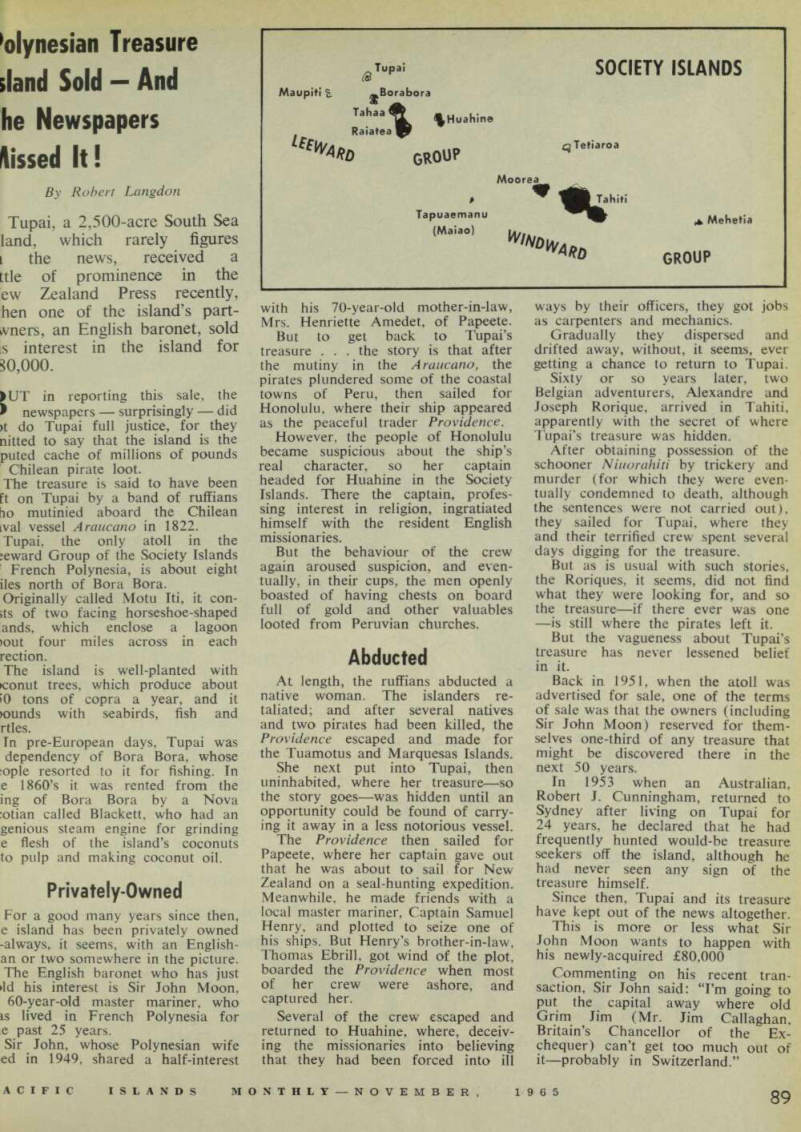
Tupai, the only atoll in the reward Group of the Society Islands French Polynesia, is about eight iles north of Bora Bora.
Originally called Motu Iti, it cou rts of two facing horseshoe-shaped ands, which enclose a lagoon ►out four miles across in each rection.
The island is well-planted with ►conut trees, which produce about ►0 tons of copra a year, and it ►ounds with seabirds, fish and rtles.
In pre-European days, Tupai was dependency of Bora Bora, whose :ople resorted to it for fishing. In e 1860’s it was rented from the ing of Bora Bora by a Nova :otian called Blackett, who had an genious steam engine for grinding e flesh of the island’s coconuts to pulp and making coconut oil.
Privately-Owned
For a good many years since then, e island has been privately owned -always, it seems, with an English an or two somewhere in the picture.
The English baronet who has just ►ld his interest is Sir John Moon, 60-year-old master mariner, who is lived in French Polynesia for e past 25 years.
Sir John, whose Polynesian wife ed in 1949, shared a half-interest
with his 70-year-old mother-in-law, Mrs. Henriette Amedet, of Papeete.
But to get back to Tupai’s treasure ... the story is that after the mutiny in the Araucano, the pirates plundered some of the coastal towns of Peru, then sailed for Honolulu, where their ship appeared as the peaceful trader Providence.
However, the people of Honolulu became suspicious about the ship’s real character, so her captain headed for Huahine in the Society Islands. There the captain, profes sing interest in religion, ingratiated himself with the resident English missionaries.
But the behaviour of the crew again aroused suspicion, and even tually, in their cups, the men openly boasted of having chests on board full of gold and other valuables looted from Peruvian churches.
Abducted
At length, the ruffians abducted a native woman. The islanders re taliated; and after several natives and two pirates had been killed, the Providence escaped and made for the Tuamotus and Marquesas Islands.
She next put into Tupai, then uninhabited, where her treasure—so the story goes—was hidden until an opportunity could be found of carry ing it away in a less notorious vessel.
The Providence then sailed for Papeete, where her captain gave out that he was about to sail for New Zealand on a seal-hunting expedition.
Meanwhile, he made friends with a local master mariner, Captain Samuel Henry, and plotted to seize one of his ships. But Henry’s brother-in-law, Thomas Ebrill, got wind of the plot, boarded the Providence when most of her crew were ashore, and captured her.
Several of the crew escaped and returned to Huahine, where, deceiv ing the missionaries into believing that they had been forced into ill
ways by their officers, they got jobs as carpenters and mechanics.
Gradually they dispersed and drifted away, without, it seems, ever getting a chance to return to Tupai.
Sixty or so years later, two Belgian adventurers, Alexandre and Joseph Rorique, arrived in Tahiti, apparently with the secret of where Tupai’s treasure was hidden.
After obtaining possession of the schooner Niuorahiti by trickery and murder (for which they were even tually condemned to death, although the sentences were not carried out), they sailed for Tupai, where they and their terrified crew spent several days digging for the treasure.
But as is usual with such stories, the Roriques, it seems, did not find what they were looking for, and so the treasure—if there ever was one —is still where the pirates left it.
But the vagueness about Tupai’s treasure has never lessened belief in it.
Back in 1951, when the atoll was advertised for sale, one of the terms of sale was that the owners (including Sir John Moon) reserved for them selves one-third of any treasure that might be discovered there in the next 50 years.
In 1953 when an Australian, Robert J. Cunningham, returned to Sydney after living on Tupai for 24 years, he declared that he had frequently hunted would-be treasure seekers off the island, although he had never seen any sign of the treasure himself.
Since then, Tupai and its treasure have kept out of the news altogether.
This is more or less what Sir John Moon wants to happen with his newly-acquired £BO,OOO Commenting on his recent tran saction, Sir John said: “I’m going to put the capital away where old Grim Jim (Mr. Jim Callaghan, Britain’s Chancellor of the Ex chequer) can’t get too much out of it—probably in Switzerland.”