Yesterday
p. 95 · Read in the full issue
The main story in PIM for November, 1945, was that industry and transport had come to a virtual standstill in Papua-New Guinea after the Minister for Territories, Mr.
E. J. Ward, terminated all contracts of conscripted native labourers in the change-over from military rule to civil government.
THE Administration believed that the natives would sign off and re-sign new contracts immediately and that everything would go on as before. This was not the case however. Less than five per cent decided to sign on again—even under the new minimum rate of 15/- a month for labourers. Most of the balance decided to return to their villages.
OTHER items in that issue of PIM of 20 years ago were:— THE authorities in Papeete, Tahiti, were faced with the problems of insufficient housing, soaring land prices, shortages of fish and a diminishing water sup ply. The town’s population had approximately doubled during the war.
THE Methodist Mission estimated that, during the war, over £90,000 worth of damage had been done to its stations in the Solomons.
THE Australian airline Qantas was considering the intro duction of a permanent service linking Sydney, Brisbane, Noumea and Fiji. A plane carry ing mail and passengers left Syd ney on November 17 on a two day survey flight.
IT was announced on October 13 that King George VI of Great Britain had appointed
Queen Salote, of Tonga, an Honorary Dame Grand Cross of the Order of the British Empire
(Obe).
WIRELESS communication had hf*'- restored between Fiji and the Gilbert and Ellice Islands Group, including Ocean Island.
With the removal of wartime restrictions, all classes of public wireless messages were being handled at pre-war rates. The beam service between Sydney and Suva was also operating again under peacetime conditions.
PLANTERS returning to New Guinea after 3J years of war had noticed that cocoa trees, although not indigenous to New Guinea, could apparently resist the ravages of the jungle, once they had attained a certain strength. Young well-grown cocoa trees on Karkar Island, and along the coast of New Britain, were bigger and better than ever, although they had had no expert plantation attention since the invasion. Once the substantial growth around them had been cut away, they were found to be in excellent condition.
Smaller trees had not fared so well.
"CMJI travel restrictions had been A eased. It was no longer necessary for overseas residents to obtain a permit to enter the Colony nor for European residents of Fiji to obtain exit permits.
SHIPPING services in the South Pacific were slowly being restored after their suspension during the war. PlM’s timetables showed that only three ships were running regular services. The Union SS Co. Ltd. was running the MV Matua from New Zealand to Fiji, Samoa, Tonga and return; Maui Pomare, a NZ Government vessel was maintain ing a direct service between Auckland and Rarotonga, Cook Islands, with alternate calls at Niue and Apia, Western Samoa; and the Burns Philp vessel, Morinda, was running at ap proximately seven-week intervals from Sydney to Lord Howe Island, Norfolk Island, New Hebrides ports and return.
Next-of-kin of 200 to 300 New Guinea civilians, over whelmed in the Japanese invasion of Rabaul in January, 1942, were receiving letters from the Austra lian Government officially stating that their deaths were apparently beyond doubt.
IN the week ending October 14, 1945, 76 charges of being in possession of arms, explosives or other Army property were made in the Nadi district of Fiji,—almost entirely against Indians. During that week the police recovered 10,000 rounds of ammunition, 27 rifles, 20 automatic pistols, 278 Mb tins of TNT. 45 grenades, and 23 smoke-bombs.
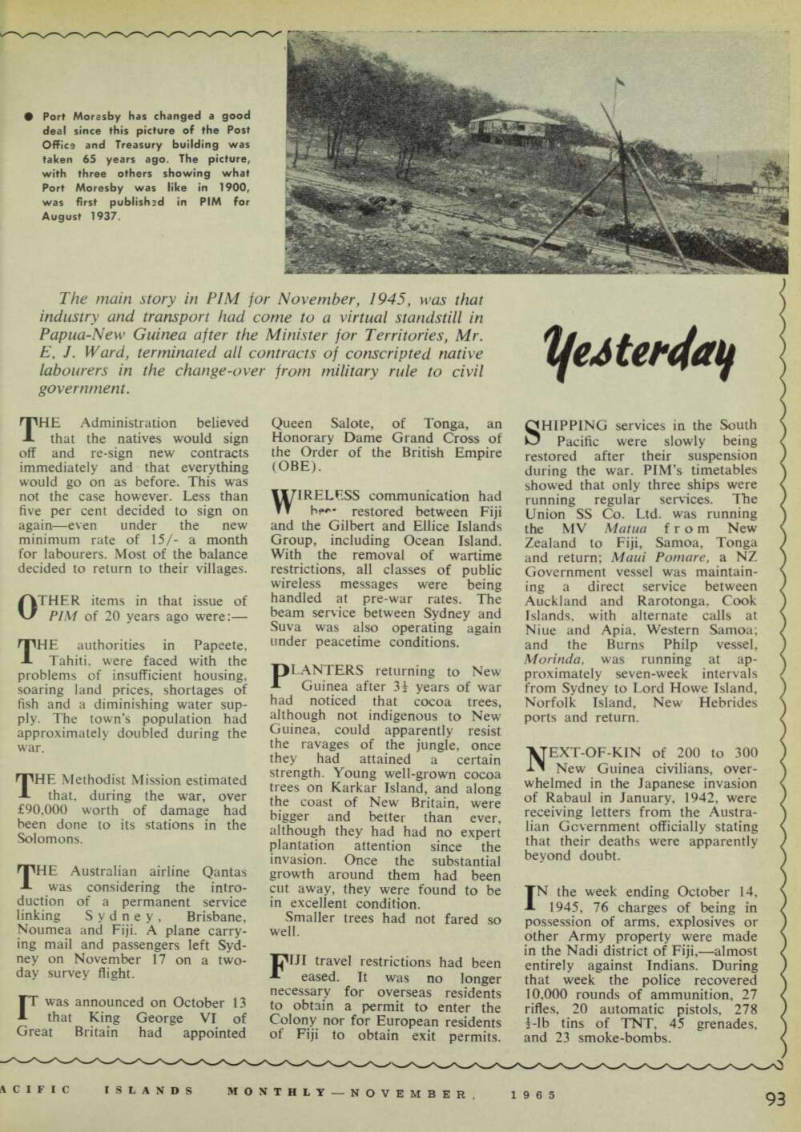
• Port Moresby has changed a good deal since this picture of the Post Office and Treasury building was taken 65 years ago. The picture, with three others showing what Port Moresby was like in 1900, was first published in PIM for August 1937.